Anduril Teams Up with Qualcomm: All-American Laptops Coming in 2027

Anduril and Qualcomm partner to launch all-American laptops in 2027 and promote a domestic supply chain.
Defense contractor Anduril and chip giant Qualcomm announced a partnership to launch the first laptop designed, manufactured, and assembled entirely in the U.S. in 2027, with a long-term goal of driving the industry toward a "fully domestic supply chain." The partnership builds on Anduril's BlueChip project, and the product will meet "Buy American" standards at launch, potentially opening the federal procurement market. The article notes that there are currently almost no truly Made-in-America laptops, that the global supply chain is highly concentrated in Asia, and that rebuilding a domestic chain faces multiple challenges including cost, skilled labor, and key component capacity. The partnership combines Qualcomm's computing chip capabilities with Anduril's defense system integration experience, targeting government and defense customers—but the 2027 timeline is tight and the long-term goal lacks a concrete roadmap, leaving real-world execution uncertain.
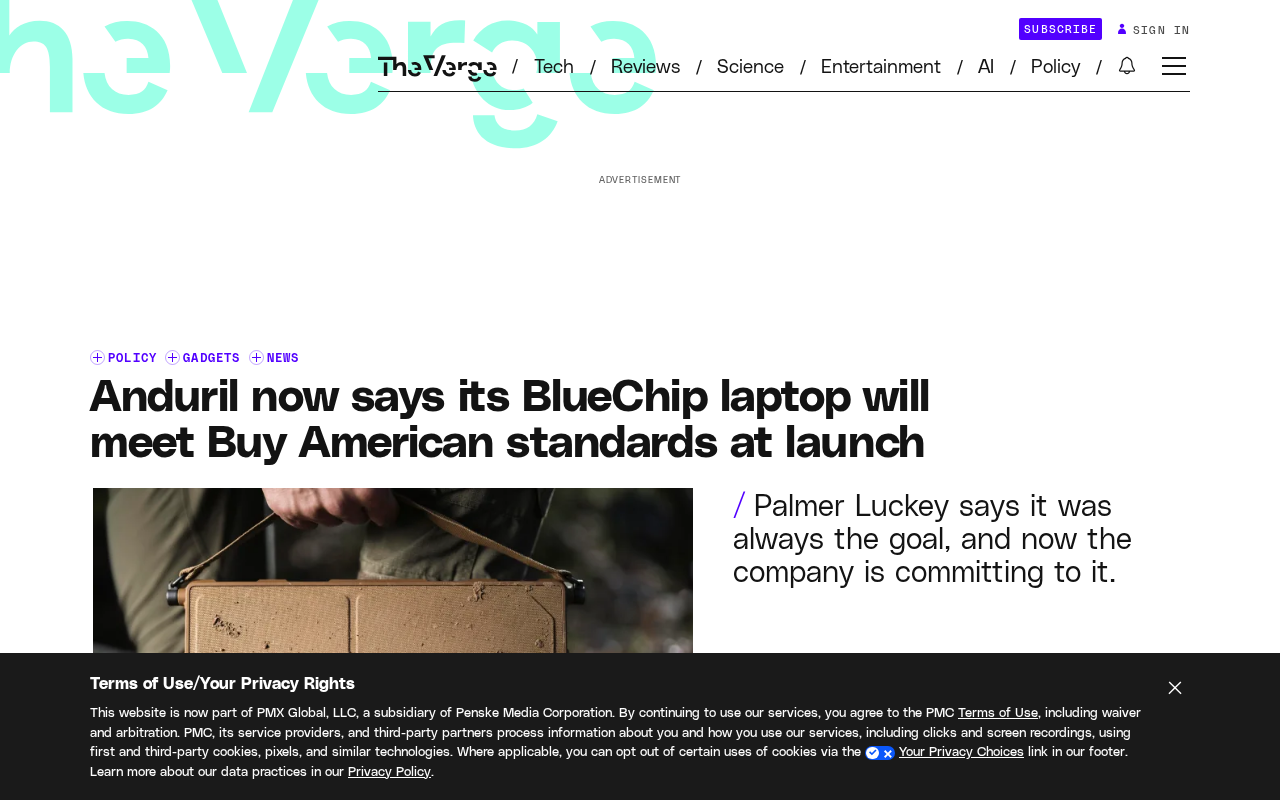
Defense contractor Anduril and chip giant Qualcomm announced on Tuesday a partnership to produce laptops entirely on U.S. soil, with the first model set to launch in 2027. The two companies also set a "long-term goal" of pushing the computer industry toward a "fully domestic supply chain." The news stands out because there are currently almost no truly "Made in America" laptops on the market.
Partnership Details and Goals
According to public information, the Anduril-Qualcomm partnership will focus on completing laptop design, manufacturing, and assembly within the United States. The first product is scheduled for 2027, with specific specs not yet disclosed. Both companies made clear that their ambition goes beyond a single product—they want to drive the entire industry toward a domestic supply chain.
This partnership builds on Anduril's previously launched BlueChip laptop project. Anduril now claims that its BlueChip laptop will meet "Buy American" standards at launch. That means the product will satisfy the strict domestic-manufacturing-percentage requirements of U.S. federal government procurement, potentially opening the door to government orders for Anduril.
Why Made-in-America Laptops Are So Rare
The original article notes that even releasing a single "Made in America" laptop is surprising, because virtually no such products exist on the market today. The global laptop supply chain is highly concentrated in Asia, with every link—from chip packaging and displays to batteries and assembly—relying on cross-border division of labor. Rebuilding a complete production chain in the U.S. would require not only massive capital investment but also confronting shortages of skilled workers and rising costs.
Anduril and Qualcomm's goal of a "fully domestic supply chain" is far harder than simply assembling in the U.S. It means key components must also be produced domestically as much as possible, or at least sourced from allied countries.
The "Buy American" standard derives from the Buy American Act in the U.S. Federal Acquisition Regulation (FAR), along with subsequent executive requirements such as the Made in America Act. At its core, it requires that the value of U.S.-made components in finished goods procured by the government meet a certain threshold (the threshold has risen in recent years, with some categories now requiring 60% or more), and it imposes restrictions on the origin of critical components. For complex products like laptops made up of hundreds of parts, meeting this standard often requires redesigning the supply chain rather than simply moving final assembly to the U.S.
In addition, federal procurement often runs alongside "Buy American" with Trade Agreements Act (TAA) compliance requirements, which emphasize that products must be manufactured in designated countries (including the U.S. and certain allies). Such compliance certifications involve extensive document audits and supply chain traceability, placing high demands on companies' compliance capabilities. Anduril's claim that its BlueChip laptop will meet Buy American standards means the product's supply chain must be planned around government procurement rules from the design stage—not simply rebranded after the fact.
The Roles of Qualcomm and Anduril
Qualcomm has deep expertise in chips, especially mobile computing and communications chips. Anduril is a fast-rising defense tech company known for autonomous systems and border surveillance technology. The combination could create synergies: Qualcomm provides the computing platform, while Anduril handles system integration and security hardening, producing specialized laptops for government and defense customers.
This partnership model also aligns with the U.S. trend in recent years of strengthening the domestic defense supply chain. Government customers have extremely high requirements for information security and supply chain controllability, which provides clear market demand for "Made in America" laptops.
Anduril's BlueChip project is essentially a "secure computing platform" initiative aimed at defense and government scenarios. Its focus is not on performance competition with consumer laptops, but on hardware-level trusted boot, supply chain traceability, and system integration. Anduril has long provided autonomous systems to the U.S. Department of Defense and border enforcement agencies, and is familiar with government customers' stringent requirements for information security, data sovereignty, and supply chain controllability—giving it unique advantages in system integration and security hardening.
Qualcomm's computing platforms are typically based on its Snapdragon series SoCs (system-on-chip), which integrate CPU, GPU, NPU, and baseband modules into a single package, offering low power consumption and high integration—well suited to mobile computing devices sensitive to size and battery life. Compared with traditional x86 laptop platforms, Arm-based SoCs have an energy-efficiency advantage but also face software ecosystem compatibility challenges. The key to the partnership lies in how to combine Qualcomm's mobile computing platform with Anduril's security-hardening requirements to create a specialized laptop solution that satisfies government compliance while supporting everyday office work and edge computing tasks.
Challenges and Uncertainties
Despite the ambitious goals, building all-American laptops faces many practical obstacles. First is cost: U.S. domestic manufacturing labor and operating costs are far higher than in Asia, which could make the product uncompetitive on price. Second is supply chain support: domestic U.S. capacity for many key components (such as high-end displays and memory chips) is limited. Finally, there's the timeline: launching the first product in 2027 means less than two years from announcement to delivery—quite tight for a complex hardware project.
Moreover, the "long-term goal" mentioned by both parties comes with no specific roadmap or milestones, and the actual level of commitment remains to be seen.
Industry Impact and Outlook
If Anduril and Qualcomm can deliver on their promises, this will become a landmark case of U.S. manufacturing reshoring. It could inspire more tech companies to consider domestic production, especially in defense, government, and critical infrastructure sectors. However, a single product can hardly change the global supply chain landscape; the real test is whether a sustainable business model and a complete industrial ecosystem can be built.
For readers interested in AI hardware and defense technology, this partnership is worth following closely. It's not just about a laptop—it's about America's strategic attempt to achieve self-reliance and controllability in key technology areas.
One-line Summary
Anduril and Qualcomm partner to launch all-American laptops in 2027 and drive a domestic supply chain.
Paragraph Summary
Defense contractor Anduril and chip giant Qualcomm announced a partnership to launch the first laptop designed, manufactured, and assembled entirely in the U.S. in 2027, with a long-term goal of driving the industry toward a "fully domestic supply chain." The partnership builds on Anduril's BlueChip project, and the product will meet "Buy American" standards at launch, potentially opening the federal procurement market. The article notes that there are currently almost no truly Made-in-America laptops, that the global supply chain is highly concentrated in Asia, and that rebuilding a domestic chain faces multiple challenges including cost, skilled labor, and key component capacity. The partnership combines Qualcomm's computing chip capabilities with Anduril's defense system integration experience, targeting government and defense customers—but the 2027 timeline is tight and the long-term goal lacks a concrete roadmap, leaving real-world execution uncertain.
Related articles

LangChain Retry Middleware Configuration: Practices and Selection Guide
Based on Reddit community discussion, this article analyzes LangChain ModelRetryMiddleware retry parameter configuration practices, covering the selection logic and alternatives for key options like max_retries, backoff_factor, and jitter.

Texas Senate Race in Trouble: Why Are Republicans Nervous?
Texas Senate race stirs Republican anxiety. Based on street interviews, this article analyzes the Democratic offensive in funding, organization, and running everywhere, and how Republicans are defending "Texas, Texas" amid the political pendulum effect.

Gemini Chat Now Generates and Edits Google Docs Directly, a New Breakthrough in Office Productivity
Google Gemini's chat interface now generates and edits PDF, Google Docs, Sheets, Slides, Markdown, TXT, and code files. Available to all users; web supports all formats, mobile only PDF for now.