AniLounge: The Making of an Open-Source Global Anime Tracker

A solo developer built AniLounge, an open-source global anime tracker, and is now inviting the community to collaborate.
AniLounge is an open-source platform built by a solo developer to solve the lack of a unified tracker for global animation. Using Vue 3 + TypeScript on the frontend and Express + PostgreSQL on the backend under the AGPL license, the project migrated from MongoDB to PostgreSQL as watchlists, ratings, and forums made relational data the better fit. It lowers the contribution barrier with one-command Docker setup, built-in demo accounts, and a curated issue list with annotated starting files — all while the developer openly seeks community collaboration.
A Solo Developer's "Itch" Project
Anyone who actively tracks anime has probably run into the same frustration: Japanese anime gets logged on MAL (MyAnimeList), while animated films and series from the rest of the world end up scattered across notes apps, with no unified tool to manage them. One indie developer felt this pain deeply enough to spend an entire year building AniLounge — a tracking platform for animation worldwide, not just Japanese anime or Western cartoons.
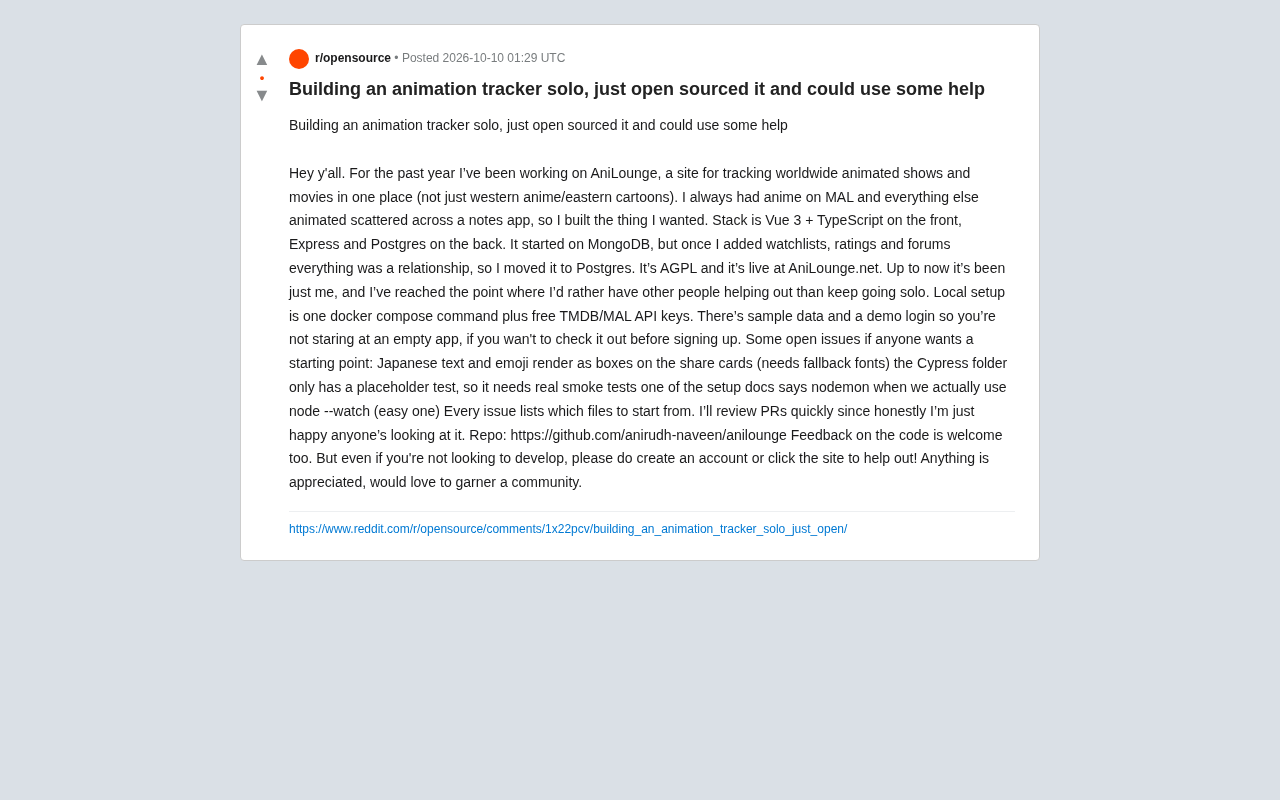
The project is now live at AniLounge.net and fully open-sourced under the AGPL license. The developer openly admits it's been a solo effort for the past year, and the time has come to invite the community in. This kind of "build a tool you wish existed" story is exactly how many great open-source projects get their start.
Tech Stack: Migrating from MongoDB to Postgres
From a technical standpoint, AniLounge's architecture is modern and fairly conventional: a Vue 3 + TypeScript frontend, with an Express backend powered by PostgreSQL.
The database migration decision is worth examining. The project originally ran on MongoDB, but as features like watchlists, ratings, and forums were added, the developer found that nearly every piece of data was related to something else. Document databases struggle with this kind of densely relational data, so the entire project was migrated to PostgreSQL.
This is a genuinely instructive case study: you can't always make the perfect architectural call upfront. When your data model evolves from "independent documents" to "a tightly interconnected entity graph," relational databases often become the natural fit. For developers wrestling with the NoSQL vs. SQL decision, this real-world migration story offers a concrete point of reference.
The core difference between MongoDB and PostgreSQL lies in their data modeling philosophy. MongoDB stores data as BSON documents, making it well-suited for flexible, deeply nested structures (e.g., a blog post and its comments living in the same document) — especially convenient during early exploration when schemas change frequently. However, when entities become highly interrelated — say, one anime title linked to multiple users' watch histories, ratings, and comments, while each user participates in multiple forum threads — MongoDB requires manually maintained references or heavy nesting to simulate JOINs, making performance and data consistency difficult to guarantee. PostgreSQL, as a relational database, natively supports foreign key constraints, transactional integrity, and complex JOIN queries — precisely what a densely connected entity network demands. AniLounge's migration timing is also representative: NoSQL's flexibility tends to win during the MVP phase, but once core business relationships stabilize, moving to a relational database often simplifies query logic and improves data consistency significantly.
Low-Barrier Local Setup and Contribution Paths
AniLounge has put real thought into lowering the barrier to participation. Getting a local environment running requires just a single docker compose command, plus free API keys from TMDB and MAL. Even more thoughtfully, the project ships with sample data and demo accounts, so contributors can explore the full feature set before registering — rather than staring at a blank, empty application.
For developers looking to contribute, the maintainer has curated a set of approachable open issues, each annotated with which files to start from:
- Font rendering on share cards: Japanese text and emoji display as boxes on share cards — fallback fonts need to be added.
- Insufficient test coverage: The Cypress directory currently contains only placeholder tests; real smoke tests need to be written.
- Documentation error: One config doc references
nodemon, but the project actually usesnode --watch— an easy fix and a great first contribution.
This approach of annotating each issue with a clear starting point is especially welcoming to new contributors, dramatically reducing the overhead of navigating an unfamiliar codebase. The developer has also promised quick PR reviews, noting candidly that "just having someone take a look would already make me happy."
Cypress is a JavaScript-based end-to-end (E2E) testing framework designed for browser applications. It simulates real user interactions — clicks, form submissions, page navigation — directly in a live browser and verifies UI behavior. The "smoke tests" mentioned in the project represent a foundational tier of software testing: quick checks run after a deployment or code commit to confirm that core functionality still works — like a power-on test, ensuring the system doesn't "catch fire" before deeper validation begins. For open-source projects, the absence of E2E smoke tests means contributors can't automatically confirm their PR hasn't broken the main user flow. Adding this layer is critical for long-term project stability, and it's also a relatively self-contained task that's well-suited for new contributors.
What This Tells Us About Open-Source Collaboration
This Reddit post reflects a challenge common to solo open-source projects in their cold-start phase: the technology may be reasonably mature, but community awareness and collaboration are lacking. The developer's ask is refreshingly pragmatic — code contributions and feedback are welcome, but even just signing up for an account or visiting the site helps the project grow in its early days.
From a code quality perspective, the project already has the foundational elements needed for sustainable collaboration: a clear tech stack, a containerized deployment workflow, sample data, a tiered issue list, and an open license. These are exactly the signals that determine whether an open-source project can attract outside contributors.
For developers interested in the open-source ecosystem or building their own side projects, AniLounge is both a ready-to-use anime tracking tool and a small case study in how to turn a personal project into a community one. If you're curious, check out the GitHub repository at anirudh-naveen/anilounge.
AGPL (GNU Affero General Public License) is one of the most restrictive licenses in the GPL family. Its key clause: anyone who builds a network service using AGPL-licensed code must make the complete source code available to users — even if no executable is distributed. This stands in sharp contrast to permissive licenses like MIT or Apache, which allow closed-source commercial use. For a tool like AniLounge that's deployed as a SaaS product, choosing AGPL means any third party building a similar service on top of the codebase must also open-source it — preventing commercial entities from free-riding on community work. This license choice protects the indie developer's efforts while signaling a "build together, share together" ethos to the community. It does, however, limit enterprise-level commercial integration to some degree — a deliberate and clearly considered trade-off.
Related articles

Felix Rieseberg Personal Homepage
Felix Rieseberg's personal homepage sparks attention on Hacker News. This article covers the Slack engineer's technical background, the rise and fall of nativefier, and the value of a developer homepage as a tech calling card.

@ai-sdk/vue 3.0.306 Patch Release Syncs with [email protected] Update
@ai-sdk/vue 3.0.306 released, synced with [email protected]. A routine patch release for the Vercel AI SDK ecosystem with no public API changes; the Vue adapter layer stays version-aligned with the core package.

Gemini 4 Argon API Launches: The Era of Million-Token Output Begins
Google launches Gemini 4 Argon with sparse MoE architecture, up to 1M output tokens, and a 68.90% Vals Index score, available across API, AI Studio, and the Gemini app.