Anker Soundcore Sleep A20 Sleep Earbuds Drop to Record-Low $99

The Anker Soundcore Sleep A20 sleep earbuds hit a record-low $99.99, an $80 discount at Best Buy and Target.
The Anker Soundcore Sleep A20 sleep earbuds have dropped to a record-low $99.99 at Best Buy and Target, an $80 cut from the original price. With an ultra-low-profile design ideal for side sleepers, plus physical isolation and scientifically backed sleep soundscapes, they effectively block snoring and ambient noise—a solid value for noise-sensitive sleepers.
Earbuds Designed Specifically for Sleep
Even the best mattress and the most consistent bedtime routine may not solve everyone's trouble falling asleep. For those who toss and turn because of environmental noise, the Sleep A20 sleep earbuds from Anker's Soundcore brand may offer a new approach—actively blocking outside interference through hardware.
Founded in 2011, Anker started out with power banks and gradually expanded into charging, audio, smart home, and other categories. Soundcore is its sub-brand focused on consumer audio, with a product lineup spanning the full price range from entry-level true wireless earbuds to flagship active noise-cancelling headphones. The Sleep A20 represents Soundcore's important move into the vertical sleep scenario, continuing Anker's consistent dual-engine strategy of "high-value hardware + software ecosystem." The accompanying Soundcore app provides sleep data tracking and sound customization features, attempting to build a soft moat around user data assets.
Currently, the Anker Soundcore Sleep A20 has dropped to $99.99 at both Best Buy and Target—an $80 reduction from its original price, setting a record low and approaching half off. For users long bothered by snoring, traffic noise, or a roommate's schedule, this is a deal worth paying attention to.
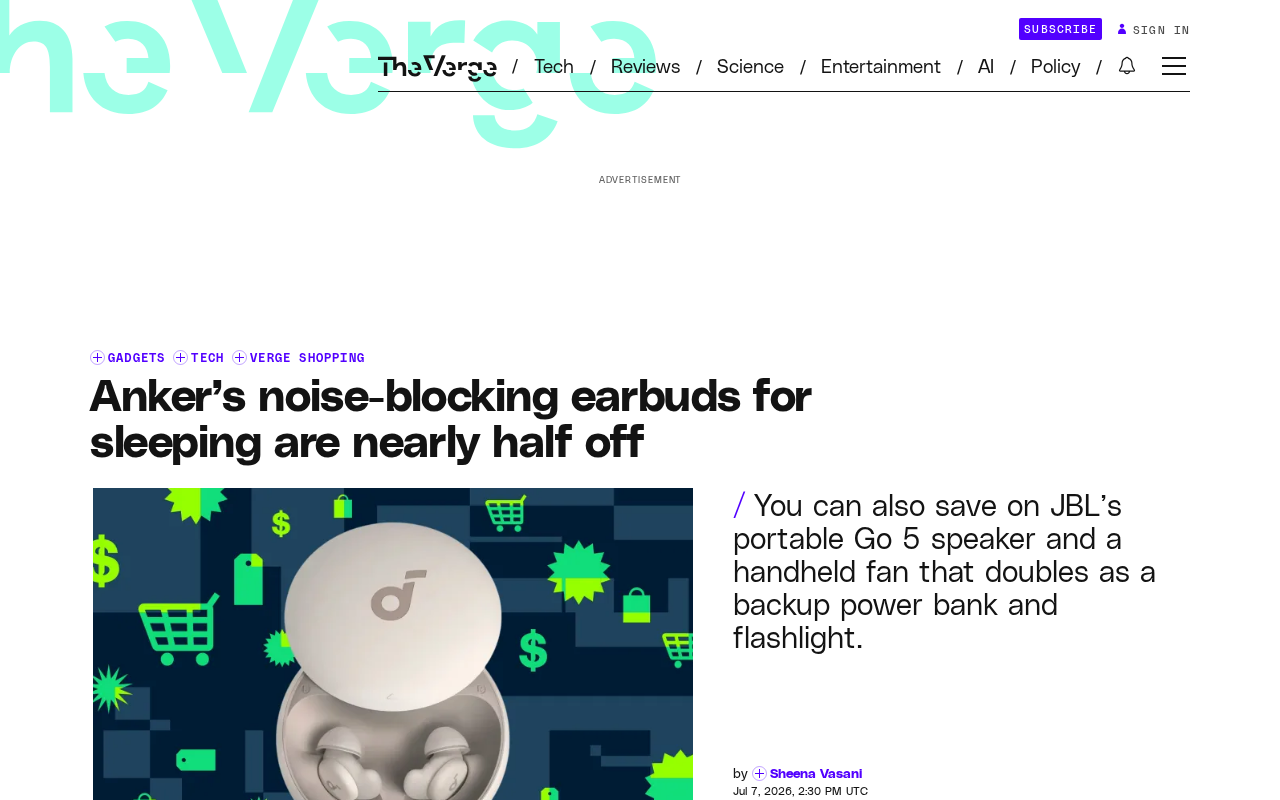
How Sleep Earbuds Differ from Noise-Cancelling Headphones
Sleep-specific earbuds and common active noise-cancelling (ANC) headphones differ significantly in design philosophy. Active noise cancellation technology uses built-in microphones to capture ambient noise, then employs a digital signal processor (DSP) to generate in real time an "anti-phase sound wave" that is exactly opposite to the noise waveform. When the two overlap in physical space, they cancel each other out, achieving noise elimination—a principle known as "destructive interference."
It's worth noting that the concept of ANC technology was first proposed by Lawrence J. Fogel in the 1950s, and it took decades of evolution before it gradually entered the consumer market. Modern ANC systems typically come in three architectures: feedforward, which places the microphone on the outside of the earphone to capture noise in advance and respond quickly—suitable for handling predictable, stable noise, but because of the physical gap between the microphone and the ear canal, the system cannot know the actual residual noise reaching the eardrum, making self-correction difficult; feedback, which places the microphone inside the ear canal to monitor and correct residual error in real time—more effective for mid-to-high frequency noise, but prone to system oscillation because the sampling point is extremely close to the speaker; and hybrid, which combines the advantages of both, with the outer microphone providing feedforward prediction while the inner microphone handles closed-loop correction. Hybrid is currently the mainstream approach for flagship noise-cancelling headphones, at the cost of significantly increased chip computing demands and power consumption. For sleep earbuds, the high power consumption of the hybrid approach creates a natural conflict with the need for all-night battery life, which is precisely why some sleep earbuds choose to sacrifice ANC depth in favor of strengthening physical isolation.
ANC works best for low-frequency stable noise (such as airplane engine hum or air conditioner droning). The main frequency of snoring is roughly between 50–500 Hz, which theoretically also falls within ANC's advantage zone. However, ANC is limited in effectiveness against infrasound below 20Hz and high-frequency bursts above 1000Hz. This limitation stems from the core physical constraints of ANC systems: the microphone captures the noise, the DSP computes the anti-phase wave, and the speaker plays it—the entire processing chain has a latency of about 1–10 milliseconds. When the noise frequency is too high (very short wavelength), the anti-phase sound wave and the original noise cannot precisely cancel due to phase offset, and may even produce "howling" or noise-cancellation failure.
This is why ANC alone is not enough for sleep scenarios; it must be combined with passive isolation and acoustic masking to compensate for its blind spots. Passive isolation relies on the difference in acoustic impedance of materials to attenuate noise: a sealed air cavity forms between the silicone eartip and the ear canal wall, and when sound waves pass from the air medium into the silicone, most of the acoustic energy is reflected due to the acoustic impedance mismatch. High-quality in-ear earbuds can provide 20–35dB of passive isolation in the mid-to-high frequency range (above 1kHz), but in the low-frequency range (below 100Hz), because the wavelength is far larger than the physical size of the earbud, passive isolation drops significantly—this is exactly why ANC is an indispensable complement in sleep scenarios. Only when all three work together do they form a complete sleep acoustic protection system.
In addition, traditional noise-cancelling headphones are often bulky and protrude from the outer ear when worn, easily pressing against the ear when lying on one's side, making them unsuitable for long sleep use.
Ultra-Low-Profile Design, No Pressure When Sleeping on Your Side
TWS (True Wireless Stereo) earbuds are the current mainstream form in the consumer audio market. The popularity of TWS earbuds owes much to the simultaneous maturation of Bluetooth Low Energy (BLE) technology and miniature lithium-polymer batteries in the mid-2010s, as well as the market education effect brought by Apple's AirPods redefining the "wireless earbud" category in 2016.
It's worth mentioning that audio streaming involves continuous high-bandwidth demand, typically using Bluetooth Classic mode (BR/EDR); whereas the LE Audio standard introduced by Bluetooth 5.2, based on the LC3 (Low Complexity Communication Codec) codec, can reduce power consumption by about 50% at the same audio quality. This is an important consideration in chip selection for the new generation of sleep earbuds—and it directly affects the fundamental difference between sleep earbuds and ordinary TWS earbuds in terms of "low-power Bluetooth chip selection, audio decoding efficiency, and active noise cancellation algorithm optimization."
However, the industrial design of ordinary TWS earbuds prioritizes audio quality and daily-use scenarios, with the earbud body typically protruding 10–15 millimeters from the outer ear. When sleeping on one's side, this exerts noticeable counterforce against the pillow, causing outer ear compression and even affecting sleep depth. To explain further from an ergonomic perspective: when lying on one's side, the weight of the head (about 4–5 kilograms) is concentrated on the outer ear. If the earbud protrusion exceeds 5 millimeters, the pressure on the ear cartilage will exceed capillary perfusion pressure (about 32mmHg). Maintaining this state for a long time leads to localized ischemic pain and triggers frequent sleep-position adjustments, directly disrupting sleep continuity. This is why sleep earbud manufacturers typically keep the earbud shell protrusion under 3 millimeters, to ensure the pressure distribution at the contact surface with the pillow stays below the comfort threshold when lying on one's side.
The core advantage of the Sleep A20 lies in its ultra-low-profile in-ear design—the overall thickness is compressed to an extremely low level, striving to keep users comfortable even when sleeping on their side. It does not pursue the ultimate audio quality of music playback; instead, it embodies a "scenario-first" product design philosophy: through physical isolation combined with gentle sleep-aid soundscapes, it effectively reduces disturbances like snoring and street noise to a level that doesn't disturb sleep. This design trade-off essentially places ergonomic constraints (side-sleeping pressure distribution) ahead of acoustic performance, reflecting the industry trend of wearable devices moving from "general scenarios" toward deep customization for "vertical scenarios."
White Noise and Sleep Soundscapes: A Design Choice with Scientific Backing
The white noise, rain sounds, and other sleep-aid soundscapes built into the Sleep A20 are not gimmicks. To understand their effectiveness, one must first understand how noise disrupts sleep. Human sleep consists of alternating non-rapid eye movement sleep (NREM) and rapid eye movement sleep (REM), typically going through 4 to 6 complete cycles per night, each lasting about 90 minutes. Among these, the third stage of NREM (N3) is slow-wave sleep, the most critical stage for physical repair, immune regulation, and memory consolidation—and also the stage most easily interrupted by noise.
From a neuroscience perspective, slow-wave sleep is named after the high-amplitude slow waves (delta waves) of 0.5–2 Hz produced by the cerebral cortex during this stage. These slow waves are tightly coupled with the memory "replay" mechanism in the hippocampus, forming the neural basis for converting the day's learning from short-term to long-term memory. At the cellular level, during slow-wave sleep the brain also activates the glymphatic system—a clearance mechanism first described in 2013 by Stanford neuroscientist Maiken Nedergaard's team, which relies on the directional flow of cerebrospinal fluid through the interstitial spaces between neurons to flush out metabolic waste accumulated during the day (including beta-amyloid protein associated with Alzheimer's disease) into the lymphatic system for elimination. This means that having slow-wave sleep interrupted by noise over the long term carries potential harm not only limited to next-day cognitive decline, but may also be linked to the accumulation of neurodegenerative risk—giving the protection of slow-wave sleep clinical significance that extends far beyond mere "comfort." When ambient noise interrupts N3 sleep, it not only leaves people feeling fatigued but also directly impairs prefrontal cortex function, leading to measurable declines in next-day attention, decision-making ability, and emotional regulation. Research shows that even if the sleeper is not fully awakened by noise, intermittent noise exceeding 40 decibels (such as snoring or a door closing) can trigger micro-arousals in the cerebral cortex, reducing the proportion of N3 sleep and impairing next-day cognitive function.
White noise is a random noise whose power spectral density is uniformly distributed across the entire frequency range. Its sleep-aid mechanism lies in the principle of "acoustic masking"—continuous background sound can lower the contrast between sudden environmental noises (like a door closing or a car horn) and the background, reducing the brain's alert response to abrupt noise changes and fundamentally blocking the trigger pathway for micro-arousals. Research shows that continuous white noise can shorten the time to fall asleep by about 38% on average. In addition, pink noise (Pink Noise, with stronger low-frequency energy, sounding similar to rain) has also been shown to have a positive effect on increasing slow-wave sleep (deep sleep)—a 2017 study published in Frontiers in Neuroscience found that pink noise stimulation synchronized with slow-wave activity significantly improved subjects' next-day memory test scores. This is the scientific basis for the product's built-in variety of soundscapes. It's worth adding that brown noise (Brown Noise, with energy further concentrated in the low frequencies, resembling distant thunder or strong wind) has gained attention on social media in recent years for its potential benefits to people with attention deficits, but the clinical evidence supporting its sleep-aid effects is currently not as robust as that for white and pink noise, and more controlled studies are still needed for verification.
Long Battery Life: A Core Metric for Sleep Earbuds
Sleep scenarios have special demands on battery life—users often need to wear them continuously for 6 to 8 hours or even all night. This means sleep earbuds must strike a balance between battery capacity and charging case battery life to truly meet all-night use needs, which is a key point distinguishing such products from ordinary TWS earbuds.
Ordinary TWS earbuds typically last 4–6 hours on a single charge, which is sufficient for the everyday scenario of "listening to a music set or podcast," but for sleep earbuds it may mean automatically powering off at three in the morning—precisely the period when the proportion of REM sleep is highest and one is most easily awakened by sound. This forces the sleep earbud category to make different trade-offs from everyday TWS in terms of low-power Bluetooth chip selection, audio decoding efficiency, and active noise cancellation algorithm optimization: sacrificing some audio-processing headroom in exchange for longer single-charge battery life. From a chip architecture perspective, the new generation of sleep earbuds using Bluetooth 5.2 or 5.3 SoCs (systems on chip) that support LE Audio can theoretically extend playback time by about 30–50% at the same battery capacity compared to designs still using classic Bluetooth audio transmission—a metric that represents a decisive product-strength differentiator for the sleep earbud category. In addition, some manufacturers further reduce power consumption by optimizing the computational scheduling strategy of the ANC algorithm: when ambient noise is detected below a certain threshold, the ANC processing frame rate is automatically reduced from hundreds of times per second to a lower frequency, replacing "full-power continuous noise cancellation" with "on-demand noise cancellation." This adaptive strategy can extend battery life by an additional 10–20% without noticeably affecting the perceived noise-cancellation effect.
The Market Signal Behind the Record-Low Price
Dropping from the original price of $179.99 to $99.99—a reduction of over 40%—is not a common level of discount in the wearable audio market. There is a broader market logic behind this pricing move: the sleep economy is one of the fastest-growing sub-sectors in the health consumption space in recent years. The global sleep aid market exceeded $80 billion in 2023 and is expected to surpass $130 billion by 2030, with a compound annual growth rate of about 7%. Core factors driving this growth include intensifying noise pollution from urbanization, a decline in overall societal sleep duration, and the general rise in consumer awareness of "quantified health."
The rise of the sleep economy is inseparable from the "Quantified Self" movement. This concept was formally proposed in 2007 by Wired magazine editors Gary Wolf and Kevin Kelly, with the core idea being "knowing yourself through data"—optimizing personal behavior by continuously tracking physiological metrics. Since the popularization of smart wristbands in the 2010s, consumers have gradually gotten used to perceiving their own health status through data, and metrics like sleep quality scores and REM sleep duration have entered the public consciousness. The deeper driving force behind this cultural shift is: when sleep changes from a vague "how do I feel" into a quantifiable "deep sleep of X minutes, sleep efficiency of Y%," consumers become more willing to pay to improve these numbers and can more easily form comparable purchasing reference frameworks in product reviews. Notably, this quantification trend has also given rise to warnings from some researchers—overly focusing on sleep data itself may induce "orthosomnia," the new pressure to fall asleep that arises from pursuing a perfect sleep score. How to balance data transparency against user mental health is becoming a new design proposition for sleep-tech products.
This trend has spawned a complete industrial chain from upstream (sleep monitoring sensor chips, algorithms) to downstream (smart mattresses, sleep earphones, sleep-aid app subscription services). Notably, competition in this market is no longer confined to the hardware layer; software ecosystems and data closed-loops are becoming the new moats—such as data interoperability between the Oura Ring and major health platforms, or Eight Sleep's dynamic temperature regulation based on sleep data. Soundcore's continuous iteration on sleep data tracking and personalized sound adjustment in its app is precisely how Anker is building soft barriers in this dimension.
On one hand, this price cut reflects Anker's desire to reach a broader "sleep health" consumer group through the lever of price; on the other hand, it also shows that the sleep earbuds sub-category is moving from niche to mainstream. From smart mattresses (Eight Sleep, Sleep Number) and sleep-tracking wearables (Oura Ring, Whoop) to sleep earbuds, the entire sector exhibits the characteristics of a mature market: diversifying hardware forms and continually descending price points. Anker's entry at the hundred-dollar price point trades price for penetration in the short term, but in the long run it needs to build differentiated advantages in sleep-aid algorithms and user data accumulation to avoid getting caught in the red-ocean competition of a pure hardware price war.
Is the Sleep A20 Worth Buying?
For users who are genuinely troubled by sleep noise and have tried ordinary earplugs or noise-cancelling headphones without satisfaction, the $99.99 Soundcore Sleep A20 offers a relatively low-barrier solution. It is not a cure-all for insomnia, but as an aid for improving the sleep environment, it offers outstanding value at the current promotional price.
Of course, the effectiveness of any sleep-aid product varies from person to person—factors such as noise sensitivity, sleeping-position habits, and ear canal shape all affect the actual experience. It's worth mentioning that individual differences in ear canal shape are especially critical to the fit of in-ear earphones: the average diameter of the ear canal is about 7–9 millimeters, but its curvature and cross-sectional shape vary from person to person, which directly affects the sealing effect of the silicone eartips and thus the actual performance of passive isolation. From an acoustic engineering perspective, even a 1-millimeter gap between the eartip and the ear canal wall can cause a 10–15dB drop in low-frequency isolation, greatly diminishing the synergistic effect of ANC and passive isolation—this is why many manufacturers include multiple eartip sizes in the packaging and recommend that users perform an ear canal seal self-test through the app. Some manufacturers have also introduced an Active Seal Check function: the system emits a low-frequency test tone through the earphone speaker while the inner microphone measures the sound pressure response inside the ear canal; if the measured sound pressure level is below a preset threshold, the app prompts the user to adjust the eartip size or re-fit the earphone. This function turns earphone fitting from "going by feel" into a quantifiable parameter, effectively reducing user complaints about poor isolation caused by improper fit. Interested users are advised to try them out first based on their own situation within the scope allowed by return and exchange policies, then decide whether to use them long-term.
Summary
Sleep earbuds represent a pragmatic exploration of consumer electronics in the health sub-sector: integrating active noise cancellation, physical isolation, and scientifically validated sleep-aid soundscapes into a hardware form optimized specifically for the lying-down posture, genuinely responding to urban populations' real need for a quiet sleep environment. From the perspective of sleep neuroscience, their value lies not only in "blocking noise" but more importantly in protecting precious slow-wave sleep from interruption through the principle of acoustic masking—and the quality of slow-wave sleep directly relates to a series of quantifiable health metrics such as memory consolidation, immune repair, and next-day cognitive performance. The Anker Sleep A20 dropping to a record-low price is both a brand promotional strategy and a reflection of the increasingly mature market signal for this category. For users seeking a quiet sleep environment, now may be a good time to buy.
Key Takeaways
Key Takeaways
Related articles

Felix Rieseberg Personal Homepage
Felix Rieseberg's personal homepage sparks attention on Hacker News. This article covers the Slack engineer's technical background, the rise and fall of nativefier, and the value of a developer homepage as a tech calling card.

@ai-sdk/vue 3.0.306 Patch Release Syncs with [email protected] Update
@ai-sdk/vue 3.0.306 released, synced with [email protected]. A routine patch release for the Vercel AI SDK ecosystem with no public API changes; the Vue adapter layer stays version-aligned with the core package.

Gemini 4 Argon API Launches: The Era of Million-Token Output Begins
Google launches Gemini 4 Argon with sparse MoE architecture, up to 1M output tokens, and a 68.90% Vals Index score, available across API, AI Studio, and the Gemini app.