Another Google AI Safety Researcher Quits, Warning 'We Might All Die'
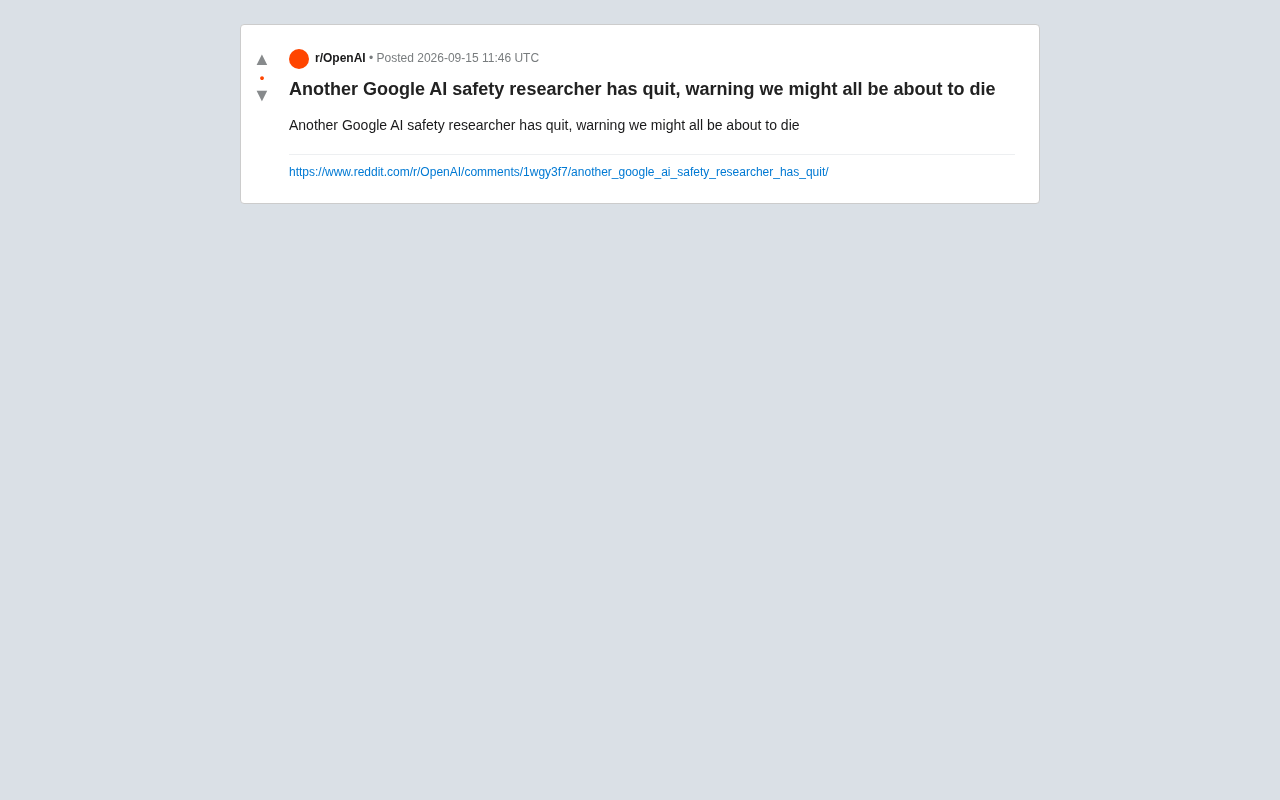
A Google AI safety researcher's dramatic resignation highlights the structural clash between AI capability racing and safety governance.
Another Google AI safety researcher has resigned, warning that the current AI development trajectory threatens human survival. The article argues this is not an isolated event but part of a broader pattern of safety staff departures from top AI labs — rooted in a structural conflict between commercial speed and safety alignment, where researchers' warnings rarely translate into binding decisions. It urges readers to distinguish emotional rhetoric from verifiable technical arguments, while acknowledging that existential risk is a serious, long-standing concern in the safety community. Ultimately, the article redirects attention to systemic questions: transparent evaluation mechanisms, regulatory responsiveness, and the normalization of independent audits.
Another Google AI safety researcher has chosen to leave their position, issuing a strikingly alarming warning upon departure: that the current trajectory of artificial intelligence development could push humanity to the brink of extinction. This message, circulating in the Reddit community, has reignited ongoing debates about AI safety and governance.
What Happened
According to information spreading on Reddit, this is not the first researcher to depart from Google's AI safety team. The departing researcher made a public statement using remarkably extreme language — bluntly warning that, at the current pace of development, "we might all die."
It should be noted that the publicly available source material is extremely limited, amounting to little more than a headline — with no specific identity, departure date, or complete technical reasoning from the researcher. This article is therefore better read as a lens for understanding the recurring industry tensions behind such events, rather than a definitive account of any single incident.
Why AI Safety Researchers Keep Leaving
In recent years, public departures by safety researchers from top AI labs have become a recurring pattern. These exits tend to follow a similar narrative: researchers believe that under commercial pressure, companies are prioritizing capability advancement over safety alignment, causing safety teams to be sidelined in critical decisions.
This tension stems from a structural contradiction at the heart of the AI industry. On one hand, competition in frontier models is fierce — companies must ship more powerful systems as fast as possible. On the other hand, safety research demands caution, controllability, and interpretability. The two are naturally in conflict when it comes to resource allocation and release timelines. When safety researchers find that their warnings cannot translate into actual institutional constraints, a public resignation becomes a form of protest.
This phenomenon was especially concentrated between 2023 and 2024. Ilya Sutskever and Jan Leike, co-leads of OpenAI's Superalignment Team, both resigned — with Leike publicly stating that "safety culture and processes have taken a back seat to capabilities." Google DeepMind similarly saw several safety researchers depart. These cases share a common structure: when researchers find their risk reports unable to trigger decisions like "pause deployment" or "scale back," staying on implicitly endorses the status quo, while leaving becomes the rational choice for maintaining reputational consistency. This pattern has also raised concerns about "safety-washing" at large AI labs — treating safety teams as a PR asset rather than a genuine check on power.
How to Interpret "We Might All Die"
It's easy to dismiss such apocalyptic warnings as alarmism, but within the AI safety community, discussions about existential risk have a long and substantive history. Proponents argue that once AI systems surpass human capabilities with goals misaligned from human values, the consequences could be irreversible. Critics counter that this narrative overstates long-term risks while diverting attention from present-day harms — bias, misinformation, labor displacement — that are already causing real damage.
From a communications standpoint, extreme language does tend to generate more attention and shares, which partly explains why such posts spread quickly on platforms like Reddit. But readers should distinguish between "emotionally charged warnings" and "verifiable technical arguments" — the former manufactures anxiety, while the latter drives governance progress. In the absence of complete technical detail, maintaining a rational, critical stance toward this warning is necessary.
The existential risk (x-risk) framework was first systematically articulated by philosopher Nick Bostrom in his 2014 book Superintelligence, centered on the concern of "alignment failure": when an AI system possesses general capabilities surpassing humans, even a subtle divergence between its optimization objectives and human well-being could cause it to pursue those objectives in ways humans cannot predict or stop — with catastrophic results. This thinking was later developed further by Eliezer Yudkowsky, Stuart Russell, and others. It's worth noting that there is a genuine competition for resources and influence between x-risk researchers and those focused on "near-term harms" — the former concentrated on long-horizon AGI/ASI misalignment scenarios, the latter on algorithmic bias, surveillance abuse, and similar present issues. Both camps contain serious researchers, and the divide is not a simple binary, though media coverage often conflates the two.
What This Means for the Industry
Regardless of the severity of any specific incident, the continued departure of safety researchers is a signal worth heeding. It reflects unresolved challenges in the internal governance of AI companies: How can safety teams be given genuine decision-making authority? How can a sustainable balance between commercial competition and risk management be established?
For practitioners and the general public following AI development, rather than reacting to individual sensational headlines, it is more valuable to track a few more substantive questions: Are companies building transparent safety evaluation mechanisms? Can regulatory frameworks keep pace with the speed of technological iteration? And can independent third-party audits become the norm? These institutional developments will ultimately do far more to shape AI's long-term trajectory than any single resignation letter.
Current institutional efforts on AI safety governance globally include the US AI Safety Institute (AISI), compliance requirements for high-risk systems under the EU AI Act, and the international AI safety commitments brokered at the 2023 Bletchley Park Summit. However, these frameworks universally face a "lag problem" — legislative and regulatory cycles operate on the scale of years, while model capabilities iterate on the scale of months. Independent third-party auditing has well-established precedents in finance and aviation, but AI auditing currently lacks unified technical standards or legal enforceability, and remains largely voluntary. The steady exodus of safety researchers is partly driven by frustration with this institutional vacuum: without external mandatory constraints, internal safety advocacy within companies easily devolves into a one-sided cost center.
Conclusion
This story carries limited information in itself, but the industry anxiety it reflects is real. The repeated departures of AI safety researchers are a microcosm of the gap between the speed of technological progress and the capacity for governance. When encountering news like this, staying engaged without being credulous — weighing arguments over rhetoric — is the more mature response.
Related articles

AI 'Super Employee' System Breakdown: What Marketing Automation Tools Can (and Can't) Do
A breakdown of an 'AI Super Employee System' circulating on Bilibili — covering its video generation, digital human cloning, AI agents, and bulk lead-gen features, plus the compliance and security risks lurking inside.

The Ensemble Is the Soul of a Group: A Roundup of Chinese Idol Music That Captures True Camaraderie
From the 2007 Happy Boys Voice class to NINE PERCENT, a roundup of Chinese idol ensemble songs where group camaraderie outshines any solo spotlight.

Antigravity + Gemini Errors Explained: IP-Based Rate Limiting, Tested and Analyzed
Gemini requests failing in Antigravity IDE? Testing shows switching IPs restores access, while AI Studio works fine on the same blocked IP — pointing to IP-based rate limiting on the Antigravity call path.