Anthropic Acquires Stainless API: A Strategic Play for SDK and MCP Ecosystem Dominance
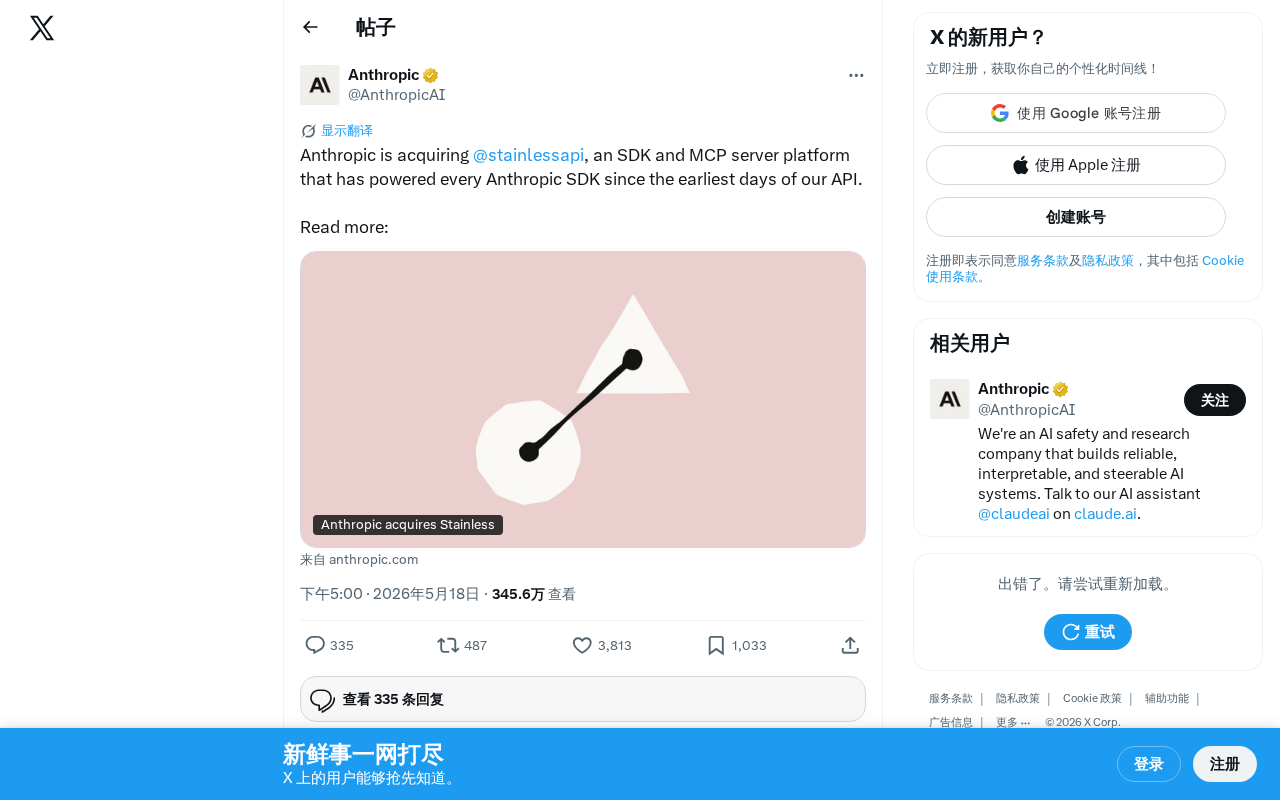
Anthropic acquires SDK vendor Stainless API to control developer tools and the MCP ecosystem.
Anthropic has acquired Stainless API, the company that has provided the underlying SDK support since Anthropic's API launch. The move carries three strategic implications: fully internalizing multi-language SDK generation and maintenance to control the developer experience; leveraging Stainless's MCP server platform expertise to accelerate MCP protocol ecosystem maturity; and eliminating dependency risk on a critical external vendor. This reflects the broader trend of leading AI companies accelerating vertical integration.
Event Overview: Anthropic Brings Its Core SDK Vendor In-House
Anthropic recently announced the acquisition of Stainless API, a company specializing in automated SDK generation and MCP server platforms. Stainless has provided the underlying support for all of Anthropic's SDKs since the very inception of the Anthropic API — this acquisition essentially brings the most critical technology vendor formally under Anthropic's own roof.
What Is Stainless API? And Why Does It Matter?
An Automated SDK Generation and Maintenance Platform
Stainless API's core product is an automated SDK generation and maintenance platform capable of producing high-quality client libraries in Python, TypeScript, Java, Go, and other programming languages based on API specifications.
The essence of automated SDK generation technology is parsing standardized API specification files like OpenAPI/Swagger to automatically produce client code, type definitions, error handling logic, and documentation for each language. Traditionally, a company maintaining SDKs in five or more languages would need several dedicated engineers, and behavioral discrepancies between language versions are nearly inevitable. Stainless's core competitive advantage lies in producing not just generated code, but high-quality, idiomatic code — the Python SDK looks like it was handwritten by a Python engineer, while the TypeScript SDK fully leverages the type system. This is precisely why top-tier API companies like Stripe and OpenAI chose Stainless.
For an AI company like Anthropic that needs to maintain multi-language SDKs simultaneously, the value of such a tool is self-evident:
- Efficiency gains: Manually maintaining multi-language SDKs consumes enormous engineering resources; Stainless dramatically reduces maintenance costs through automation
- Consistency assurance: After every API update, SDKs across all languages can be quickly and consistently synchronized
- Quality control: Avoids common issues in manual maintenance such as version inconsistencies and outdated documentation
MCP Server Platform
Beyond SDK generation, Stainless has been deeply involved in building MCP (Model Context Protocol) server platforms. MCP is a communication protocol open-sourced by Anthropic in November 2024, designed to solve the fundamental problem of "connection fragmentation" between AI models and external tools or data sources.
Before MCP, every AI application needed custom integration code for each tool, creating an M×N complexity explosion. MCP reduces this to M+N by defining a unified client-server architecture — tool providers only need to implement an MCP Server once, and all MCP-compatible AI clients can call it directly. From a technical architecture perspective, MCP draws inspiration from LSP (Language Server Protocol), the foundational protocol behind the thriving VS Code ecosystem. Hundreds of mainstream services including GitHub, Slack, and PostgreSQL have already launched MCP Servers, and the rapid expansion of this ecosystem positions MCP to become the de facto standard for AI tool integration. Stainless's deep expertise in the MCP ecosystem makes it an irreplaceable component of Anthropic's technology stack.
Three Layers of Strategic Logic Behind the Acquisition
Layer One: Full Control Over the Developer Experience
As AI large model competition intensifies, the capabilities of models from OpenAI, Google, Anthropic, and others are converging. In this landscape, which platform developers choose often comes down to a deceptively simple question — how smooth is the integration experience?
The strategic value of developer ecosystems has been thoroughly validated in the cloud computing era. AWS maintained its long-standing lead over Azure and GCP largely because it was first to establish developer mindshare and toolchain ecosystems — once developers become familiar with a particular set of SDKs and toolchains, migration costs are extremely high, creating powerful platform lock-in. According to industry research, when developers choose an AI API provider, SDK quality, documentation completeness, and integration convenience often outweigh pure model performance metrics. Stripe's success is largely built on its industry-recognized reputation for having "the best payment SDK."
With the Stainless acquisition, Anthropic fully internalizes SDK design, generation, and maintenance, enabling faster responses to developer needs and delivering high-quality multi-language support immediately with every API version iteration. This builds the brand perception that "Claude API is the easiest to integrate" in developers' minds. This isn't merely a technical optimization — it's a long-term investment in the developer ecosystem.
Layer Two: Accelerating MCP Protocol Ecosystem Maturity
The MCP protocol represents Anthropic's major bet at the AI infrastructure level. Acquiring a company with deep expertise in MCP server platforms means Anthropic can significantly accelerate the maturation of the MCP ecosystem.
As more tools and services connect to Claude models through the MCP protocol, Anthropic's platform stickiness will increase substantially, creating a positive feedback loop. Once MCP becomes the industry's de facto standard, Anthropic's position as both the protocol's creator and largest ecosystem maintainer will translate into lasting competitive advantage.
Layer Three: Eliminating Supply Chain Risk — From Dependency to Autonomy
From a business perspective, all of Anthropic's SDKs have relied on Stainless's technology from the very beginning. This deep dependency on an external vendor was acceptable when the company was smaller. But as Anthropic's valuation has skyrocketed and its enterprise customer base continues to expand, bringing core infrastructure under its own control has become urgent.
The essence of this acquisition is eliminating critical supply chain risk.
Industry Impact: Accelerating Vertical Integration Among AI Companies
Leading Companies Are Internalizing Key Technologies
This acquisition reflects a notable trend in the AI industry: leading companies are accelerating vertical integration, seeking to control as many layers of the technology stack as possible — from model training and inference optimization to developer tools.
Vertical integration is not a new concept in tech. Apple built an unreplicable moat through its custom A-series chips, operating system, and app ecosystem; Amazon extended from an e-commerce platform to AWS cloud infrastructure, and then to custom Graviton chips. The vertical integration wave in AI is even more rapid: Google introduced TPU chips designed specifically for deep learning as early as 2016 and owns a complete stack from the TensorFlow framework to the Vertex AI platform; Meta open-sourced PyTorch and developed its own MTIA inference chips; OpenAI has deepened its infrastructure ties with Microsoft Azure and acquired data infrastructure companies like Rockset. Anthropic's acquisition of Stainless is the latest extension of this trend at the "developer tools layer" — as model capability gaps narrow, technology stack completeness and developer experience fluidity are becoming the new competitive moats.
Implications for API Tool Startups
For startups in the SDK platform and API tooling space, this deal sends a dual signal:
- The positive side: If your product is excellent enough and deeply embedded with major clients, acquisition is an ideal exit path
- The challenging side: Independent SDK tool companies may face increasing competitive pressure, as large clients could choose to build in-house or acquire at any time
Conclusion: Win the Developers, Win the Next Phase of Competition
Anthropic's acquisition of Stainless API may seem low-profile, but its strategic significance should not be underestimated. This deal marks Anthropic pushing forward on three dimensions simultaneously: solidifying its core technology stack, optimizing the developer experience, and advancing MCP ecosystem development.
As AI platform competition enters deeper waters, whoever wins developers' trust and adoption will seize the advantage in the next phase of competition.
Related articles
Meta Muse Hits 900K Downloads in Six D…
Meta Muse Hits 900K Downloads in Six Days: The AI Agent Era Has Officially Arrived
Meta's AI agent Muse hit 902K downloads in 6 days, topping US App Store and Google Play charts above ChatGPT and Claude. A deep dive into Muse's capabilities and the AI Agent race.
 Industry Insights
IRS Fully Embraces Claude AI, Accelerating Federal Government's AI Adoption
The IRS is recruiting staff with 24/7 Claude AI access, marking Anthropic's breakthrough into the federal government. Explore the strategic implications and tax use cases.
 Industry Insights
The IRS Mobile App Debate: A Trust Crisis in Government Digital Transformation
The IRS's proposed mobile app has sparked heated debate. This article analyzes the core arguments, exploring data security, privacy, and the trust crisis in government digital transformation.