Anthropic Advocates for AI Slowdown: The Hidden Logic Behind the Open Source vs. Closed Source Debate

Anthropic's AI slowdown push blends genuine safety concerns with closed-source commercial interests and geopolitics.
This article examines the recent joint "AI slowdown" statement from Anthropic and other U.S. AI companies, arguing that what appears to be a safety initiative is deeply entangled with closed-source commercial interests and geopolitical competition. The piece traces the closed-source camp's logic — using existential AI risk as justification for concentrating control among a few "ethical" companies — and questions why open-source models like DeepSeek are framed as security threats. The author argues that open source is not inherently unsafe, and that incumbents acting as both competitors and rule-setters raises serious questions about their motives. True AI governance requires transparent, multi-stakeholder frameworks, not self-appointed gatekeepers.
A Debate Over the Pace of AI
A recent story has sparked heated discussion in the AI community: Anthropic and a group of U.S. AI companies issued a joint statement calling for a "slowdown" in the pace of AI development. As interpreted by commentators online, the statement reportedly involves not just Anthropic, but also OpenAI's Sam Altman and Elon Musk. The core argument is that AI is advancing too fast and too dangerously — that humanity needs to voluntarily pump the brakes to avoid the risk of technology spiraling out of control.
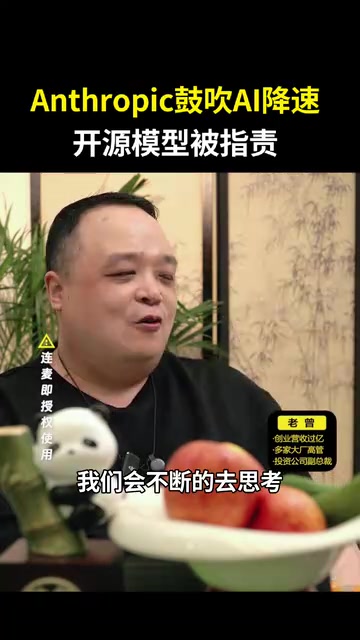
On the surface, this looks like a responsible act of industry self-regulation. But when you consider Anthropic's track record and the consistent positions of the people behind it, the motivations behind this "slowdown movement" start to look far less straightforward.
The Core Argument of the Closed-Source Camp
As discussed in commentary on this topic, Anthropic (with Dario Amodei frequently cited as the figurehead) has long championed a particular view: AI must remain in the hands of the United States — specifically, a small number of "ethical" closed-source companies. The reasoning goes that other nations might misuse AI, and only closed-source, tightly controlled companies can truly keep AI in check.

The logic chain roughly goes: AI capabilities are becoming too powerful → this poses an existential risk to humanity → a small elite must maintain control → only closed-source models can achieve that control → therefore closed source is superior to open source. Within this narrative, "slowing down" and "staying closed" are packaged as moral choices made in humanity's best interest.
The problem is that when you tie technological safety to commercial monopoly and geopolitical interest, it becomes very hard to believe the motivation is purely ethical. When "acting in humanity's interest" happens to perfectly align with "keeping it under our control," that alignment deserves serious scrutiny.
The Finger Points at Chinese Open-Source Models
Another major thread running through this debate is the accusation leveled at Chinese AI companies. According to commentary summarizing related articles, DeepSeekAd, Kimi (Moonshot AI), Alibaba, and other Chinese firms have been accused of "distillation" — that is, using the outputs of American AI models to train their own models, allowing them to close the capability gap rapidly.

The more fundamental point of contention, however, is the choice of development philosophy: Chinese companies have largely embraced an open-source approach, while leading U.S. companies have mostly gone closed-source. The closed-source camp argues that once an open-source model is released publicly, it can fall into the hands of bad actors — since open-source providers don't impose sufficient restrictions on AI capabilities, the result is a security risk.

This effectively treats technological openness as equivalent to security risk, and uses that equivalence to conclude that "closed source is always better." It's a significant logical leap — and arguably the most contested part of this entire debate.
Knowledge Distillation is a deep learning technique for transferring the "knowledge" of a larger "teacher model" into a smaller "student model." In practice, the teacher model generates outputs (including probability distributions, intermediate representations, etc.) for a large set of inputs, and those outputs are then used as training signals for the student model. The student doesn't directly copy the teacher's weights — it learns the teacher's behavioral patterns. This technique is widely and legally used across the AI field, with Meta, Google, and others publishing open research on it.
The controversy lies in where the line is drawn: if you use the API outputs of a closed commercial model to train a competing product, does that violate the service terms or constitute intellectual property infringement? The law has yet to provide a clear answer. OpenAI and similar companies typically include explicit prohibitions in their terms of service against "using outputs to train competing models," but proving such violations in technical terms is extremely difficult. Characterizing distillation as "theft" or a "security threat" remains a legally and technically contested claim.
The Real Tensions in the Open vs. Closed Source Debate
At its core, the open-source vs. closed-source debate is a collision between two competing sets of values:
- The closed-source camp emphasizes control and safety, arguing that a small number of institutions should centrally manage frontier models to prevent capability proliferation.
- The open-source camp emphasizes transparency, accessibility, and the democratization of technology — arguing that openness accelerates innovation, lowers barriers to entry, and enables broader scrutiny and oversight of AI.
What deserves particular attention is how "safety" is increasingly being weaponized as a commercial and political tool. When a closed-source company is simultaneously a market competitor and the leading advocate for "slowdowns" and "safety standards," it's playing both offense and defense at the same time. The anxiety surrounding open-source models like DeepSeek is, in large part, not really about safety — it's about the fact that these models have shattered the technical barriers and commercial moats of closed-source giants at a fraction of the cost.
The rise of open-source models has demonstrated one thing clearly: advanced AI does not have to be controlled by a handful of companies. That fact directly undermines the foundational claim that "closed source is necessary for safety."
Understanding this debate also requires some background on the internal factions within the AI Safety field. Anthropic's founding team largely came from OpenAI and was deeply influenced by Effective Altruism (EA) thinking. Their core concern is "superintelligence alignment failure" — the idea that a future AI system vastly more capable than humans might be impossible to constrain, resulting in existential risk. This concern has produced a policy agenda centered on slowing AI down and centralizing its management.
However, the AI safety research community is significantly divided on this question. Another school of thought argues that concentrating frontier capabilities in a small number of companies actually reduces transparency, making it impossible for outsiders to independently assess the risks; open research, they argue, allows a broader safety research community to audit and evaluate these systems. The two camps have long been at odds over the fundamental question of "centralized control vs. distributed oversight" — a context that's essential for judging whether Anthropic's advocacy represents genuine safety concern or strategic policy positioning.
How to Think About This Debate
For everyday users and industry practitioners, independent judgment is essential.
First, the "AI slowdown" movement does contain legitimate safety concerns. The real ethical, employment, and misuse risks created by rapid AI iteration are genuine and shouldn't be dismissed outright.
Second, it's worth examining the interests of those doing the advocating. When a call for slowdowns happens to benefit incumbents in consolidating their position and suppressing challengers, the commercial motivations cannot be ignored.
Third, open source does not inherently mean unsafe, and closed source does not inherently mean fully controllable. Genuine AI governance requires transparent, multi-stakeholder rules — not handing control to a handful of self-proclaimed "ethical" companies.
This debate over slowdowns, closed source, and open source is far more than a dispute over technical roadmaps. It is, at its heart, a contest over who gets to define the future of AI — and who gets to control it.
Related articles

Chain of Thought Isn't Just for AI: How Humans Can Use CoT to Improve Thinking Quality
Chain of Thought isn't just a prompt trick for large models. Starting from a Hacker News discussion, this article analyzes why CoT works for human thinking too, breaks down actionable ways to transfer it, and highlights the key differences between human CoT and machine CoT.
Cloudflare Teams Up with OpenAI: Closi…
Cloudflare Teams Up with OpenAI: Closing the Loop from Vulnerability Discovery to Defense with AI
Cloudflare uses OpenAI Daybreak to investigate security vulnerabilities and generate reviewable remediation plans, while developers use Codex to boost coding efficiency and quality.

Orca Multi-Agent Orchestration in Practice: A Guide to Parallel Collaboration with Claude and Codex
Orca is Stable AI's free open-source agent workbench supporting 34 agents like Claude Code and Codex in parallel. Learn its Git worktree isolation, multi-model orchestration, and mobile management.