Anthropic and METR Caught in Regulatory Capture Controversy
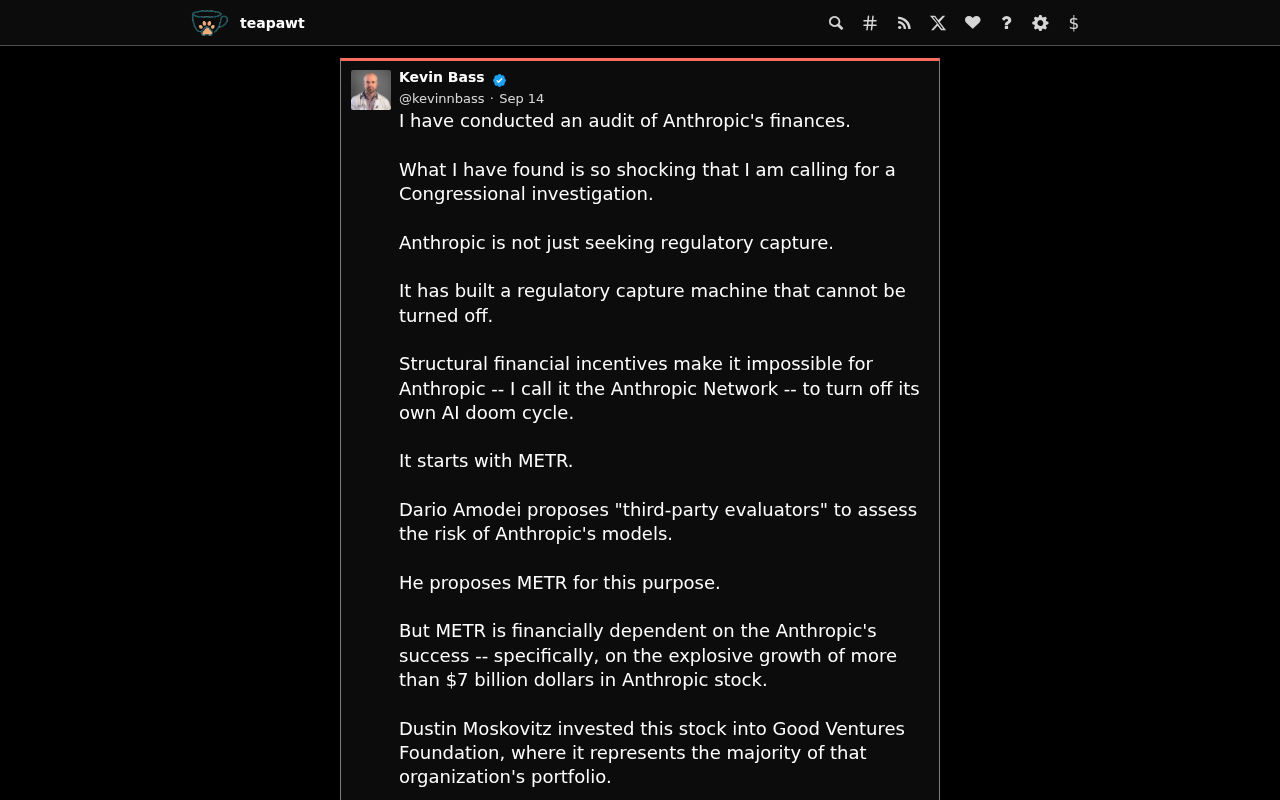
Hacker News post alleges Anthropic engages in regulatory capture via METR, sparking debate on AI evaluation independence.
A Hacker News post titled "Regulatory Capture by Anthropic Through METR" received 81 upvotes and 36 comments, alleging that the close relationship between AI safety evaluation organization METR and Anthropic may constitute regulatory capture. The article examines METR's role as a third-party evaluator, analyzes structural conflicts of interest arising from its reliance on AI companies for model access, compute, and funding, and notes that during the AI regulatory vacuum, such organizations struggle to escape industry economic ties. Community discussion is divided on whether conflict-of-interest disclosure mechanisms suffice to safeguard independence. The article proposes governance paths including mandatory disclosure, multi-party oversight, diversified funding, and evaluation transparency, arguing that public responses from Anthropic and METR are necessary to rebuild trust.
A Debate Over the Independence of AI Regulation
A post titled "Regulatory Capture by Anthropic Through METR" appeared on Hacker News, garnering 81 upvotes and 36 comments. The post directly targets the close relationship between AI safety evaluation organization METR and AI company Anthropic, questioning whether this relationship has already constituted "regulatory capture."
Regulatory capture is a classic concept in public choice theory, referring to a situation where a regulatory body is swayed by the industry interest groups it is supposed to regulate, causing regulatory policy to deviate from the public interest. As AI safety increasingly becomes a policy focus, this allegation touches on the core contradiction of industry governance.
Regulatory capture was systematically articulated by economist George Stigler in 1971 and belongs to the branch of public choice theory. Its core proposition is that regulatory bodies do not naturally represent the public interest; regulated industries have strong incentives to invest resources—lobbying, personnel infiltration, revolving doors, funding research—to tilt regulatory rules in their own favor. Classic cases include the U.S. Civil Aeronautics Board's protective regulation of the aviation industry and the personnel flows between financial regulators and Wall Street. Identifying regulatory capture typically involves looking at three signals: information asymmetry between regulators and the regulated, asymmetric industry investment in regulatory resources, and regulatory outcomes that systematically deviate from the public interest. In the AI field, due to the lack of a statutory regulatory body, "capture" manifests more as evaluation organizations' resource dependence on a handful of frontier companies rather than administrative capture in the traditional sense.
METR's Role and the Focus of Controversy
METR (Model Evaluation & Threat Research) is a nonprofit organization focused on assessing AI model capabilities and risks, whose work includes independent testing and safety evaluation of frontier models. At a stage when AI regulatory frameworks are still taking shape, such third-party evaluation organizations are held to high expectations—they should provide policymakers and the public with objective technical judgments.
The core of the controversy lies in whether an evaluation organization's conclusions can remain neutral when its funding, personnel, or research agenda are deeply tied to a particular AI company. The post's title directly points at Anthropic, suggesting that METR may have lost independence due to its association with Anthropic, thereby affecting the fairness of the entire AI regulatory ecosystem.
METR (Model Evaluation & Threat Research), formerly the evaluation team of the Alignment Research Center, became an independent nonprofit organization in 2023. Its main work is conducting pre-deployment dangerous capability evaluations of frontier AI models, covering risk dimensions such as autonomous replication, cyberattacks, and biological misuse. Its evaluation protocols often require model developers to provide access to unreleased models and compute resources, and it charges fees for evaluation services. This "evaluated party pays" model is not uncommon in third-party auditing, but experience in the auditing industry shows that long-term ties between the payer and the auditor weaken independence. METR has issued evaluation reports for companies such as Anthropic and OpenAI, and the public availability of its methodology documentation is limited, which constitutes the technical basis for outside doubts about its independence.
Why This Question Deserves Serious Attention
AI safety evaluation currently lacks mature industry standards and a government regulatory system, and third-party organizations in practice often rely on AI companies to provide model access, compute resources, and even funding support. This structural dependence itself sows the seeds of potential conflicts of interest.
If personnel flows, joint research, or funding relationships exist between evaluation organizations and the companies being evaluated, it is difficult for outsiders to verify the transparency of the evaluation process. More critically, when these evaluation results are used as a basis for regulation or policy recommendations, any bias can be amplified to the entire industry level.
Conflict-of-interest disclosure mechanisms are a common institutional tool in professional services for safeguarding independence, typically exemplified by independence declarations in certified public accountant audits, author conflict-of-interest disclosures in academic journals, and registration systems for lobbying activities. Their effectiveness depends on three conditions: the disclosed content is verifiable, violations carry enforceable penalties, and the disclosed information can be accessed by stakeholders and used in decision-making. In the AI evaluation field, there is currently no unified disclosure standard, and funding amounts, personnel exchanges, and joint research between evaluation organizations and AI companies are often not made public, making it difficult for disclosure mechanisms to exert a constraining effect. Critics point out that voluntary disclosure suffers from selective disclosure problems, while mandatory disclosure faces enforcement challenges regarding who regulates and how to verify.
Divergent Views in Community Discussion
Judging from the comment activity on Hacker News, 36 comments indicate a considerable degree of community interest in this topic. Around allegations of regulatory capture, there are usually two positions: one side holds that talent in the AI safety field is scarce, that personnel and resource overlaps between evaluation organizations and AI companies are difficult to avoid, and that the key question is whether conflict-of-interest disclosure mechanisms have been established; the other side holds that even with disclosure mechanisms in place, structural dependence will still cause evaluation conclusions to systematically favor funders.
Since the original material does not provide the specific content of the comments, it is impossible to determine the specific leanings of the community discussion, but the question raised by the title itself is sharp enough—during the critical window when the AI regulatory system is being formed, how to safeguard the independence of evaluation organizations is a governance issue that requires public discussion.
Implications for the AI Governance Ecosystem
This controversy reflects the deeper dilemma of AI industry governance: the pace of technological progress far outstrips the pace of building regulatory institutions, resulting in a regulatory vacuum period filled by industry self-organized evaluation organizations, which in turn find it difficult to completely escape their economic ties to the industry.
Possible solutions include: establishing mandatory conflict-of-interest disclosure systems for evaluation organizations, introducing multi-party independent oversight, ensuring diversification of evaluation funding sources, and promoting transparency of evaluation methods and results. For Anthropic and METR, if the relevant doubts continue to intensify, publicly responding and disclosing details of their cooperative relationship will be a necessary step to rebuild trust.
One-line Summary
A Hacker News post alleges that Anthropic engages in regulatory capture through METR, sparking public discussion about the independence of AI evaluation organizations.
Paragraph Summary
A post titled "Regulatory Capture by Anthropic Through METR" on Hacker News received 81 upvotes and 36 comments, directly pointing out that the close relationship between AI safety evaluation organization METR and Anthropic may constitute regulatory capture. The article outlines METR's role as a third-party evaluation organization, analyzes the structural conflicts of interest arising from its reliance on AI companies for model access, compute, and funding, and notes that during the AI regulatory vacuum period, such organizations are held to high expectations yet find it difficult to escape industry economic ties. Community discussion is divided over whether conflict-of-interest disclosure mechanisms are sufficient to safeguard independence. The article concludes by proposing governance paths such as establishing mandatory disclosure systems, introducing multi-party oversight, ensuring diversified funding sources, and promoting evaluation transparency, and argues that public responses from Anthropic and METR disclosing details of their cooperative relationship are a necessary step to rebuild trust.
Related articles

Gemini 4 Neon Released: A Balance Between Frontier Intelligence and Efficient Task Execution
Google DeepMind releases Gemini 4 Neon, focused on frontier intelligence and fast end-to-end task execution. This article breaks down its benchmark performance in coding, enterprise analysis, scientific reasoning, and cybersecurity, its four thinking levels, pricing, and safety alignment data.

Is AI the Culprit Behind Global Outages? The Trust Crisis Behind the NSA and FAA Failures
Fourth major failure in five days hits NSA classified network. Microsoft blames a software bug, FAA denies its new AI system, NSA says routine maintenance. Senator Warner suggests AI accelerates vulnerability discovery, leading to rushed fixes — while 39% of Americans already view AI negatively, exposing a deepening trust crisis.

Robot Developer Builds Custom B-rep Kernel with 3,487 Tests
A robot developer builds a custom B-rep geometry kernel with 3,487 tests, exploring why robotics needs dedicated CAD tools and the barriers to building one.