Anthropic and OpenAI Both Claim to Have Proven VP≠VNP—Has a 47-Year-Old Problem Finally Been Solved?
Anthropic and OpenAI both claimed within four hours that AI proved VP≠VNP, with machine verification passed but human review incomplete.
Anthropic and OpenAI published papers within four hours of each other, claiming their internal AI models proved the 47-year-old VP≠VNP conjecture in algebraic complexity theory, accompanied by 73,000 and 440,000 lines of machine-checkable proof code respectively. The article explains the conjecture: determinants have fast algorithms while permanents are suspected to lack polynomial-size arithmetic circuits, and VP≠VNP is equivalent to the non-existence of polynomial-size circuits for the permanent. Both proofs use proof by contradiction, combining net embeddings with narrow-bridge lower bound arguments and diagonal methods to construct contradictions. The proof does not imply P≠NP because arithmetic circuits are more demanding than Boolean circuits. Machine verification has passed, but whether the statement accurately expresses the intended meaning and whether the proof has been reviewed by human mathematicians remain incomplete, so for now it can only be called a "claim."
The Event: Two AI Companies Post Proofs Within Four Hours
In the early hours of November 24 Beijing time, Anthropic published a 70-page paper accompanied by 73,000 lines of machine-checkable proof code, claiming that its internal research model had discovered a proof of a core conjecture in arithmetic complexity theory. About four hours later, OpenAI also posted a paper with 440,000 lines of proof code, saying that an unnamed internal model had obtained the result on November 6. The next morning, OpenAI released another batch of papers, two of which pushed further: one claimed the lower bound could be even higher, and the other separated several smaller classes within VP from one another.
The core claim of both papers points to the same conjecture: VP ≠ VNP. This is a question in theoretical computer science that has been open for 47 years, often called "the algebraic version of P vs NP."
Background: Determinants Are Easy to Compute, Permanents Are Hard
To understand this conjecture, first look at two polynomials. The determinant of a 2×2 matrix is ad-bc, and the permanent is ad+bc—differing only by a sign. The rule is similar as matrices grow: pick one number from each row with no repeated columns, multiply them to form a term, and sum the terms over all choices. The difference is that the determinant assigns a negative sign to half the terms by a fixed rule, while the permanent is all plus signs.
For a 20×20 matrix, the number of choices is a 19-digit number, and summing term by term is simply impractical. But the determinant can be computed quickly via Gaussian elimination: reduce the matrix to upper triangular form, then multiply the diagonal entries. For 32×32, about 20,000 operations suffice. The permanent has no such elimination shortcut, and the best known general algorithm remains exponential—each additional row and column roughly doubles the number of column combinations to check.
"Not having found a shortcut does not mean there is no shortcut." This sentence is key to understanding the whole problem. 2×2 matrix multiplication was once optimized from 8 multiplications to 7. To prove that the permanent "can't be computed fast no matter what," one must first rigorously specify "which moves are allowed."
Formalization: Arithmetic Circuits and VP/VNP
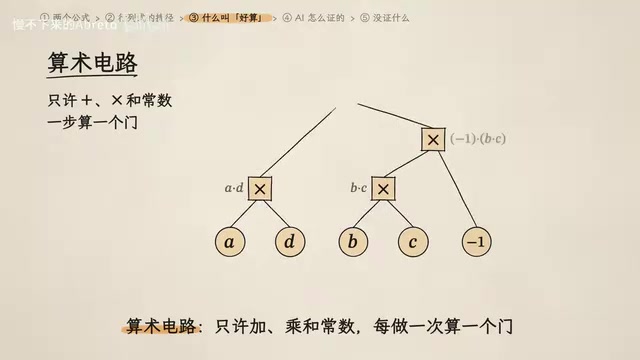
The model mathematicians use is called an arithmetic circuit, which allows only addition, multiplication, and constants. Each addition or multiplication is one "gate." The determinant lies in the class VP—there exists a polynomial-size arithmetic circuit for it. The permanent lies in the class VNP, which additionally allows one more operation: summing the values over exponentially many choices. Each individual choice is easy to compute, but there are m factorial choices.
Valiant, who proposed the conjecture, also proved that the permanent is one of the hardest problems in VNP: every polynomial in VNP can be written as a not-too-large permanent. Therefore VP ≠ VNP is equivalent to saying: the permanent has no polynomial-size arithmetic circuit. This is named by analogy with P vs NP, hence it is often called "the algebraic version of P vs NP."
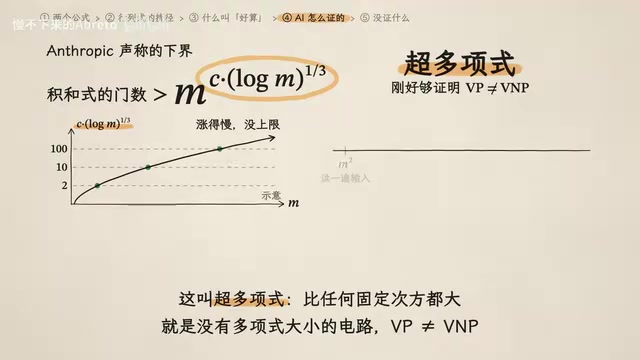
The difficulty is that what must be proven is a "no"—one must deal with all possible circuits, including designs no one has thought of. For over 40 years, for general arithmetic circuits, the known lower bound for the permanent has not exceeded m squared times a logarithm. But reading the input alone involves m squared numbers, meaning the provable lower bound is only slightly more than reading the input once.
Arithmetic circuit is a computational model analogous to Boolean circuits, but the gates only perform addition, multiplication, and multiplication by constants; inputs are variables and constants, and the output is a polynomial. The number of gates (circuit size) measures computational cost. Polynomial families in the class VP can be computed by polynomial-size arithmetic circuits, corresponding to "easily computable" polynomials. The class VNP is closed under "summation": if a polynomial family can be written as a sum over exponentially many terms, each of which is itself in VP, then it belongs to VNP. The permanent is the quintessential example of a complete problem in VNP. Valiant's conjecture VP≠VNP occupies a position in algebraic complexity theory analogous to P≠NP in Boolean complexity theory, but the two are not directly equivalent.
Proof Idea: Proof by Contradiction and the "Narrow Bridge" Contradiction
The skeletons of the two proofs are similar, both by contradiction: first assume that the permanent has a polynomial-size circuit. Since the permanent is one of the hardest problems in VNP, if it has a small circuit, then every problem in VNP has a small circuit.
Next, both papers use a polynomial representation method called a "net": points are computational modules, and lines are data passed between modules. Embedding the net in space and charging by line—the more data and the farther it is stretched, the higher the cost. Then comes the key question: is there a clever way to connect that is cheaper than honestly stretching lines? There are only two possible answers: no, or yes.
If there is no such line-saving trick, then "honestly stretching lines" is already optimal. At this point, pick a net whose computed polynomial is also in VNP, and by assumption has a small circuit. A polynomial computed by a small circuit has an inescapable property: it can always be decomposed into a sum of terms, each of which roughly splits the points of the net into two halves, with data passed between the halves only through a single "narrow bridge." The smaller the circuit, the narrower the bridge, with bridge width comparable only to the logarithm of the number of gates—for a million gates, the bridge width is at most about 20 bits. Rerouting the lines crossing both sides through the narrow bridge, and moving the two bridgeheads closer to their respective halves, shortens the paths of most lines and lowers the total cost. This contradicts "honestly stretching lines is already optimal."
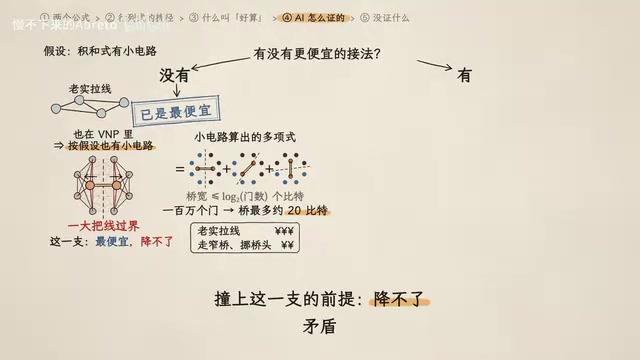
If there is a line-saving trick, paired with a small circuit, one can build an "accelerator." In Anthropic's construction, the accelerator acts on a class of programs that "guess": the program's result is the sum of the results over all guesses. Originally there was not enough time for a program to compute its own result, but with the accelerator there is. So construct a program that reads its own code and guesses which path to take: one path records 1, the other uses the accelerator to compute its own result. Adding the results of the two paths gives V = 1 + V, a contradiction. This is exactly the diagonal method—the same origin as proving the undecidability of the halting problem.
The key point is whether it is the "no trick" or "trick" case; Anthropic's original manuscript states it does not know the answer; but both cases lead to contradiction, so there is no need to know which one.
Diagonal method is a self-referential argument: construct an object that produces a contradiction by referring to itself. In computability theory, Cantor used the diagonal method to prove that the reals are uncountable, and Turing used it to prove the halting problem undecidable. The core idea here is similar: suppose there exists an "accelerator" that can quickly compute a certain class of sums; then one can construct a program that reads its own code and uses the accelerator to compute its own result, leading to the contradiction V = 1 + V. This self-referential structure does not depend on the specific implementation of the accelerator, only requiring that it can compute that class of sums, and is therefore general.
Does It Prove P≠NP? No
Both papers explicitly state: no. P vs NP asks about ordinary computers—processing 0s and 1s bit by bit, corresponding to Boolean circuits. Arithmetic circuits must compute the polynomial itself, while Boolean circuits only need to answer correctly when each input bit is 0 or 1, allowing far more paths; this proof does not carry over.
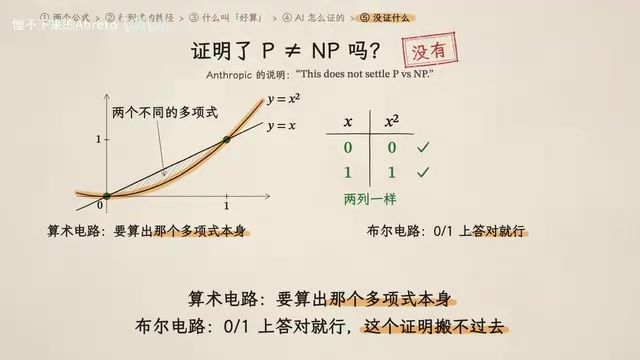
Conversely, there is a known result: if a stronger version of P ≠ NP holds, then VP ≠ VNP follows; but VP ≠ VNP does not currently imply P ≠ NP.
Boolean circuit is a classical computational model: inputs are bits 0/1, gates perform logical operations such as AND, OR, NOT, and the output is 0/1. A Boolean circuit only needs to output the correct result when each input bit is 0 or 1, rather than outputting a polynomial expression as an arithmetic circuit does. Therefore, arithmetic circuits have stronger computational requirements and can simulate Boolean circuits, but not vice versa. The P vs NP problem corresponds to lower bounds for Boolean circuits, while VP vs VNP corresponds to lower bounds for arithmetic circuits. It is known that certain strengthened versions of P≠NP imply VP≠VNP, but VP≠VNP itself does not directly imply P≠NP.
Credibility: Machine Verification Passed, Human Review Incomplete
The first papers from both Anthropic and OpenAI were compiled from scratch and re-checked step by step by third parties, all passing. But what machines can guarantee is only that the proof matches the written statement; whether the statement accurately expresses the intended meaning requires knowledgeable people to read it against the original.
Anthropic's statement is only 98 lines, short enough to be read line by line manually. Line 93 is "VP is a proper subset of VNP." The paper states: at the time of release, the correctness of the statement had only been checked by AI, and the proof itself had not yet been checked by a human mathematician. Later, an algebraic complexity expert publicly stated that the definitions of VP and VNP in the statement are completely consistent with standard definitions; but as of the morning of the 26th, no expert had been found to publicly state that they had reviewed the entire proof.
So, for now, one can only say this is a "claim." If the proof holds, it shows that: over the reals, using only addition, multiplication, and constants, the number of circuit gates for the permanent eventually exceeds any fixed power; but whether it truly requires exponentially many is still unknown. This "eventually" is very late—according to the constants used in the proof, merely making the lower bound exceed m squared, the number of digits written for the matrix row count is a 20-digit number.
Why It Matters
Regardless of the final review outcome, this event presents a new research paradigm: AI models generate large-scale formal proofs, which are then machine-verified. The volume of 73,000 and 440,000 lines of proof code far exceeds the comfort zone of a single human mathematician manually checking, and formal verification has become the first gate of credibility. The gate of "whether the statement is written correctly" still requires human experts. For readers interested in AI for Science, this may be a more noteworthy signal than "whether VP ≠ VNP holds."
Related articles

Braised Meat Shop Forced Out by Rent Hike: A Life-and-Death Contest Between Craft and Location
Braised meat shop owner forced out by a 100,000 yuan rent hike moves overnight; landlord's daughter takes over with seasoning packets and overnight meat sickens customers. A tale of location versus craft.

AI One-Click Emotional Short Drama: Bilibili Creator Tests the "Beautiful Landlady" Script
Bilibili creator uses AI to produce the emotional short drama "The Beautiful Landlady Comes to Fix the Guy's Drain," testing everything from script generation to character consistency.

Braised Meat Stall Goes Viral, Landlord Raises Rent—She Leaves Gracefully by Contract While Rival Cuts Corners and Loses Everything
A braised meat stall's rent was hiked from ¥68K to ¥168K after going viral; the owner moved out by contract while her rival cut corners and lost it all.