Anthropic Bans Users: Touching Training of Larger Models a Violation?

Community reports say Anthropic bans accounts touching training of larger models, raising concerns about platform rule boundaries and developer risk.
The article centers on a Hacker News community discussion claiming that "Anthropic bans any behavior touching training larger models." It notes that the claim lacks official corroboration but is enough to raise developers' concerns about platform usage boundaries. The article analyzes three possible interpretations of the banning standard: targeting only competitive distillation, preventing capability spillover, and automated risk control false positives, and discusses the practical impact on developers' model selection, multi-model backups, data compliance, and appeal records. It argues that the incident reflects large model platforms shifting from open APIs to conditional openness, with stricter control over data exits, and that developers should incorporate platform rule risk into technical architecture design.
Background: A Vague Banning Rule
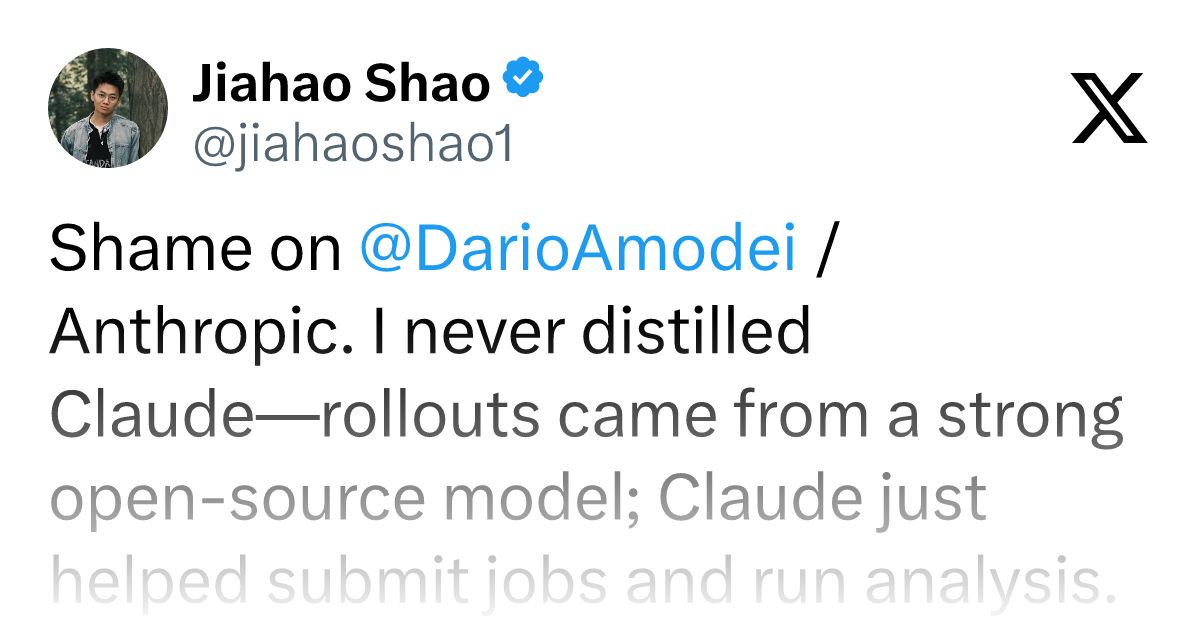
According to a Hacker News discussion, some users report that Anthropic will ban accounts for any behavior "touching training larger models." This claim comes from the community title "Anthropic blocks users for anything touching training larger models." Although the original information only includes points and comment counts, with no screenshots or official statements to corroborate it, it is enough to raise developers' concerns about the boundaries of platform use.
The core controversy is: what exactly is the banning standard? Is it prohibiting users from using Claude's output to train competitor models, or does it even count discussing, testing, or fine-tuning one's own small models as a violation? The original material does not provide an answer, and the uncertainty itself is the risk.
Why This Rule Deserves Attention
Large model service providers typically prohibit "using outputs to train competing models" in their terms. If Anthropic's banning actions are truly as the community describes, covering any behavior "touching training larger models," it means the boundary has expanded from "prohibiting distillation" to "prohibiting any related experimentation." For developers, this affects model selection, experiment design, and data compliance strategies.
Another layer of impact lies in ecosystem trust. API users put their business logic and data on the platform, and what they fear most is that the platform alone holds the right to interpret the rules. A single ban may prompt teams to reassess the costs of multi-model backups, local deployment, or open-source alternatives.
Three Possible Interpretations of the Rule's Boundaries
Interpretation 1: Only Aimed at Competitive Training
The most lenient explanation is that Anthropic only bans using Claude output to train large models that compete with itself. This is a common industry practice aimed at preventing model distillation and loss of intellectual property. Under this interpretation, ordinary users fine-tuning small models or conducting academic research should not be affected.
Model Distillation refers to using the outputs of an already-trained large model (the teacher model)—such as logits, probability distributions, or generated text—to train another smaller model (the student model), so that the student model approximates the teacher model's performance on specific tasks. In commercial terms, service providers typically prohibit users from using their outputs to train competing models, because this amounts to transferring capabilities that the platform obtained through massive compute investment to third parties "for free," weakening its own competitive advantage. Distillation technology itself is a standard method in both academia and industry, but when used to train commercial models that directly compete with the teacher model, it often crosses the service provider's red line.
Interpretation 2: Preventing Capability Spillover
A stricter explanation is that the platform fears users will systematically obtain high-quality data through the API to improve the capabilities of other models. Even if they are not direct competitors, any "training larger models" may trigger risk control. This places research-oriented users and startup teams in a gray area.
Capability Spillover refers to the situation where a platform's high-quality outputs are systematically collected by users and used to improve the capabilities of other models or systems outside the platform, thereby indirectly draining the platform's core asset—model capability. Unlike direct distillation, capability spillover does not require users to train models that directly compete with the platform; as long as the outputs are used to enhance any external model, the platform may view it as a risk. For service providers offering APIs, output is data, and data is an asset. Therefore, risk control systems may remain sensitive to behaviors such as bulk calls, high-frequency generation, and domain-specific data collection. This explains why some research-oriented or data-intensive uses easily trigger scrutiny.
Interpretation 3: Automated Risk Control False Positives
A third possibility is that the risk control system automatically bans based on keywords or behavior patterns, causing normal experiments to be misjudged. A common complaint in community discussions is precisely "I don't know why I was banned." If there is a lack of appeal channels and clear explanations, the cost of false positives is passed on to users.
Automated Risk Control is a mechanism by which platforms use rule engines or machine learning models to monitor user behavior in real time and take automated action. Common triggers include: a large number of API calls in a short period, request content containing training-related keywords (such as "fine-tune" or "training data"), and outputs being exported in bulk. The advantage of automated risk control is high efficiency and broad coverage, but the disadvantage is a lack of contextual judgment, making it easy to misclassify normal academic experiments, data organization, or model evaluation as violations. When platforms lack transparent rules and effective appeal channels, the cost of false bans is borne entirely by users, which is the root of the "I don't know why I was banned" complaints in community discussions.
Practical Impact on Developers
First, model training projects need to re-examine the terms of service, especially data sources and output usage. Second, teams should maintain multi-model solutions to avoid business interruption caused by a ban on a single platform. Third, conversations and experiments involving model training should be recorded locally so that evidence can be provided during appeals.
For researchers and independent developers, the most realistic question is: when platform rules are opaque, how can they prove their use is compliant? The original material does not provide an official response from Anthropic, so at present this can only be a risk warning based on community feedback, not a conclusion.
Industry-Level Signals
Large model platforms are shifting from "open APIs" to "conditional openness." The more valuable the training data, the more sensitive the platform is to where outputs flow. If Anthropic is indeed adopting an aggressive banning strategy, it may push some users toward open-source models or self-hosted solutions, and it will also prompt other vendors to clarify rule boundaries to win developer trust.
Although this discussion contains limited information, it points to a real trend: competition in model capabilities is becoming control over data exits. Developers need to incorporate "platform rule risk" into technical architecture design rather than remediating afterward.
FAQ
What are the specific standards for Anthropic's bans?
The original material does not provide official details; the community claim is any behavior "touching training larger models." It is advisable to rely on Anthropic's official terms of use.
Can ordinary users be mistakenly banned?
This possibility exists, especially when automated risk control lacks manual review. Keeping usage records can help with appeals.
How should developers respond?
Evaluate multi-model backups, monitor updates to terms, avoid directly using platform outputs to train competing models, and keep local records of key experiments.
One-line Summary
Community reports say Anthropic bans accounts touching training of larger models, raising concerns about platform rule boundaries and developer risk.
Paragraph Summary
The article centers on a Hacker News community discussion claiming that "Anthropic bans any behavior touching training larger models." It notes that the claim lacks official corroboration but is enough to raise developers' concerns about platform usage boundaries. The article analyzes three possible interpretations of the banning standard: targeting only competitive distillation, preventing capability spillover, and automated risk control false positives, and discusses the practical impact on developers' model selection, multi-model backups, data compliance, and appeal records. The article argues that the incident reflects large model platforms shifting from open APIs to conditional openness, with stricter control over data exits, and that developers should incorporate platform rule risk into technical architecture design.
Related articles

AI Coding Enters the Team Collaboration Era: Interpreting Three Major Moves from Meta, GitHub, and Mistral
Meta acquires Conductor, GitHub Copilot Fusion becomes available, Mistral opens Large 4 weights—three moves show AI coding shifting from code generation to organizing development workflows. This article explains task orchestration, model collaboration, and cost control for developers.

Building a RAG Assistant with Dify: A Practical Guide to Knowledge Bases, Workflows, and Agent Nodes
How should knowledge bases, workflows, and Agent nodes connect in a Dify RAG assistant? We break down the division of labor and wiring logic for a shippable app.
 Tech Frontiers
The AI Industry Doesn't Lack Marketing—It Lacks Good Products
AI faces market selloffs and public skepticism—is marketing really the problem? This analysis of market signals and product experience argues the core困境 is incomplete products and a gap between promises and experience; the only way to change perceptions is to ship better products.