Anthropic Bets on AI Drug Discovery: Can Claude Autonomously Design Drugs?

Anthropic explores using Claude to autonomously design drug molecules, pushing LLMs into life sciences.
Anthropic is reportedly exploring the use of its flagship model Claude to autonomously design drug molecules, extending LLM applications into life sciences. Building on breakthroughs like AlphaFold, Claude could serve as an intelligent coordinator — leveraging reasoning, literature comprehension, and tool-calling to orchestrate end-to-end drug design workflows. While promising faster discovery and lower R&D barriers, the effort raises critical dual-use safety concerns that align with Anthropic's safety-first approach.
AI Enters the Drug Discovery Frontier
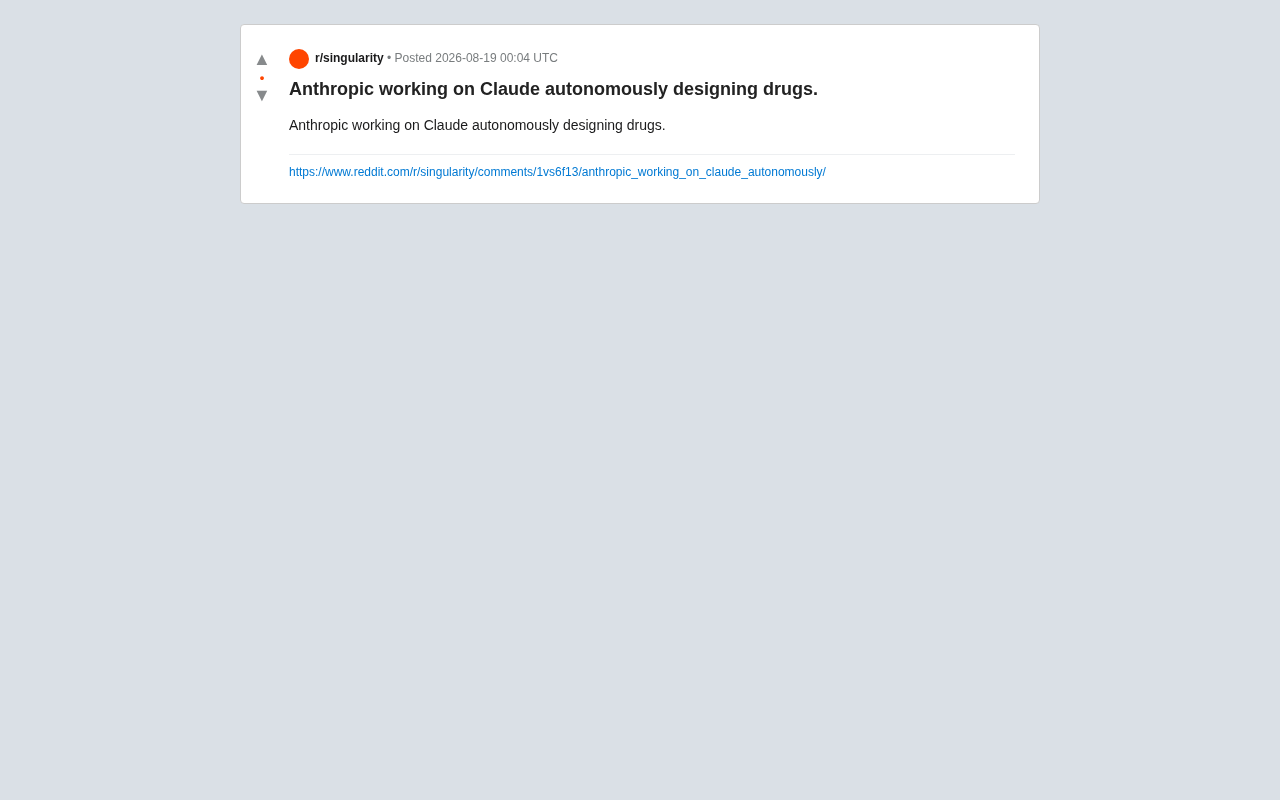
Recently, news about Anthropic sparked heated discussion on Reddit and other online communities: the safety-first AI company is exploring the ability of its flagship model Claude to autonomously design drug molecules. If this direction proves viable, it would mean the application boundaries of large language models are expanding from conversation and programming into the highly specialized realm of life sciences.
Drug development has long been one of the most time-consuming and costly areas of scientific research. The widely cited industry figure is that a new drug takes an average of over 10 years and billions of dollars from inception to market, with extremely high failure rates during clinical stages. This high cost stems from the rigorous scientific validation process — a new drug typically goes through target discovery, lead compound optimization, preclinical research (including animal testing and toxicology assessment), and Phase I (safety), Phase II (efficacy), and Phase III (large-scale validation) clinical trials before finally being submitted for regulatory approval. According to the classic study by the Tufts Center for the Study of Drug Development, the full lifecycle capitalized cost of a single new drug can reach $2.6 billion, and approximately 90% of drug candidates that enter clinical stages ultimately fail. This high attrition rate forces pharmaceutical companies to advance multiple pipelines simultaneously to hedge risk, further driving up overall R&D spending. Any technology that can improve efficiency in early discovery and molecular design phases could deliver enormous commercial and social value. This is the fundamental reason why Anthropic and many other AI companies are betting on this field.
From AlphaFold to Claude: The Technical Evolution of AI Drug Discovery
Protein Structure Prediction Laid the Foundation
AI breakthroughs in life sciences didn't start today. DeepMind's AlphaFold achieved milestone results in protein structure prediction — an accomplishment recognized with the Nobel Prize in Chemistry. Launched in 2020, AlphaFold predicted three-dimensional protein structures with accuracy far surpassing all other methods at the 14th Critical Assessment of protein Structure Prediction (CASP14), solving the "protein folding problem" that had plagued biology for 50 years. Its core innovation lies in using multiple sequence alignment (MSA) and attention-based deep learning architectures to predict atomic-level 3D coordinates directly from amino acid sequences. By 2022, the AlphaFold database had publicly released predicted structures for over 200 million proteins, covering virtually all known proteins. In 2024, AlphaFold's key contributors Demis Hassabis and John Jumper were awarded the Nobel Prize in Chemistry. This achievement powerfully demonstrated the enormous potential of machine learning in tackling complex biomolecular problems.
However, protein structure prediction is primarily a task of "understanding," while autonomous drug molecule design is a challenge of "creation" — the model needs to generate candidate molecules within an enormous chemical space that simultaneously possess efficacy, safety, and synthesizability. The so-called "chemical space" refers to the set of all theoretically possible compounds. It's estimated that the number of drug-sized organic small molecules is on the order of 10^60, far exceeding the number of atoms in the observable universe. Traditional medicinal chemists can typically only screen from known compound libraries or make localized modifications to lead compounds based on experience. AI-driven generative molecular design (using methods such as variational autoencoders, generative adversarial networks, and reinforcement learning) can conduct directed exploration within this astronomical space, but generated molecules must still satisfy pharmacokinetic constraints like Lipinski's Rule of Five and practical synthesizability — a vast gap remains between "generation" and "usability." This places higher demands on AI's reasoning and generation capabilities.
The Unique Role of General-Purpose LLMs in Drug Design
Unlike specialized models such as AlphaFold, Claude is a general-purpose large language model. Anthropic's approach likely involves leveraging Claude's powerful reasoning, literature comprehension, and tool-calling capabilities to serve as an "intelligent coordinator" in the drug development pipeline — integrating specialized molecular simulation tools, databases, and experimental data into an end-to-end autonomous design workflow.
This "Agent + specialized tools" paradigm is the mainstream direction for current AI application deployment. An AI Agent refers to enabling a large language model to not just passively answer questions, but actively plan tasks, invoke external tools, observe results, and iteratively make decisions. In a drug design scenario, this means Claude might: first identify disease targets through literature search, then call molecular docking software (such as AutoDock) to evaluate binding affinity between candidate molecules and targets, then use ADMET prediction tools (predicting molecular absorption, distribution, metabolism, excretion, and toxicity properties) to screen optimal candidates, and finally iteratively optimize molecular structures based on feedback. This "think-act-observe" (ReAct) loop allows general-purpose models to handle highly specialized workflows without needing all domain knowledge and computational capabilities built into the model itself. Claude doesn't have to perform all computations itself — instead, like an experienced researcher, it plans research paths, invokes appropriate tools, interprets results, and iteratively optimizes.
Technical Feasibility and Real-World Challenges of Claude's Autonomous Drug Design
Potential Advantages of AI Drug Discovery
If Anthropic's exploration makes progress, its value would primarily manifest in several areas:
- Accelerating early drug discovery: AI can screen and generate massive numbers of candidate molecules in extremely short timeframes, dramatically compressing traditional trial-and-error cycles.
- Cross-domain knowledge integration: Claude can digest vast amounts of biomedical literature and discover connections that human researchers might overlook.
- Lowering R&D barriers: Enabling more research institutions and small biotech companies to leverage AI capabilities for drug design.
Safety Risks That Cannot Be Ignored
You may not have noticed, but Anthropic has consistently placed AI safety at its core. Allowing AI to autonomously design biologically active molecules touches directly on the dual-use risk that the company is most concerned about — the same technology that can design life-saving drugs could also be misused to design harmful substances.
Dual-use risk is a central issue in biosecurity. In 2022, a paper published in Nature Machine Intelligence drew widespread attention: researchers used an AI generative model to design 40,000 potentially toxic molecules in just 6 hours, some of which were structurally similar to known chemical warfare agents. This case profoundly revealed the two-sided nature of AI molecular design capabilities. In its Responsible Scaling Policy, Anthropic explicitly classifies assistance in designing biological and chemical weapons as the highest risk level (ASL-3 and above), requiring rigorous safety assessments and access controls before deploying models with such capabilities.
Therefore, it's foreseeable that Anthropic will implement strict safety guardrails and usage restrictions as it advances this capability. This is also what distinguishes it from competitors focused purely on performance. Additionally, AI-designed molecules must ultimately pass wet lab experiments and clinical validation — AI can only improve early-stage efficiency and cannot skip the scientific validation steps of drug development.
AI Drug Discovery Industry Landscape and Future Outlook
Anthropic is not fighting alone. From Google DeepMind's Isomorphic Labs, to NVIDIA's BioNeMo platform, to numerous AI drug discovery startups, global tech giants and capital are racing to enter this arena.
Isomorphic Labs was spun off from DeepMind in 2021, focusing on commercializing AI technologies like AlphaFold for drug discovery, and has already signed collaboration agreements with Eli Lilly and Novartis worth nearly $3 billion combined. NVIDIA's BioNeMo platform provides GPU-accelerated infrastructure for training and inference of biomolecular foundation models, supporting the deployment of protein language models (such as ESM-2) and molecular generative models. Furthermore, AI drug discovery startups like Recursion Pharmaceuticals, Insilico Medicine, and Exscientia have advanced AI-discovered drug candidates into clinical trials. Notably, Insilico Medicine's anti-fibrosis drug INS018_055 became the world's first drug candidate entirely discovered by AI to enter Phase II clinical trials, providing preliminary validation of AI drug discovery's feasibility. AI + biomedicine is becoming one of the most promising directions for LLM commercialization, second only to AI-powered coding.
It's worth emphasizing that this news primarily originates from community discussions, and Anthropic has not yet published detailed technical specifics or research papers. The exact progress and capability boundaries remain to be disclosed by the company. However, this development alone sends a clear signal: general-purpose large models are moving from being assistants in the "digital world" to deeply engaging with the "physical and biological world."
For professionals following AI development, Claude's foray into drug design represents both an expansion of technical capabilities and a real-world test of AI safety governance. Whether it can truly change the game in the pharmaceutical industry is something worth watching closely.
Key Takeaways
Related articles

A Single Pixel Shift Can Fool AI? A Deep Dive into Shift Invariance
Why can shifting an image by just one pixel cause AI recognition errors? This article explains the math behind CNN's lack of shift invariance and how BlurPool fixes it.

198K GitHub Stars in Two Weeks: What Do Stars Actually Measure?
An open-source project gained 198K GitHub Stars in two weeks without a single stable release. What do stars really measure? A practical 20-second framework to assess viral project maturity.

Spring Boot + Next.js Full-Stack in Practice: A Complete Guide to Building an AI-Powered Image App
Build a Google Photos clone with Spring Boot, Next.js, and ImageKit AI image processing. A free, open-source full-stack project you can complete in one weekend.