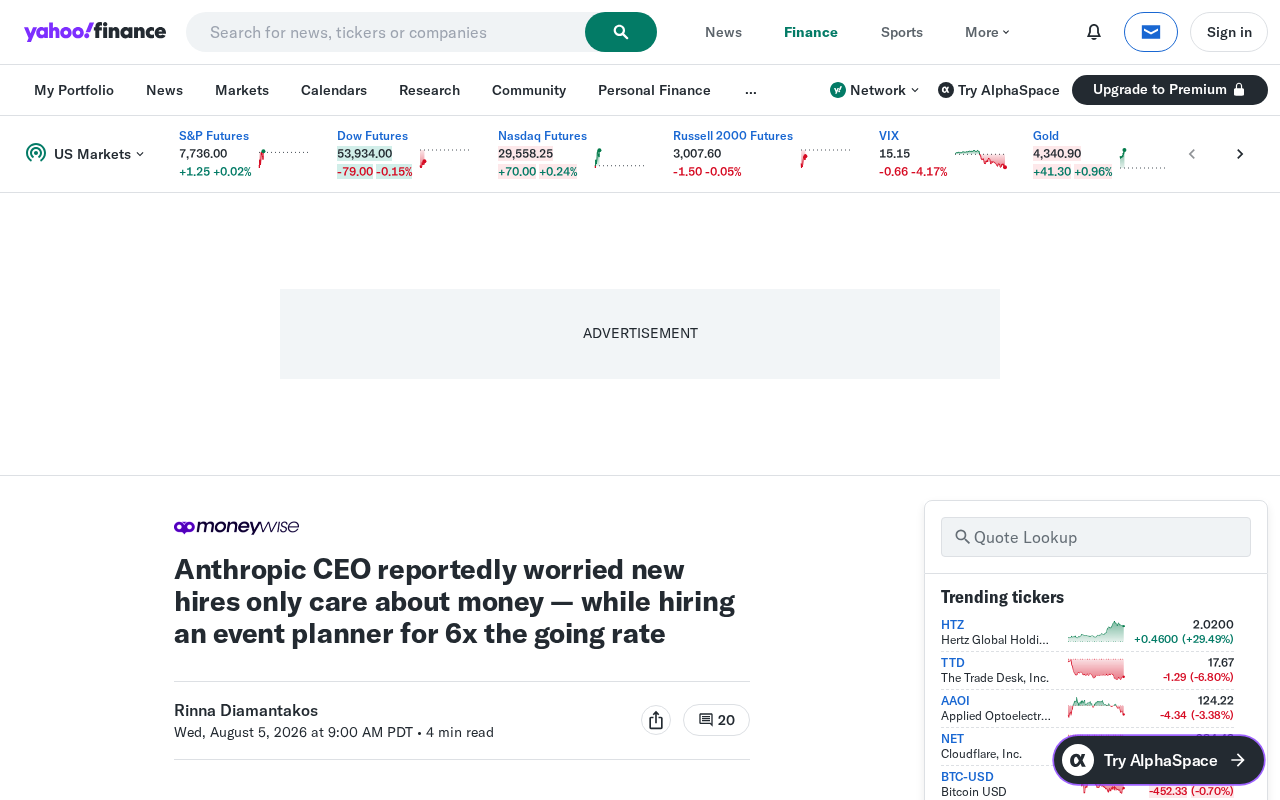
Anthropic CEO Worries New Hires Only Care About Money: The Mission Crisis Amid the AI Talent Bubble

Anthropic's CEO fears new hires prioritize pay over AI safety, exposing the mission-driven scaling paradox in AI's talent bubble.
Anthropic CEO Dario Amodei has raised concerns that new employees care more about compensation than the company's AI safety mission. Against the backdrop of an overheated AI talent market—where top researchers command tens of millions in total compensation—this reflects a structural tension all mission-driven companies face when scaling. The article examines the AI compensation arms race, the historical pattern of cultural dilution in growing tech companies, divided community reactions, and what this signals about potential bubble dynamics in the AI industry.
A Telling Signal from the Industry
According to reports from international media, Anthropic CEO Dario Amodei recently expressed an internal concern: an increasing number of new hires seem to care only about compensation, rather than the company's AI safety mission. The news sparked heated discussion on tech communities like Hacker News, accumulating a large volume of comments in short order—reflecting the deep contradictions within the AI industry's current talent market.
As a company built around the core philosophy of "developing AI responsibly," Anthropic was founded in 2021 by siblings Dario Amodei and Daniela Amodei, with a core team composed largely of former OpenAI research vice presidents and senior researchers. Their departure from OpenAI was directly triggered by disagreements over GPT-3's commercialization path and OpenAI's shift from a nonprofit to a "capped profit" structure. Anthropic's flagship technical concept is "Constitutional AI"—guiding and constraining AI system behavior through an explicit set of principles, rather than relying solely on Reinforcement Learning from Human Feedback (RLHF). The company's Claude model series has become one of GPT-4's primary competitors, with Anthropic's valuation exceeding tens of billions of dollars as of 2024, though it has consistently emphasized its status as a Public Benefit Corporation.
When the leader of a company that uses "mission-driven" as a key differentiator from competitors starts worrying about new employees' motivations, the underlying issues are far more complex than a simple complaint.
Sky-High Compensation Is Reshaping the AI Talent Market
This concern is far from unfounded. Over the past year-plus, the battle for AI talent has reached a fever pitch. From Meta offering tens of millions or even over a hundred million dollars to poach top researchers, to major labs continuously raising compensation baselines to compete for scarce talent, the industry's salary levels have been pushed to unprecedented heights.
Compensation structures for top AI talent have far exceeded traditional tech industry norms. Several key factors drive these salary levels: first, researchers with large-scale language model pre-training experience number only a few hundred globally, making supply extremely scarce; second, major tech giants view AI as the strategic high ground that will determine their fate over the next decade, and are willing to spare no expense to lock in talent; third, massive venture capital flowing into AI startups has enabled even small companies to offer compensation approaching that of big tech. This "arms race" for talent has pushed the base salary for ordinary senior machine learning engineers into the $500,000–$800,000 range, while total annual compensation packages (including equity) for top research scientists can reach tens of millions of dollars.
In this market environment, AI professionals—especially machine learning engineers and research scientists with scarce skills—naturally view compensation as a significant factor in career decisions. When a candidate can freely choose among multiple top-tier labs, and the difference between offers amounts to millions of dollars, the weight of "mission alignment" on the decision-making scale inevitably diminishes.
From this perspective, Amodei's concern is fundamentally a structural problem: when capital floods in and a compensation bubble inflates, any company trying to screen talent through "idealism" will face the same dilemma.
The Tension Between Mission and Commercial Reality
Anthropic's Identity Positioning Challenge
Since its founding, Anthropic has positioned itself as a "more safety-focused" AI company. Its founding team left OpenAI largely due to disagreements over AI safety and governance philosophy. As a result, the company has long preferred hiring people who share its long-term vision and are willing to dedicate themselves to AI safety.
Understanding why Anthropic places such emphasis on employees' mission alignment requires understanding the unique nature of AI safety research. AI Alignment research aims to ensure AI systems' behavior remains consistent with human intent and values—a fundamental problem that remains unsolved. Unlike purely pursuing model performance (such as accuracy or inference speed), safety research often requires researchers to proactively impose constraints on models, forgo certain capability improvements, or even delay product releases. This means that if team members lack intrinsic commitment to the safety mission, they may tend to "cut corners" in daily work—prioritizing performance metrics while neglecting safety constraints. This risk is particularly acute given the rapid advancement of AI capabilities, as a single insufficiently cautious decision could produce unforeseeable consequences.
However, as the company scales and fundraising amounts climb (Anthropic has secured billions of dollars in investment from giants like Google and Amazon), it inevitably must compete with OpenAI, Google DeepMind, Meta, and others in the same talent pool. When the primary competitive weapon becomes compensation, relying on "mission" alone can hardly sustain the attraction of a sufficient scale of top talent.
Can Idealism Scale?
Here lies a profound paradox: a small, elite startup team can perhaps be composed entirely of idealists, but when a company needs to expand to hundreds or thousands of people, relying purely on mission alignment for recruitment becomes nearly impossible. The cost of scaling is often the dilution of values.
Mission-driven companies encountering cultural dilution during scaling has abundant precedent in the tech industry. Early Google adopted "Don't Be Evil" as its creed, attracting a wave of idealistic engineers, but as the company expanded to over 100,000 employees, the motto gradually became ceremonial and was ultimately removed from its code of conduct in 2018. SpaceX's early team was willing to work at below-market compensation because the mission of "sending humans to Mars" provided enormous psychological motivation, but as the company achieved commercial success, it too had to increase compensation competitiveness. Academic research refers to this phenomenon as the "mission discount"—the salary discount employees are willing to accept for a mission they believe in is typically 10–20%, but when market premiums exceed this threshold, the mission's appeal diminishes significantly.
Amodei's concern is, to some extent, the classic challenge every "mission-driven" tech company encounters during growth—how to maintain early cultural purity while rapidly scaling.
Community Discussion: A Collision of Diverse Perspectives
In the Hacker News discussion, the community displayed clear divisions of opinion.
Some voices expressed understanding of Amodei's concern, arguing that a company bearing the responsibility of AI safety genuinely needs higher value alignment among its employees—otherwise, when conflicts arise between commercial interests and safety principles, the team might make the wrong choices.
But a considerable number of comments challenged this attitude. They pointed out that expecting employees to "not care about money" is itself somewhat idealistic or even hypocritical—especially when company executives and investors are reaping enormous returns from the AI boom, asking ordinary employees to prioritize "mission" seems somewhat inequitable. Some directly stated: in today's high-cost-of-living environment (particularly in San Francisco, where Anthropic is headquartered and median home prices exceed $1.3 million), caring about compensation is an entirely reasonable concern, and equating it with "lacking a sense of mission" amounts to moral coercion.
Other comments analyzed the situation from a more macro perspective, arguing this is precisely a typical symptom of the AI bubble: when capital floods into a field, talent naturally gravitates toward the highest bidder—this is market dynamics, not a matter of personal virtue.
What This Means for the AI Industry
Bubble Signal or Normal Competition?
Regardless of how one views Amodei's remarks, they provide a window into the current health of the AI industry. Sky-high compensation, frenzied poaching, and talent inflation—these phenomena are both manifestations of industry prosperity and potential signs of bubble accumulation.
Looking back at tech history, irrational exuberance in talent markets has often accompanied bubbles. During the peak of the 2000 dot-com bubble, Silicon Valley programmer salaries skyrocketed, with fresh graduates receiving six-figure signing bonuses and generous stock options; during the 2021 cryptocurrency frenzy, blockchain engineers commanded a compensation premium 2–3 times that of traditional software engineers. The common characteristic of these bubbles is that capital inflows far outpace the growth of talent supply, causing compensation to decouple from fundamentals. After bubbles burst, compensation typically reverts to the mean. Whether the current AI field is in a similar phase remains debatable, but a rising proportion of practitioners "in it for the money" is indeed a common signal across historical bubbles. Notably, total venture capital investment in AI between 2022–2024 has exceeded $100 billion—a figure far surpassing any other technology sector during the same period.
Implications for Corporate Culture Management
For all rapidly expanding AI companies, this incident offers important management lessons: how to find a balance between compensation competitiveness and cultural alignment, and how to design incentive mechanisms that keep employees' personal interests aligned with the company's long-term mission, will be key factors determining whether these companies can go the distance.
Simply complaining that employees "only care about money" does nothing to solve the problem. A truly effective approach might involve more transparent communication of values, more thoughtful long-term incentive design (for example, tying equity vesting to safety research milestones rather than purely commercial metrics), and precise screening during recruitment—building a team that is both capable and mission-aligned. Some organizational behavior research suggests that when employees feel their work is genuinely producing positive social impact—rather than merely being sloganeering—mission alignment transforms into lasting intrinsic motivation.
Conclusion
Amodei's concern may appear to be a CEO complaining about employee motivations, but it actually reveals a deeper question beneath the AI golden age: when technology's commercial value is infinitely amplified and capital floods in at unprecedented scale, how much room remains for idealism?
For a company like Anthropic that flies the banner of safety and mission, this question is particularly sharp. It concerns not only recruitment strategy but whether the company can hold its ground between commercial pressure and its founding vision. And for the industry as a whole, this may be a signal worth heeding—when everyone is chasing money, does anyone still remember why they set out in the first place?
Related articles
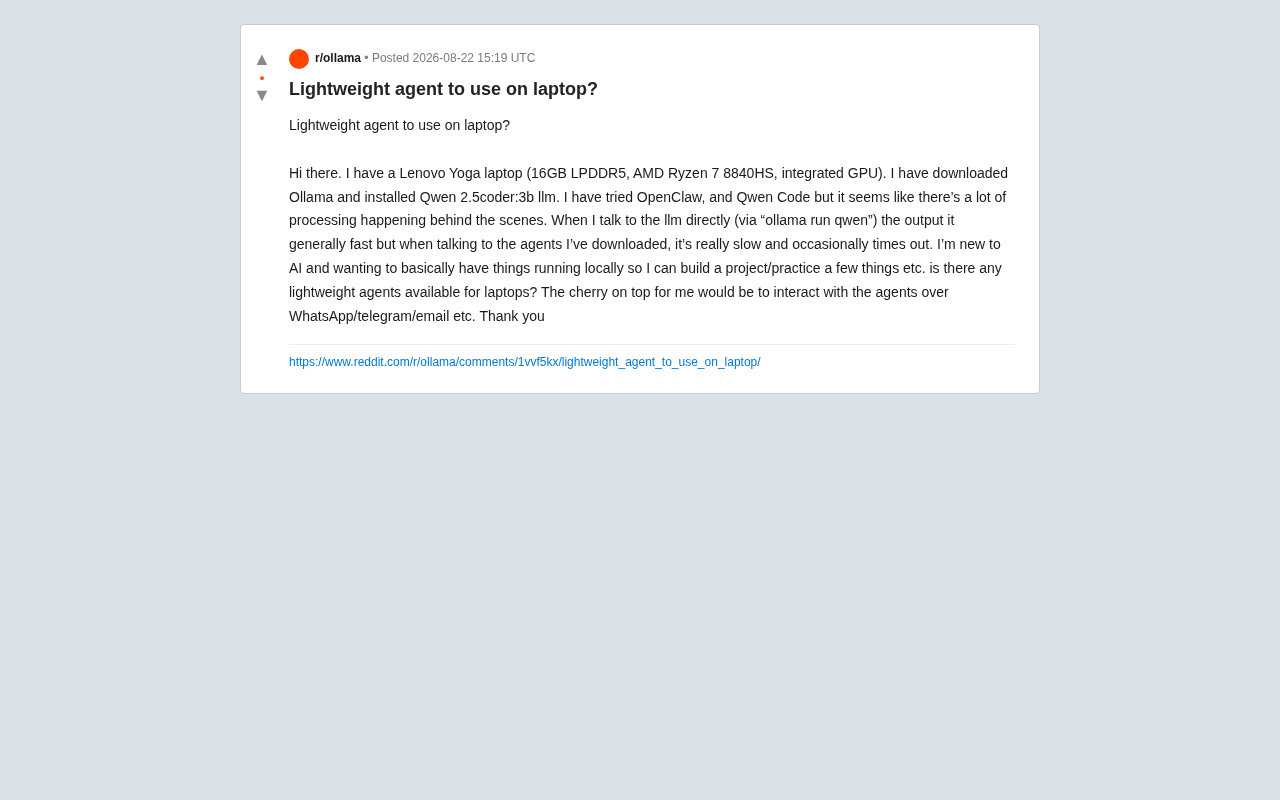
Local AI Agent Deployment Too Slow? A Lightweight Optimization Practical Guide
Local AI Agent deployment slow and timing out? This guide covers Agent framework overhead, hardware bottlenecks, and practical optimizations including context trimming, quantization, and Telegram Bot integration.

Choosing a Laptop for AI Studies: MacBook vs NVIDIA Laptop — An In-Depth Comparison Guide
In-depth analysis for AI students choosing laptops: MacBook Air M5 with remote GPU vs NVIDIA laptop, comparing CUDA support, portability, battery life, and value.

Self-Hosted LLM Tech Stack: A Complete Guide to Managing Your Local AI Cluster from the Terminal
A deep dive into self-hosting LLM tech stacks: inference engines, model management, vector databases, and how to manage your local AI cluster from the terminal.