Anthropic Confidentially Files for IPO, Plans to List on Nasdaq Under Ticker ANT

Anthropic confidentially files an S-1 to list on Nasdaq under ticker ANT, racing ahead of OpenAI to become the first publicly listed frontier AI lab.
Anthropic has confidentially submitted an S-1 to the SEC to list on Nasdaq under ticker "ANT," potentially beating OpenAI to become the first frontier AI lab to go public. The article analyzes the confidential submission mechanism, the "revolutionize every area of human endeavor" narrative, and the potential impacts on the AI industry, while noting that offering size, valuation range, and underwriters remain undisclosed.
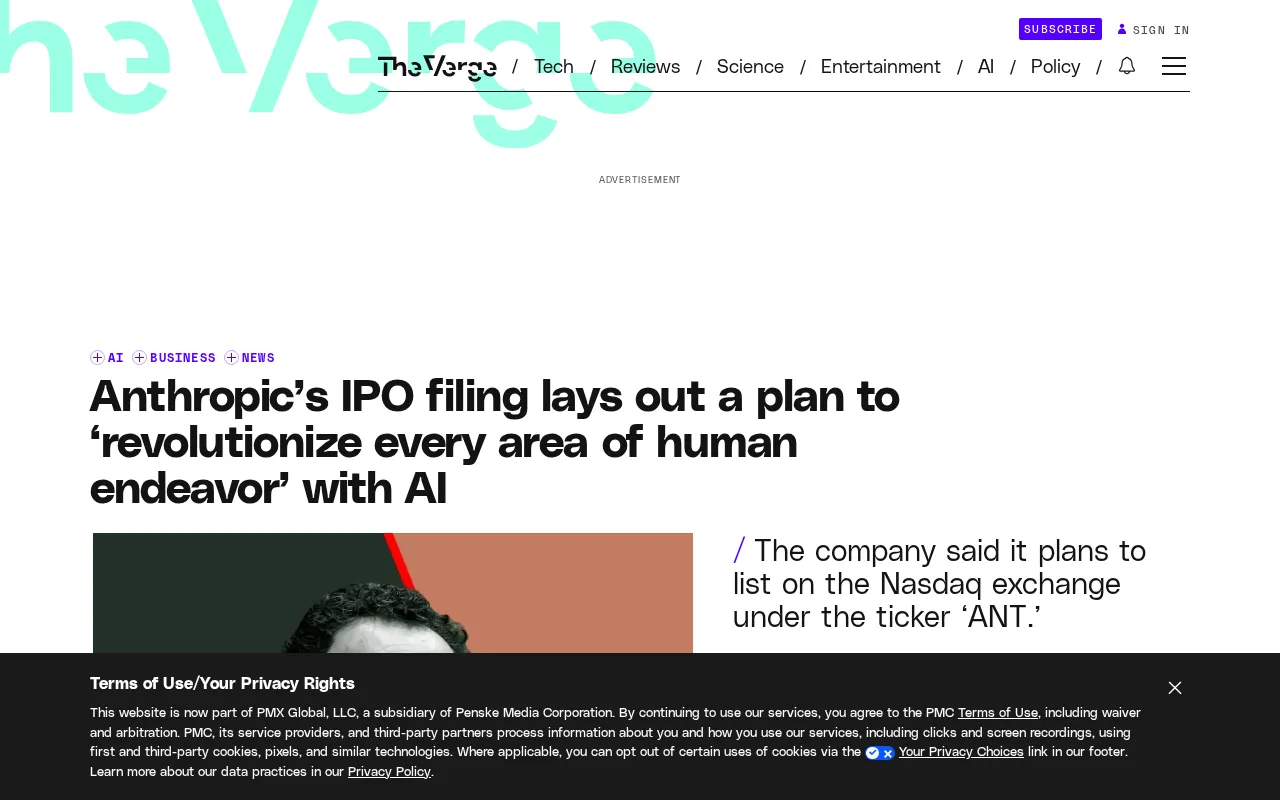
Anthropic has officially taken a key step toward going public. The AI company behind the Claude model series has confidentially submitted an S-1 registration statement to the U.S. Securities and Exchange Commission (SEC), planning to list on Nasdaq under the ticker "ANT." If all goes smoothly, Anthropic will complete its IPO ahead of OpenAI, becoming the first leading player in the new wave of large-model competition to enter the public capital markets.
An IPO Race Against Time
According to disclosed information, Anthropic is using the "confidential submission" approach. This mechanism allows a company to engage in multiple rounds of non-public communication with the SEC before officially publishing its prospectus, and to release it only after financial statements, risk disclosures, and other details have been refined. For an AI company still in a period of heavy investment, this approach both locks in the IPO timeline early and avoids prematurely exposing core financial data.
Even more intriguing is the competitive dimension. OpenAI has repeatedly signaled its intent to go public but has yet to take substantive action. By moving first, Anthropic hopes to occupy the mental position of "the first publicly listed frontier AI lab" in the capital markets. In an industry that requires continuous heavy spending on large-model training, whoever gains access to public-market financing sooner holds an extra card in the compute arms race.
An S-1 is a securities registration statement filed under the U.S. Securities Act of 1933. It is the core document a company submits to the SEC when initiating the IPO process in the United States, covering business description, risk factors, financial statements, management discussion, equity structure, and use of proceeds. A company can only conduct roadshows, accept subscriptions, and ultimately list for trading after the SEC declares the S-1 effective. A companion 424B filing specifies the offering price, underwriters, and number of shares. For ordinary investors, the S-1 is also the most authoritative and complete public material for understanding a company's true operating condition.
"Confidential submission" is a mechanism introduced by the 2012 JOBS Act and later expanded to various types of issuers, allowing companies to privately submit a draft registration statement to the SEC for review comments before officially filing. Its benefits include resolving accounting, disclosure, and compliance issues under confidentiality, avoiding premature exposure of competitively sensitive information, and retaining the option to withdraw or not go public midway through the process. The official public version is typically released about 15 days before the roadshow begins, at which point core financial data becomes fully public.
"Revolutionize Every Area of Human Endeavor": Ambition Written Into the Prospectus
The original report noted that Anthropic positioned itself in the filing as aiming to use AI to "revolutionize every area of human endeavor." This is not casual PR rhetoric but part of the prospectus narrative: it seeks to explain to potential investors that Claude is not merely a chatbot but general-purpose infrastructure for enterprises, developers, and knowledge workers.
Based on the typical structure of an S-1, such statements usually appear alongside market opportunity (TAM), product roadmap, and commercialization path. Anthropic needs to answer a core question in the filing: amid strong rivals like OpenAI and Google, what justifies a sustained growth premium? Writing "revolutionize every area" into the prospectus is essentially laying the groundwork for a high-valuation story.
TAM (Total Addressable Market) is a common market-opportunity quantification metric in prospectuses. Companies use it to estimate the total demand their products could theoretically cover, thereby supporting the growth story. For AI companies, the definition of TAM is often highly flexible: it can be calculated based on the traditional software market, or it can encompass knowledge work, developer tools, and even broader enterprise services. When reading, investors typically focus on whether the TAM calculation methodology is reasonable and the company's current penetration rate relative to this vast market, because an overly broad TAM is easily seen as padding the valuation narrative.
What Confidential Submission Means
Confidential submission does not equal an immediate listing. The company still needs to complete SEC review, publish the prospectus, conduct a roadshow and price the offering, and go through a series of other processes. For Anthropic, choosing to initiate the process now may be related to several practical factors: large-model training costs remain high, private financing cannot fully match expansion needs, and public markets can provide more sustained capital supply and greater brand exposure.
Another signal that should not be overlooked is the ticker "ANT." Short, memorable, and strongly associated with the company name, such tickers typically indicate that a company wants to establish clear capital-market recognition. For an AI brand serving enterprise customers, going public is itself a large-scale endorsement of trust.
Potential Impact on the AI Industry Landscape
If Anthropic successfully goes public, it will establish a valuation anchor for the entire frontier AI sector. Previously, outsiders' valuations of leading AI companies mostly came from primary-market financing rounds, lacking daily pricing from public markets. Once tradable shares exist, investors' scrutiny of AI companies' profitability, cash-burn rate, and gross margins will become more stringent, and this pressure will also be transmitted to unlisted competitors.
For OpenAI, a competitor's earlier IPO could create a kind of "first-mover advantage"—an earlier public shareholder base, earlier inclusion in index funds, and earlier establishment of analyst coverage. These seemingly technical factors will gradually amplify in long-term capital competition.
Of course, going public also means stricter disclosure obligations. Anthropic will need to publicly disclose in quarterly reports data previously kept behind the scenes, such as revenue structure, customer concentration, and compute costs. For a company whose core philosophy is "safety" and "responsible AI," how to balance commercial growth and mission narrative under public scrutiny will be a long-term challenge after listing.
A valuation anchor refers to a pricing benchmark provided by public markets for a certain class of assets that can be continuously observed and compared. Before Anthropic's IPO, valuations of frontier AI companies mainly came from primary-market financing rounds, negotiated by a small number of institutional investors, with low price-update frequency and limited transparency. Once tradable shares exist, multiples such as price-to-earnings and price-to-sales ratios will become reference points for analysts and investors to measure the entire sector, and will also be used to price financing for unlisted companies. This anchoring effect may both raise peers' valuation expectations and lower the sector's overall premium due to strict public-market scrutiny.
Key Information Yet to Be Revealed
Currently disclosed content remains limited. Key details such as the full prospectus, offering size, valuation range, and underwriter list have not been made public. Information at the confidential submission stage usually includes only the company's basic intentions; the true financial picture will only become clear after the public version of the S-1 is released.
What is certain is that Anthropic has turned its IPO from "rumor" into "process." At a stage when the AI industry is shifting from a technology race to a capital race, the significance of this step should not be underestimated.
One-line Summary
Anthropic confidentially files S-1 to list on Nasdaq, racing ahead of OpenAI to become the first publicly listed AI lab.
Paragraph Summary
Anthropic has confidentially submitted an S-1 prospectus to the SEC, planning to list on Nasdaq under the ticker "ANT," and is expected to become the first frontier AI lab to enter public markets ahead of OpenAI. The article notes that the confidential submission mechanism allows the company to communicate privately with the SEC first, lock in the IPO timeline, and avoid prematurely exposing core financial data. The prospectus uses the narrative of "revolutionizing every area of human endeavor" to lay the groundwork for a high valuation. If the IPO succeeds, Anthropic will provide a public-market valuation anchor for the AI industry and increase capital pressure on competitors, but it will also face stricter disclosure obligations. Key information such as offering size, valuation range, and underwriters has not yet been made public.
Related articles

semanticfa: An R Package for Response-Free Semantic Factor Analysis
Introducing the semanticfa R package: a language-model-embedding-based semantic factor analysis tool that analyzes psychometric scale structure without respondent data, supporting factor interpretation, redundant item flagging, and short-form construction, complementing traditional factor analysis.

Hidden Risks in Fine-Tuning Data? SimpleLoRIF Uses Gradient Tracing to Safeguard Against Safety Degradation
SimpleLoRIF uses gradient embeddings to identify seemingly harmless fine-tuning samples that induce safety degradation, enabling million-scale data filtering and building SafeTulu to reduce GCG attack success rates by up to 22%, outperforming LLM-as-a-judge.

ThinkWorld: A VLA Framework that Reinforces Dynamic Chain Reasoning with World Imagination
ThinkWorld introduces Chain-of-Dynamics (CoD) representation and imagination reinforcement learning, unifying human videos and robot experience in one action reasoning space to improve VLA model generalization.