Anthropic Copyright Settlement Payouts: Have Authors Actually Received Their Money?
Anthropic copyright settlement authors still await payouts, highlighting transparency issues in AI copyright compensation.
An author posted on Reddit that their work was included in the Anthropic copyright settlement, which announced payouts as early as September 2026, but they still haven't received money—only ongoing email updates. The post raises the broader question of whether creators can actually get paid after AI companies reach class settlements over copyrighted works. The article explains that distribution involves claims review, objections, court approval, fund custody, and allocation, often taking over a year; announced timelines are estimates, not guarantees. No community feedback confirms payment yet, and creators are advised to check claim status, correct information, and keep confirmation numbers.
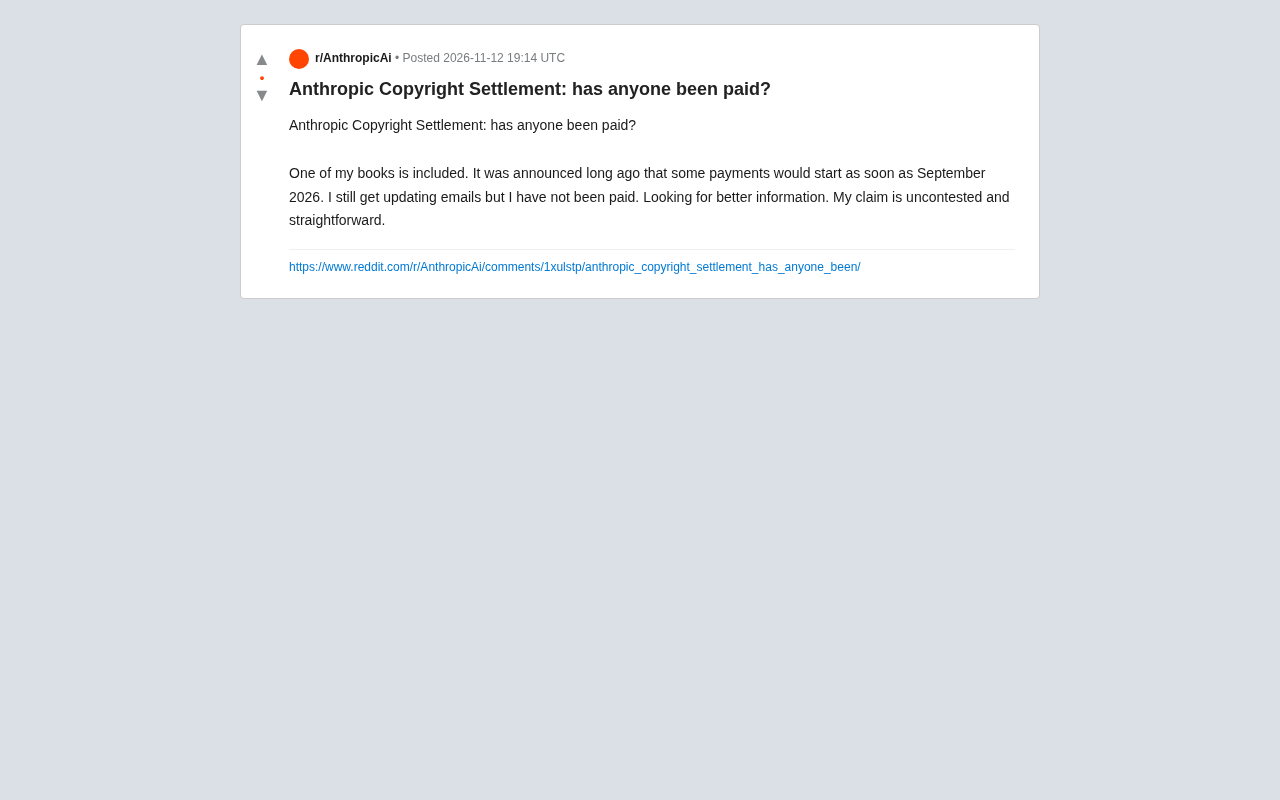
An author posted on Reddit asking: their book was included in the Anthropic copyright settlement, and earlier announcements said some payments would begin as early as September 2026—but they still haven't received any money, only ever-updating email notifications. The author's claim is undisputed and the process is simple, yet they're still stuck waiting. The post quickly drew attention because it touches on a broader question: when AI companies are hit with class-action lawsuits over their use of copyrighted works and reach settlements, can creators actually get paid?
Why settlement payouts are slow to arrive
From the post's description, the author's only source of information is official email updates, with no more transparent way to check progress. This isn't an isolated case. In large copyright class settlements, fund distribution typically goes through multiple stages—claims review, objection handling, final court approval, fund custody, and allocation—each of which can take months or longer. Even when announcements give a time window like "as early as September 2026," it's usually an estimate, not a commitment.
More importantly, many authors don't know what stage their claim is at. Official emails typically only say "processing," without providing real-time status for individual cases. This information asymmetry breeds anxiety and makes "has anyone actually received money" a recurring question in the community.
A class action settlement is a common dispute resolution mechanism in U.S. law: when a large number of individuals are harmed by the same conduct, representative plaintiffs can file suit, and once the settlement agreement is approved by the court, it applies to all eligible class members. Compensation funds are typically deposited by the defendant into a settlement fund, then distributed by a court-appointed trustee or claims administrator based on claims review results. The entire process is governed by Rule 23 of the Federal Rules of Civil Procedure and requires notice, claim submission, an objection period, and final court approval—so from settlement announcement to actual payment often spans more than a year.
Community feedback and multi-source verification
Under the original Reddit post, no replies explicitly stated they had received payment. However, discussion around this settlement continues across multiple platforms. According to prior analyses by Bilibili creators and YouTube channels, settlement fund distribution tends to prioritize complete, undisputed claims, but the overall process is still constrained by the custodian's pace of work. These analyses generally conclude that the timelines in early announcements are more "earliest possible" than "guaranteed payment."
Cross-referencing, the consensus is: settlement payouts are indeed progressing, but the timing of individual payments remains highly uncertain. The disagreement lies in explanations for the delay—some believe it's mainly administrative red tape, while others speculate that the fund custodian is waiting for more claims to be confirmed before initiating batch payments. Without granular official data, neither explanation can be fully verified.
The Anthropic copyright settlement stems from a group of authors alleging that the company used copyrighted books and other works to train its large language models. Core issues in such cases typically include: whether training data constitutes "fair use," whether works were reproduced in full, and how the class members are defined. A settlement does not equal an admission of infringement; it's a compromise reached by both parties to avoid litigation uncertainty. The size of the settlement, the categories of works covered, and the eligibility conditions for claims all affect how much each rights holder can ultimately receive—and determine the workload for review and distribution.
How creators should follow up
For creators like the original poster whose claims are undisputed, passively waiting for email updates isn't the only option. You can proactively check your claim status through the settlement's administration website or officially designated channels, and confirm that your personal information and payment method are complete and accurate. If you find missing information, correcting it promptly often prevents getting stuck in the final distribution stage.
At the same time, keep all claim-related emails and confirmation numbers so you can make inquiries when needed. Some authors in the community also suggest following the court's final approval documents and the custodian's announcements, which typically explain the distribution timetable and batching logic.
A claims administrator is typically a third-party entity appointed by the court, responsible for issuing notices, receiving and reviewing claims, handling objections, and ultimately distributing funds. Its official website generally provides a claim status lookup portal where authors can log in with their confirmation number or registered email. If website information is limited, you can also consult the court's public case records (such as the PACER system) for documents like the settlement agreement, final approval order, and distribution plan, which specify the distribution timetable and batching logic. Keeping all emails and confirmation numbers is key evidence when later inquiring with the administrator or class counsel.
Implications for the AI copyright ecosystem
The significance of this settlement goes beyond individual payouts. It is drawing a practical boundary around the use of AI training data: when models use copyrighted works, rights holders can claim compensation. But the efficiency of enforcement directly affects creators' trust in this mechanism. If the distribution process remains opaque for a long time, even if money is eventually received, it may undermine the credibility of the settlement.
From an industry perspective, settlements between AI companies and copyright holders will only increase, and designing more transparent, more trackable compensation distribution mechanisms will become an unavoidable issue. For creators, understanding the process and proactively following up is the most practical approach right now.
One-line Summary
Anthropic copyright settlement authors still haven't received payouts, reflecting transparency issues in AI copyright compensation enforcement.
Paragraph Summary
An author posted on Reddit that their work was included in the Anthropic copyright settlement, which announced payouts would begin as early as September 2026, but they still haven't received money—only ever-updating email notifications. The post drew attention because it touches on whether creators can actually get paid after AI companies reach class settlements over copyrighted works. The article analyzes that settlement distribution requires claims review, objection handling, court approval, fund custody, and allocation—taking months or longer—and announced time windows are mostly estimates, not commitments. No community feedback explicitly confirms payment, and multi-source analyses suggest distribution is progressing but individual timing is uncertain. Creators can proactively check claim status, correct information, and keep confirmation numbers. The settlement also highlights transparency issues in AI training data copyright compensation enforcement.
Related articles

Claude Code Pitfall Guide: Using CC Switch to Avoid Account Ban Risks
Claude Code installation failing in China? A Bilibili creator shares a stable NPM install + CC Switch login-bypass solution with no bans for months, plus spec-driven development and project memory to keep code from getting messier with each change.

Claude Code Ban Prevention and Memory Management: CLAUDE.md and ccswitch in Practice
How to avoid account bans when using Claude Code in China? This article summarizes a Bilibili creator's tested approach: install via NPM to bypass network restrictions, use ccswitch to bypass official account login, and covers CLAUDE.md project memory, MCP, Skills, Hooks, and other specification constraint practices.

Microsoft Foundry: How Enterprises Can Keep Runaway AI Costs Under Control
Microsoft Foundry, part of Azure, offers built-in security and governance with a unified view of model counts, credit usage, and total spend—helping enterprises prevent runaway AI agent token costs. This article analyzes its enterprise positioning, use cases, and cost-control value.