Anthropic Dynamic Workflows: A New Paradigm for Claude Agent Collaboration

Anthropic uses Unix-inspired dynamic workflows to coordinate multiple Claude agents on complex tasks.
At AI Engineer New York, Anthropic introduced dynamic workflows inspired by Unix philosophy, letting multiple specialized Claude agents collaborate on large projects. A workflow engine dynamically handles task decomposition, agent routing, and result aggregation, so developers only define high-level goals. Trialed internally for code migration and documentation, it reduces cognitive load but raises debugging complexity and token costs. Simple tasks still suit single agents; dynamic workflows fit multi-step, multi-tool scenarios and hint at an early "Agent OS."
Anthropic Dynamic Workflows: A New Paradigm for Claude Agent Collaboration
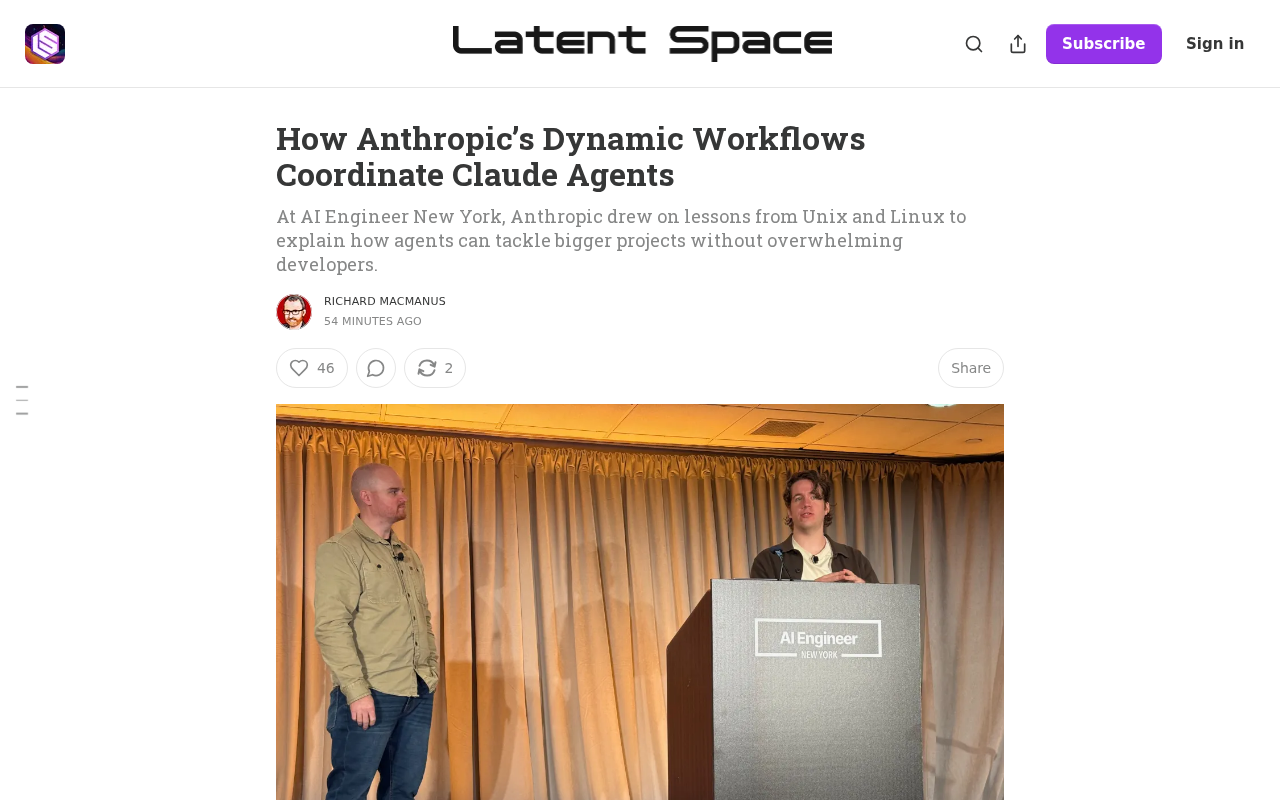
At the AI Engineer New York conference, Anthropic shared how it borrowed design philosophies from Unix and Linux to let multiple Claude agents collaboratively handle complex projects without drowning developers in management overhead. This Dynamic Workflows approach offers a new way to engineer Multi-Agent Systems for real-world deployment.
From Unix Philosophy to Agent Collaboration
Anthropic's core idea is this: no matter how capable a single agent becomes, it will still hit context window limits and excessive task coupling when facing large projects. Rather than endlessly scaling up a single model, it's better to let multiple specialized agents each handle their own domain, coordinated through dynamic workflows.
This approach is clearly inspired by Unix pipelines—each small tool does one thing, and powerful functionality emerges from composing them through standard interfaces. Anthropic maps this principle onto Claude agents: each agent has a specific role and toolset, and a workflow engine orchestrates the dependencies between them.
Context Window refers to the maximum number of tokens a large language model can process in a single inference, including both input prompts and output content. When a project's codebase, documentation, or conversation history exceeds this limit, the model loses earlier information, degrading reasoning quality. The multi-agent approach works around single-model window limits by splitting tasks across different agents, so each agent only carries the local context relevant to its role. This is one of the technical motivations behind Anthropic's emphasis on "not endlessly scaling a single model."
How Dynamic Orchestration Works
Unlike static DAGs (Directed Acyclic Graphs), dynamic workflows allow subsequent steps to be adjusted at runtime based on intermediate results. For example, a code generation task might first have a planning agent break down requirements, then dynamically decide how many coding agents to invoke and whether a code review agent needs to step in.
This "orchestration layer" handles three things: task decomposition, agent routing, and result aggregation. Developers only need to define high-level goals without manually specifying the invocation order of each agent. Anthropic emphasizes that this significantly reduces developers' cognitive burden while improving the system's adaptability to uncertain tasks.
DAG (Directed Acyclic Graph) is a common modeling approach for static workflows: nodes represent tasks, directed edges represent dependencies, and cycles are not allowed. Developers must fix all steps and dependencies before execution, making it hard to handle new requirements that only emerge during runtime. Dynamic workflows defer some orchestration decisions to runtime, determining which agents to invoke next and how many branches to parallelize based on the actual output of previous agents. This "execute first, decide later" pattern is closer to the Actor model or reactive systems, at the cost of some predictability, requiring more robust logging and observability to support.
What It Means for Developers
According to Anthropic's presentation at the conference, dynamic workflows have already been trialed internally in scenarios like code migration and documentation generation. The main benefit reported by developers is no longer needing to write explicit control logic for every edge case—the workflow engine automatically handles handoffs between agents.
However, this approach also introduces new debugging challenges—when multiple agents work in parallel, error attribution becomes more complex. Anthropic recommends keeping independent logs and intermediate artifacts for each agent to enable tracing.
The Boundaries of Multi-Agent Collaboration
Anthropic doesn't claim dynamic workflows are a panacea. At the conference, they candidly noted that for simple tasks, a single Claude call is still more efficient. Dynamic workflows are better suited for scenarios requiring multi-step reasoning and multi-tool coordination, such as large codebase refactoring or cross-modal content generation.
Another key limitation is cost: parallel agents mean more token consumption. Anthropic recommends developers dynamically enable agent counts based on task complexity to avoid over-orchestration.
Token cost is the billing and budgeting unit for large language model inference. Calling multiple agents in parallel means input context gets sent repeatedly and intermediate results get passed around multiple times, with token consumption typically growing approximately linearly—or even faster—with the number of agents. Add to that the fact that each agent often needs to carry role prompts, tool descriptions, and history, and the actual overhead can far exceed a single call. That's why Anthropic recommends dynamically starting and stopping agents based on task complexity: use a single call for simple tasks, orchestrate multiple agents only for complex ones, and treat token budget as a first-class workflow constraint during design.
Outlook: The Embryonic Agent Operating System
From Unix to Kubernetes, every abstraction upgrade in computing has followed a similar path: first independent processes, then schedulers, and finally operating systems. Anthropic's dynamic workflows may well be an early form of an "Agent Operating System."
If this direction holds, future developers may no longer write business logic directly, but instead design collaboration rules between agents. This is both an opportunity and a reshaping of existing software engineering practices.
Agent OS is an analogous concept referring to an abstraction layer that provides unified scheduling, communication, resource allocation, and lifecycle management on top of multiple agents. Just as an operating system hides the details of CPU, memory, and I/O, an Agent OS aims to hide routing, retries, context passing, and error recovery between agents. Unix provided processes and pipes, Kubernetes provided Pods and schedulers, and an Agent OS might provide standardization of roles, tools, and collaboration protocols. Anthropic's dynamic workflows are currently closer to the "scheduler" stage, with gaps remaining in observability, security, permissions, and cross-vendor interoperability before reaching a full operating system.
One-line Summary
Anthropic borrows from Unix philosophy to coordinate multiple Claude agents through dynamic workflows for complex tasks.
Paragraph Summary
At AI Engineer New York, Anthropic proposed a dynamic workflows approach inspired by Unix's "small tools composed together" philosophy, enabling multiple specialized Claude agents to collaboratively handle large projects. The workflow engine dynamically performs task decomposition, agent routing, and result aggregation at runtime, so developers only need to define high-level goals. The approach has been trialed internally for code migration and documentation generation, reducing cognitive burden but introducing debugging complexity and higher token costs. Anthropic emphasizes that simple tasks still suit single agents, while dynamic workflows fit complex scenarios requiring multi-step reasoning and multi-tool coordination—seen as an early form of an "Agent Operating System."
Related articles

Chain of Thought Isn't Just for AI: How Humans Can Use CoT to Improve Thinking Quality
Chain of Thought isn't just a prompt trick for large models. Starting from a Hacker News discussion, this article analyzes why CoT works for human thinking too, breaks down actionable ways to transfer it, and highlights the key differences between human CoT and machine CoT.
Cloudflare Teams Up with OpenAI: Closi…
Cloudflare Teams Up with OpenAI: Closing the Loop from Vulnerability Discovery to Defense with AI
Cloudflare uses OpenAI Daybreak to investigate security vulnerabilities and generate reviewable remediation plans, while developers use Codex to boost coding efficiency and quality.

Orca Multi-Agent Orchestration in Practice: A Guide to Parallel Collaboration with Claude and Codex
Orca is Stable AI's free open-source agent workbench supporting 34 agents like Claude Code and Codex in parallel. Learn its Git worktree isolation, multi-model orchestration, and mobile management.