Anthropic Executive Claims Open-Source AI Models Pose Higher Risk, Sparking Open-Source Community Controversy

Anthropic executive says open-source AI is higher risk, sparking fierce community debate over commercial motives and regulatory direction.
An Anthropic executive stated that open-source AI models pose higher risks because their weights are public and safety guardrails can be removed, especially in cybersecurity. This sparked backlash on Reddit. Open-source supporters argue transparency and auditability are the real safeguards, and closed-source models can also be jailbroken and lack external verification. Many question Anthropic's commercial motives, seeing it as an attempt to suppress fast-growing open-source rivals like Llama and Mistral. The real impact may be regulatory: if 'open-source is higher risk' becomes policy consensus, open-source models could face pre-release reviews and download thresholds, hurting academia and small developers. The rational takeaway is that both approaches have security pros and cons, and choices should be scenario-based, not camp-driven.
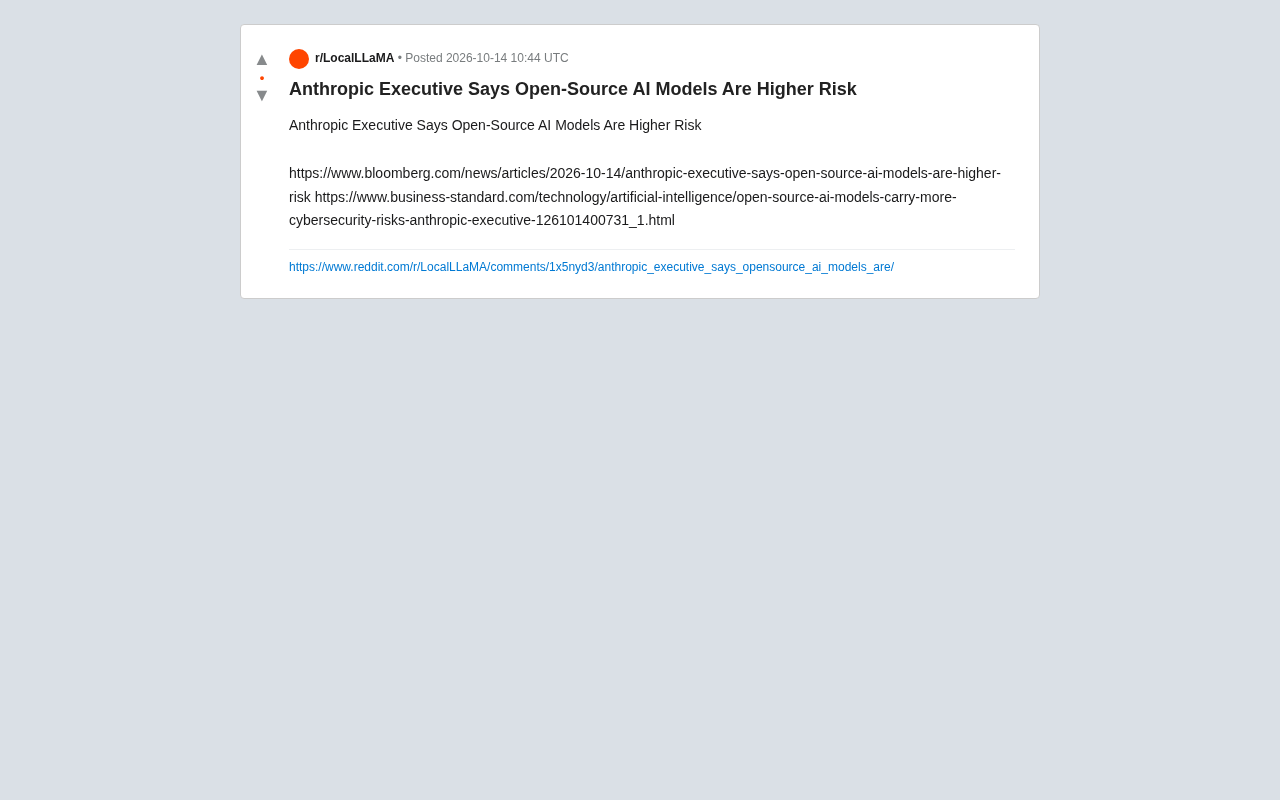
Background: The Controversial Remarks by an Anthropic Executive
According to reports from Bloomberg and Business Standard, an Anthropic executive recently stated in a public appearance that open-source AI models pose higher security risks compared to closed-source models, particularly in the cybersecurity domain. This statement quickly ignited heated discussions in communities like Reddit, with supporters and opponents each holding their ground.
As the developer of the Claude series of models, Anthropic itself operates on a closed-source business model, placing it in the same "closed camp" as giants like OpenAI and Google. Therefore, its executive's criticism of open-source models has been interpreted by many as a self-serving defense driven by commercial interests.
Core Argument: Why Open-Source Models Are Considered Higher Risk
According to the executive's core logic, open-source models have their weights and code fully public, meaning malicious actors can download and modify them, remove safety guardrails, and use them to generate malicious code, phishing emails, or automated attack tools. Closed-source models, with controlled API access, allow vendors to deploy multiple layers of security filtering and abuse monitoring on the server side.
This argument is not entirely without merit. Open-source models can indeed be fine-tuned for harmful purposes, and once weights are released, they cannot be "recalled." But logically speaking, closed-source models can also be jailbroken, and API abuse is common. The level of risk depends on the specific threat model and use case, not simply "open-source = dangerous."
Model Weights are the complete set of parameters retained by a neural network after training, essentially a file containing billions or even hundreds of billions of floating-point numbers. They determine the model's output behavior for any input. Open-source models typically refer to weight files being publicly released, allowing anyone to download, run, fine-tune, or even continue training them. Since weights cannot be recalled once released, the publisher cannot add new safety filters to already-downloaded copies after the fact. In contrast, closed-source models (such as Claude, GPT-4) only provide API interfaces; users cannot access the underlying weights, and vendors can continuously update security policies on the server side. However, it should be noted that open-source does not mean no license—many models (like the Llama series) come with terms of use, though these terms are technically difficult to enforce. The biggest controversy over public weights is that it shifts security responsibility from the vendor to society as a whole.
Jailbreak and Guardrails are key terms for understanding this debate. Guardrails refer to the refusal mechanisms formed during model training through RLHF (Reinforcement Learning from Human Feedback) or rule-based filtering, such as refusing to generate malicious code or hate speech. Jailbreaking involves carefully crafting prompts to bypass these guardrails and make the model output content that should be refused. Closed-source models also face jailbreak risks, and attack techniques (such as role-playing, encoding obfuscation, multi-turn manipulation) are continuously公开 in the community. The difference is: closed-source vendors can quickly patch new jailbreak techniques on the server side once detected, while open-source models' guardrails, once overridden by local fine-tuning, cannot be remotely repaired by the original developer. Therefore, the key variable in risk comparison is not open-source or closed-source itself, but the attacker's capabilities, the model's deployment method, and whether there is accompanying abuse monitoring.
The Open-Source Community's Pushback: Security Does Not Equal Closure
In Reddit discussions, many developers pointed out that open-source is precisely the key mechanism for improving AI safety. Open-source models allow researchers worldwide to audit code, discover vulnerabilities, and propose fixes—a transparency that simply does not exist in closed-source systems.
Some commenters gave examples: if Anthropic's Claude model has biases or security vulnerabilities, external researchers can hardly verify it and must rely on the vendor's self-reporting. Meanwhile, the open-source community has repeatedly discovered security flaws in commercial models, driving progress across the industry.
Questioning Commercial Motives
Many Reddit users直言 that the Anthropic executive's statement is essentially a commercial competitive strategy. Open-source models (such as the Llama series, Mistral, etc.) are rapidly closing the performance gap with closed-source models, posing a substantial threat to Anthropic's business model. By linking open-source with "high risk," it could influence enterprise customers' procurement decisions and the direction of regulatory policy.
Such skepticism is not unfounded. In tech history, there are numerous cases of closed-source vendors suppressing open-source competitors under the pretext of security. Microsoft once called Linux a "cancer," but ultimately had to embrace open-source.
The Llama Series and Mistral are two of the most representative projects in the current open-source large model ecosystem. Llama, released by Meta, has allowed commercial use since Llama 2, and Llama 3 further narrowed the performance gap with closed-source models like GPT-4. Mistral is a French startup known for efficient small-parameter models and an open-weight strategy; its Mixtral mixture-of-experts model approaches the level of top-tier closed-source models on multiple benchmarks. The rise of these models has changed the competitive landscape of the AI market: enterprise customers can deploy open-source models on their own servers, avoiding API call costs and data leakage risks. For companies like Anthropic whose main revenue comes from API subscriptions, every bit of performance improvement in open-source models adds replacement pressure. Therefore, when executives of closed-source vendors publicly emphasize open-source risks, outsiders naturally associate it with commercial interests, which is the direct reason for the high volume of skepticism in Reddit discussions.
Potential Regulatory Impact
The real impact of this debate may manifest at the policy level. If "open-source models are higher risk" becomes a consensus among regulators, future additional restrictions on open-source AI models could emerge, such as requiring security reviews before model release or imposing thresholds on download and use.
This would be a major blow to the open-source ecosystem. The appeal of open-source AI lies in anyone being able to freely use, modify, and distribute models, lowering the barrier to innovation. Once regulation tightens, small developers and academic institutions will bear the brunt.
AI Safety Review and Model Release Thresholds are potential policy consequences of this debate. Currently, the EU's AI Act and some U.S. state-level legislation are exploring tiered regulation of foundation models, requiring high-risk models to undergo compliance assessments before market entry. If regulators accept the judgment that "open-source models are higher risk," they may impose additional requirements on open-source models, such as: submitting safety assessment reports before release, registering downloaders with real names, or restricting the release of open weights for models above a certain parameter size. Supporters argue this can prevent malicious abuse, while opponents point out that such thresholds would severely impact academic research and small developers, because compliance costs are negligible for large companies but catastrophic for the open-source community. More subtly, if regulation targets only open-source and does not address abuse of closed-source APIs, it could instead solidify the monopoly position of big tech, running counter to policy goals of promoting innovation.
A Rational Perspective: Risk Discussion Should Not Degrade into Camp Warfare
Objectively speaking, both open-source and closed-source have their security advantages and disadvantages. Open-source excels in transparency and auditability, while closed-source excels in controlled access. A truly effective AI safety strategy should establish cross-camp collaboration mechanisms, rather than weaponizing security issues as tools for commercial competition.
For developers and enterprises, choosing between open-source and closed-source models should be based on specific application scenarios, data sensitivity, and compliance requirements, not swayed by one side's PR rhetoric.
One-line Summary
Anthropic executive says open-source AI is higher risk, sparking fierce community debate over commercial motives and regulatory direction.
Paragraph Summary
An Anthropic executive recently stated publicly that open-source AI models pose higher risks due to公开 weights and removable guardrails, especially in cybersecurity. This remark triggered strong backlash in communities like Reddit. Open-source supporters point out that transparency and auditability are the true safeguards, and closed-source models can also be jailbroken and lack external verification. Many commenters question whether Anthropic's stance is driven by commercial competition, aiming to suppress fast-catching-up open-source rivals like Llama and Mistral. The real impact of the debate may be at the regulatory level: if "open-source is higher risk" becomes a policy consensus, open-source models could face additional restrictions such as pre-release reviews and download thresholds, dealing a major blow to academic institutions and small developers. The rational conclusion is that open-source and closed-source each have security pros and cons, and choices should be based on specific scenarios rather than camp allegiance.
Related articles

JobRunner MCP Server: AI Agents Can Now Fix Failed Java Jobs
JobRunner launches an open-source MCP server enabling AI agents to view cluster status, diagnose failures, and recover Java jobs—incident response from any cloud coding environment or existing agent.

MLAI Digital Launches 9 Security Agents: MCP Server Safeguards the Full Lifecycle of Agentic AI
MLAI Digital launches Security MCP Server with nine built-in specialized security agents covering vulnerability discovery, attack simulation, prompt injection detection, API and infrastructure assessment, and accelerated remediation—embedding security validation across the full Agentic AI lifecycle from development to production.

Running Isaac Lab on H100 GPUs: Exploring Better Approaches
Exploring optimization methods for running Isaac Lab on NVIDIA H100 GPUs, including MIG configuration, mixed precision, TensorRT acceleration, and community experience to improve robotics simulation and reinforcement learning efficiency.