Anthropic Expands Cyber Verification Program: Security Experts Gain Access to More Powerful Models

Anthropic expands its Cyber Verification Program, opening flagship models to verified security experts and adding a tier for authorized offensive use cases.
Anthropic has expanded its Cyber Verification Program, allowing verified security professionals to access Claude Mythos 5.1, Opus 5.5, and Sonnet 5.5 with safeguards for defensive work. A new tier authorizes penetration testing and red team exercises. This "verification + tiering" model aims to balance model capability access with misuse risk, enabling security teams to use advanced AI while keeping dual-use offensive capabilities within a controlled framework.
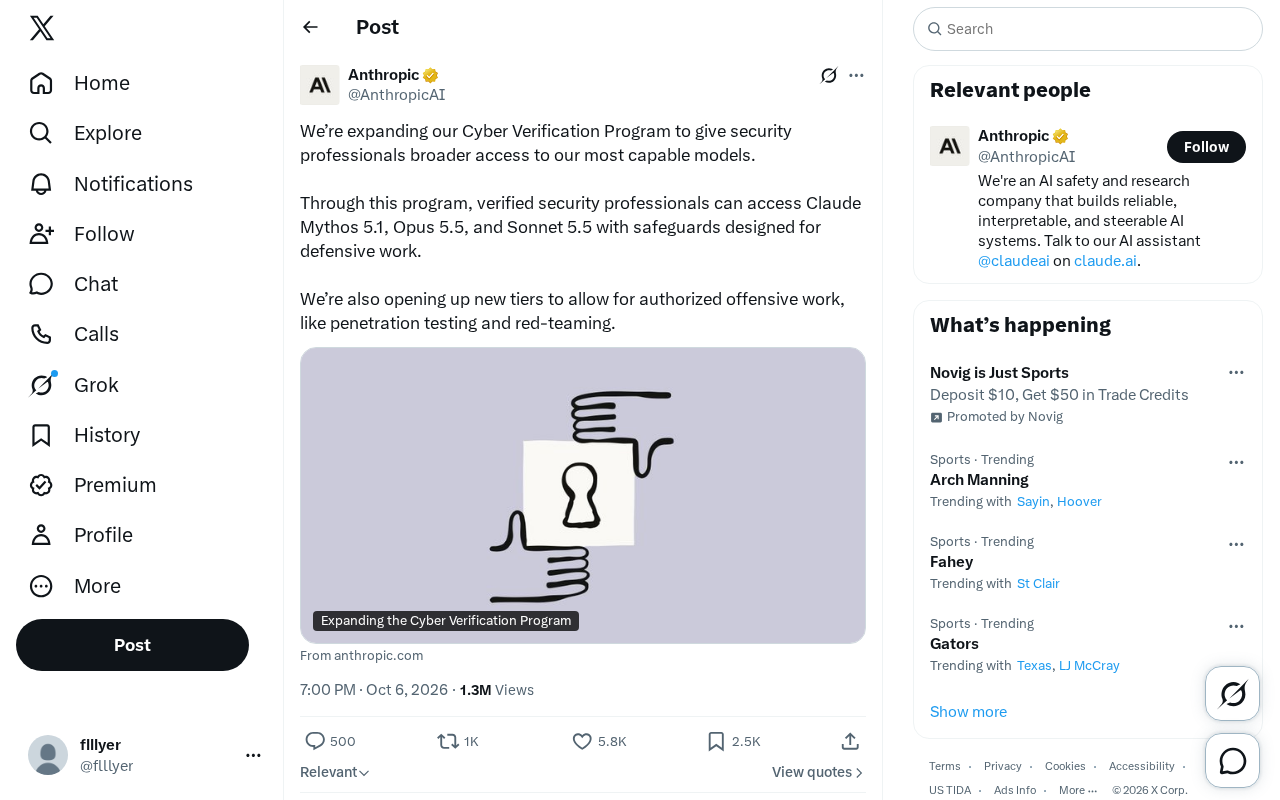
Anthropic has announced the expansion of its Cyber Verification Program, giving verified security professionals broader access to its most powerful models. According to an official tweet, the program allows security experts to use Claude Mythos 5.1, Opus 5.5, and Sonnet 5.5, with safeguards designed specifically for defensive work. At the same time, Anthropic has opened a new tier to authorize offensive security work such as penetration testing and red team exercises.
Core Elements of the Program Expansion
The Cyber Verification Program is not an entirely new initiative, but this expansion represents a significant increase in both access scope and model capabilities. Previously, security professionals may have had only limited access to some models; now verified users can access multiple flagship models under Anthropic, including Mythos 5.1, Opus 5.5, and Sonnet 5.5. These models have strong capabilities in reasoning, code understanding, and complex task processing, and can assist security teams with vulnerability analysis, threat modeling, and automated defense strategy generation.
Interestingly, Anthropic emphasizes that these access permissions come with "safeguards designed specifically for defensive work." This means the models may be subject to specific policy restrictions during use to ensure they are not misused for malicious attacks. This design approach reflects a trend in the AI security field: while improving model capabilities, reducing risk through access controls and usage constraints.
Cyber Verification Program is an access mechanism established by Anthropic for cybersecurity professionals, with the core purpose of determining the model tiers and capability scope users can access through identity and use-case verification. Such verification typically requires professional credentials, organizational affiliation, or project descriptions to distinguish legitimate security research from potential abuse. This connects with Anthropic's Usage Policy and Responsible Scaling Policy: the latter stipulates that corresponding safety measures must accompany model capabilities when they reach specific thresholds, and the verification program is the implementation mechanism at the distribution stage. Similar industry practices include OpenAI's cybersecurity-specific access and Google's AI red team program, all of which attempt to achieve "controlled openness" in high-risk domains.
New Tier for Authorized Offensive Security Work
In addition to defensive use cases, Anthropic has opened a new tier allowing authorized offensive security work, such as penetration testing and red team exercises. This move is somewhat controversial but reflects real-world needs: security professionals need to simulate attacker behavior to discover system weaknesses, and AI models can accelerate this process.
By incorporating offensive use cases into an authorization framework, Anthropic attempts to meet the security community's needs within a controllable scope. Red team exercises and penetration testing are important components of cybersecurity defense, but related tools and techniques often have dual-use characteristics. Anthropic's approach is to explicitly include these use cases in the verification program rather than banning them outright, thereby seeking a balance between security and abuse prevention.
Red Teaming originated from military adversarial exercises. In the cybersecurity and AI fields, it refers to professional teams playing the role of attackers, actively attempting to breach system defenses to discover vulnerabilities. For AI models, red teaming includes inducing models to output harmful content, jailbreaking to bypass safety alignment, and probing for training data leakage. It is a key component of pre-deployment safety assessments and a recommended practice by regulatory bodies such as the U.S. NIST AI Risk Management Framework.
Penetration Testing is a form of authorized simulated attack in which testers probe target systems according to clearly defined scope and rules to verify defense effectiveness. The fundamental difference from malicious attacks lies in authorization, scope limitation, and result reporting. When AI models are used for penetration testing, they can accelerate information gathering, exploit chain construction, and other steps, but they also bring dual-use risks—the same capability may be misused. Therefore, Anthropic incorporates it into tiered authorization, requiring verification of identity and use-case boundaries.
Impact on the Cybersecurity Industry
This program expansion may have multiple impacts on the cybersecurity industry. First, security teams can more conveniently leverage advanced AI models for daily defense work, such as log analysis, anomaly detection, and incident response. Second, the opening of authorized offensive use cases may drive the development of AI-assisted penetration testing tools, but it will also spark discussions about liability attribution and abuse risks.
From an industry competition perspective, Anthropic's move echoes other AI vendors' positioning in the security field. As AI model capabilities improve, how to safely open access to high-risk domains (such as cybersecurity) has become a question all vendors must face. Anthropic manages risk through its verification program and tiered authorization, providing a reference model for the industry.
Balancing Security and Accessibility
The expansion of the Cyber Verification Program reflects Anthropic's trade-off between model security and accessibility. On one hand, restricting unverified users' access to the most powerful models can reduce the risk of malicious use; on the other hand, providing broader access to verified security professionals helps realize AI's value in defensive security.
This "verification + tiering" model may become the standard practice for distributing AI models in highly sensitive domains in the future. For security practitioners, understanding and participating in such programs may provide earlier access to advanced AI tool support.
This article is based on information from Anthropic's official tweet. For specific program details, please refer to the official announcement.
One-line Summary
Anthropic expands its Cyber Verification Program, opening flagship models to verified security experts and adding a tier for authorized offensive use cases.
Paragraph Summary
Anthropic has announced the expansion of its Cyber Verification Program, allowing verified security professionals to access Claude Mythos 5.1, Opus 5.5, and Sonnet 5.5, with safeguards designed specifically for defensive work. A new tier has also been added to authorize offensive security work such as penetration testing and red team exercises. The article analyzes that this "verification + tiering" model attempts to strike a balance between openness of model capabilities and abuse risk: enabling security teams to use advanced AI for vulnerability analysis, threat modeling, and incident response, while bringing dual-use offensive capabilities into a controllable framework. This move echoes industry trends, may drive the development of AI-assisted security tools, and provides a reference model for model distribution in highly sensitive domains.
Related articles

Chain of Thought Isn't Just for AI: How Humans Can Use CoT to Improve Thinking Quality
Chain of Thought isn't just a prompt trick for large models. Starting from a Hacker News discussion, this article analyzes why CoT works for human thinking too, breaks down actionable ways to transfer it, and highlights the key differences between human CoT and machine CoT.
Cloudflare Teams Up with OpenAI: Closi…
Cloudflare Teams Up with OpenAI: Closing the Loop from Vulnerability Discovery to Defense with AI
Cloudflare uses OpenAI Daybreak to investigate security vulnerabilities and generate reviewable remediation plans, while developers use Codex to boost coding efficiency and quality.

Orca Multi-Agent Orchestration in Practice: A Guide to Parallel Collaboration with Claude and Codex
Orca is Stable AI's free open-source agent workbench supporting 34 agents like Claude Code and Codex in parallel. Learn its Git worktree isolation, multi-model orchestration, and mobile management.