Anthropic Files for IPO at ~$2 Trillion Valuation Amid $42 Billion Annual Losses

Anthropic files for IPO at ~$2T valuation while reporting ~$42B in annual losses, spotlighting AI's core valuation paradox.
AI company Anthropic has reportedly filed for an IPO targeting a valuation of approximately $2 trillion, which would place it among the world's most valuable companies. Yet documents cited in social media discussions indicate annual losses of roughly $42 billion. This "high valuation + heavy losses" combination reflects capital markets betting on future AI dominance over near-term profitability. Losses stem from frontier model training compute, hardware, and top talent costs — framed as strategic investment. Critics warn that rapid model commoditization and open-source competition make the pricing risky. However the IPO plays out, it will serve as a critical test of public market appetite for the AI business model and set valuation benchmarks for peers like OpenAI and xAI.
Anthropic Files for IPO
According to information circulating on Reddit, AI company Anthropic has officially filed a public listing application, targeting a valuation of approximately $2 trillion. If confirmed, this would place Anthropic among the highest-valued companies in the world — in the same tier as Apple, Microsoft, and NVIDIA. For an AI startup with a relatively short operating history, such a valuation is nothing short of striking.
It should be noted that the information in this article is primarily sourced from social media discussions. Key details such as the specific prospectus, underwriting team, and IPO timeline have yet to be confirmed by official filings. The analysis below is therefore based on currently available information, and readers should approach specific figures with appropriate caution.
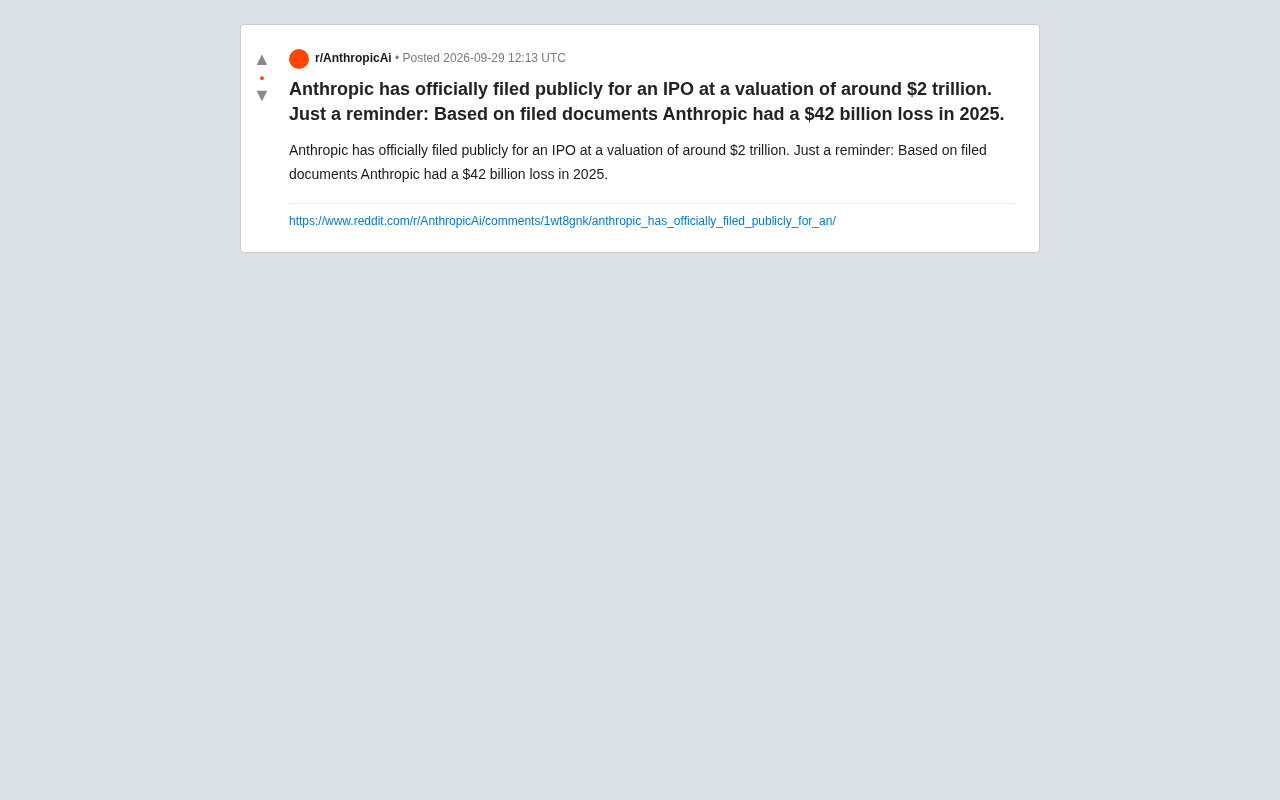
The Stark Contrast: $2 Trillion Valuation vs. $42 Billion in Losses
What has truly sparked debate is the financial reality behind the valuation. According to documents cited in relevant discussions, Anthropic recorded approximately $42 billion in losses during the reporting period. Pushing a company that is still burning cash at massive scale toward a $2 trillion valuation — that contrast is at the heart of the controversy.
This kind of combination is not entirely unique to the AI industry, but its magnitude is still rare. The coexistence of high valuation and heavy losses reflects a shift in how capital markets price AI foundation model companies — moving away from traditional metrics like profitability and cash flow, and toward bets on future technological leadership and market share.
Where Do the Losses Come From?
Massive losses at large language model companies typically stem from several sources: the enormous compute required to train frontier models, the cost of renting GPUs or building out data centers, high compensation for top research talent, and subsidized inference services used to capture market share. For a company like Anthropic, which focuses on frontier models such as the Claude series, the marginal cost of each model iteration is extremely high and difficult to fully offset with commercial revenue in the near term.
In other words, the $42 billion in losses is to a significant extent the result of deliberate strategic investment rather than operational mismanagement. The real question is whether this investment pace can translate into sustainable profitability within a foreseeable timeframe.
For context, training a frontier-level large language model — such as GPT-4 or the Claude 3 series — has been estimated by various sources to cost anywhere from hundreds of millions to several billion dollars, with costs growing non-linearly as model parameter counts scale up. Anthropic's Claude series also emphasizes safety alignment methods such as Constitutional AI, which require additional research labor and compute beyond standard training. Inference costs are equally significant — every user conversation with Claude requires real-time GPU compute, and as user volume grows, inference costs often scale faster than training costs. This helps explain why many AI companies continue to face margin pressure even as revenue grows rapidly.
How Capital Markets Price AI Companies
The debate surrounding Anthropic is, in essence, a microcosm of broader market anxiety about valuation bubbles across the AI sector. Proponents argue that foundation models are the core of the next generation of computing platforms, and that early leaders will develop moats comparable to operating systems — making today's losses a necessary price for future dominance.
Critics, however, point out that model capabilities are commoditizing rapidly, with open-source models continuously closing the gap with closed-source ones, while ongoing price wars compress margins. In this environment, pricing a company losing hundreds of billions annually at $2 trillion carries obvious risks.
What Does an IPO Mean for Anthropic?
If the IPO proceeds, public market capital would provide ammunition for Anthropic's continued high-intensity R&D and compute investments. But going public also means stricter disclosure requirements and more frequent performance scrutiny — quarterly earnings reports will force the company to strike a balance between "burn and expand" and "demonstrating a path to profitability." For a company accustomed to relying on private funding and tolerating sustained losses, this represents a meaningful shift in operating logic.
The valuation logic for AI foundation model companies shares some similarities with internet-era platform companies, but there are key differences. Early internet platforms — such as Amazon AWS and Google Search — commanded high valuations based on network effects and the low marginal cost of digital distribution; once scale effects kicked in, profits could be released rapidly. AI foundation models, by contrast, have not shown the same degree of declining marginal costs — compute demand continues to grow with each model iteration, and top-tier models must be continually updated to maintain competitive advantage. This raises substantial uncertainty about whether the traditional tech growth flywheel of "burn cash → achieve dominance → harvest profits" applies equally in AI — and that uncertainty is the fundamental fault line between bulls and bears.
Anthropic's major shareholders and strategic partners include Google and Amazon, both of which have made strategic investments in the multi-billion dollar range and are deeply intertwined through cloud compute supply agreements. This structure introduces additional complexity post-IPO: public market investors will need to assess whether the interests of these strategic shareholders are fully aligned with those of ordinary shareholders, and whether the company's dependence on specific cloud platforms for compute procurement represents a hidden constraint on its bargaining power. Historically, the dual role of "strategic investor as both shareholder and supplier" has been a governance risk factor closely scrutinized by analysts in multiple high-profile tech IPO cases.
Key Signals Worth Watching
Before official documents are fully disclosed, several signals deserve close attention from investors and industry observers: whether the pace of revenue growth is moving in sync with a narrowing of losses; the scale and retention rates of enterprise customers and API revenue; and how compute costs as a percentage of revenue are trending. These metrics are far more revealing of a company's true health than valuation figures alone.
For the AI industry as a whole, Anthropic's IPO — regardless of its final valuation — will serve as an important barometer of market sentiment. Its pricing will directly influence valuation benchmarks for peers like OpenAI and xAI, and will test the public market's genuine appetite for the "high valuation + high losses" AI model.
Conclusion
The news that Anthropic has filed for an IPO at approximately $2 trillion while carrying roughly $42 billion in annual losses brings the core tension of the AI industry into sharp relief: the enormous imaginative gap between technological leadership potential and actual financial performance. This could be a high-stakes bet on the future, or it could mark the beginning of a rational revaluation of sector valuations. Until the official prospectus is fully disclosed, it is too early to draw firm conclusions — but this IPO is undoubtedly one that everyone following the AI industry should watch closely.
Related articles

Workbuddy for Absolute Beginners: How a Desktop AI Agent Fits Into Real Workflows
A beginner's guide to the Workbuddy desktop AI agent: installation, claiming credits, file management, and building automated workflows—compared with CodeX for fit and cost, helping professionals shift from AI question-askers to AI managers.

OpenAI's New Agent Stack: Computer Use, Decisions API, and Ultra-Fast Workflows
OpenAI Dev Day unveiled a new agent stack: Computer Use outperforms humans, Decisions API delivers ultra-low-latency classification via Luna, Agents API opens the same Computer Use capabilities, and GPT-6.1 Sol costs only one-seventh of Astra. Core updates, benchmark data, and developer insights.

Liang Wenfeng Open-Sources DeepInfo Inference Framework, Takes On U.S. Ban
DeepSeek open-sources its DeepInfo inference framework after its models, featuring GPU/CPU cross-pipelining, small-model prediction with large-model verification, and full Huawei Ascend and NVIDIA chip support—facing the U.S. federal ban head-on. This article analyzes its significance for AI deployment and open-source strategy.