Anthropic Files for IPO at $2 Trillion Valuation, But Prospectus Reveals an $80.7 Billion Loss Puzzle

Anthropic's prospectus reveals an $80.7B book loss alongside positive operating profit, as its $2T valuation bets on AI growth.
Anthropic has filed its prospectus for a Nasdaq listing under ANT, targeting a valuation of up to $2 trillion. Revenue rose from about $4.585B in 2025 to $16.286B in H1 2026, though quarterly growth slowed from doubling to nearly 50%. Of the $80.7B H1 net loss, about $72.4B comes from fair value changes on convertible notes—a non-cash item—while Q2 operating profit turned positive at about $974M. The biggest risk is over $800B in compute commitments extending to 2045, creating fixed-cost exposure under a maturity mismatch. Seven co-founders also hold 50.1% of voting rights, diluting external capital's voice. The $2T valuation is essentially a public pricing of whether AI growth can cover massive capital investment.
Title
Anthropic Files for IPO at $2 Trillion Valuation, But Prospectus Reveals an $80.7 Billion Loss Puzzle
Meta Description
Anthropic files its prospectus targeting a $2 trillion valuation, with a first-half net loss of $80.7 billion even as operating profit turns positive. Breaking down the loss structure, slowing revenue growth, $800 billion compute commitments, and founder control to reveal the real risks and capital logic behind the AI giant's IPO.
Article Content
Anthropic has officially filed its prospectus, planning to list on Nasdaq under the ticker ANT, with market chatter putting the target valuation as high as $2 trillion. But flipping through the 318-page document, one glaring number stands out: a net loss of $80.7 billion for the first half, while operating profit over the same period has already turned positive. This contrast of "losing more yet becoming more valuable" is precisely the most authentic microcosm of the capital narrative surrounding today's AI giants.
Revenue Curve: A Leap from $4.5 Billion to $16.2 Billion
Let's start with growth. For the full year 2025, Anthropic's revenue was approximately $4.585 billion, and by the first half of 2026, revenue had surged to $16.286 billion. In the second quarter alone, revenue exceeded $11.5 billion.
This curve is astonishingly steep, but the slope is changing. Revenue more than doubled from Q1 to Q2, while the increase from Q2 to Q3 dropped to nearly 50%. Slowing growth is not surprising in itself—maintaining a doubling pace becomes difficult once the base grows larger. What really needs watching is whether this slowdown is a temporary fluctuation or whether demand is starting to hit a ceiling. For a company anchored at a $2 trillion valuation, the market's pricing implies assumptions of high-speed growth over the coming years, and any marginal change in growth signals will be amplified in interpretation.
The Truth Behind the $80.7 Billion Loss: Book Numbers vs. Real Cash Flow
A net loss of $80.7 billion sounds like a disaster, but breaking down the structure leads to a completely different conclusion.
Of the first-half net loss, approximately $72.4 billion comes from changes in the fair value of income from financial instruments such as convertible notes, mainly related to the company's rising valuation. In other words, this portion of the "loss" is the result of accounting treatment and does not mean the money actually flowed out of the accounts. The more the valuation rises, the larger this book loss becomes—a typical distortion from non-cash items.

More noteworthy is the signal at the operating level: second-quarter operating profit has already reached approximately $974 million. As model inference efficiency improves, compute costs as a share of revenue are also declining. This means Anthropic has crossed the break-even line in its core business, and the unit economics model is improving. Gains in inference efficiency directly lower the cost per call, while revenue continues to expand—squeezed from both ends, operating leverage begins to release.
Putting these two lines together, the prospectus actually presents two stories: a massive loss on an accounting basis, and a swing to profitability on an operating basis. For investors, the latter clearly carries more weight, but the volatility of the former cannot be ignored either—if the valuation corrects, fair value changes will inversely affect the financial statements.
Convertible Notes and Fair Value Changes: Convertible notes are a financing instrument with both debt and equity characteristics, allowing investors to convert the notes into company shares under agreed conditions. In accounting treatment, such instruments are typically classified as financial liabilities measured at fair value through profit or loss. When the company's valuation rises, conversion becomes more attractive to investors, the fair value of the notes rises accordingly, and the company must recognize an increase in liabilities on its books, recorded as a "loss." Conversely, when the valuation falls, a book gain is recorded. Such losses or gains do not involve actual cash outflow or inflow and are non-cash items, so they are usually excluded when assessing a company's true operating condition. Understanding this is key to making sense of the coexistence of Anthropic's $80.7 billion net loss and its positive operating profit.
Operating Profit and Operating Leverage: Operating profit refers to profit after deducting operating costs and period expenses but before interest and taxes, and is the most direct indicator of core business profitability. Anthropic's second-quarter operating profit turned positive at approximately $974 million, indicating that its model-call revenue has covered daily expenses such as inference compute, R&D, and sales. Operating leverage refers to the effect whereby fixed costs are diluted as revenue grows, amplifying profit at a faster rate. For AI companies, improved inference efficiency directly lowers the unit cost per call, while revenue continues to expand—the combination causes operating leverage to begin releasing. This also explains why, alongside a massive accounting loss, the signals at the operating level are actually improving.
$800 Billion Compute Commitment: The Biggest Hidden Risk
If the loss figure is a visual shock, the compute contracts are where the risks in this prospectus are most concentrated.

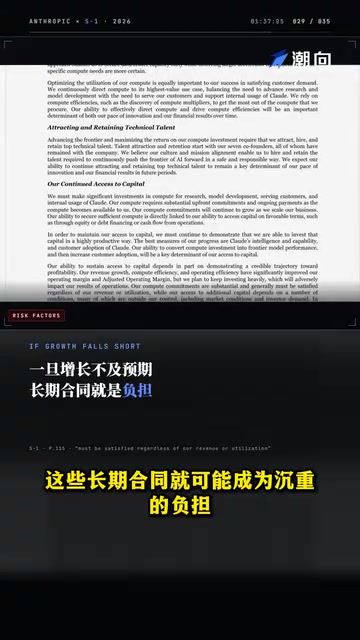
Anthropic has already signed compute commitments exceeding $800 billion, involving large-scale cloud computing and data center contracts, some with terms extending as far as 2045. The problem lies in the maturity mismatch: most of the company's revenue depends on customers actually calling the models, while compute costs may be locked in years in advance. If customer growth falls short of expectations, these long-term contracts will turn from "capacity assurance" into a "heavy burden."
This is a common challenge in the AI infrastructure arms race. Compute is the prerequisite for training and inference; without locking it in early, a company may fall behind when large-scale demand arrives; but locking in too early and too much ties it to fixed costs. Anthropic's choice is an aggressive bet that demand will continue to grow, and the success of this bet ultimately depends on whether model call volume can support the amortization of these contracts.
Maturity Mismatch and Compute Commitments: Maturity mismatch refers to a temporal mismatch between a company's asset side (revenue collection) and liability side (cost payment). The compute contracts Anthropic has signed extend as far as 2045, meaning cloud computing and data center costs for nearly the next two decades are locked in advance, forming rigid expenditures; yet revenue depends on customers' actual quarterly model call volume and is uncertain. Once call volume growth falls short of expectations, long-term contracts turn from "capacity assurance" into a "fixed-cost burden," squeezing profit margins. Such contracts may appear in accounting as lease liabilities or purchase commitments, and investors need to watch the pace of their amortization relative to revenue growth—a core perspective for assessing the risks of AI infrastructure companies.
Founder Control: Seven People Hold 50.1% of Voting Rights
There is another easily overlooked detail: although Amazon and Google have invested heavily, the founding team has designed a special share structure that gives seven co-founders 50.1% of the voting rights.
This means the voice of external capital at the board level is structurally diluted. For investors bullish on Anthropic's long-term technology roadmap, this ensures strategic continuity and prevents short-term financial reporting pressure from interfering with R&D investment; but for institutions hoping to influence company decisions through their shareholding, this is a governance risk that needs to be priced. The tension between large investments and limited control is not uncommon in tech company IPOs, but against the backdrop of a $2 trillion valuation, any governance uncertainty will be amplified.
Dual-Class Share Structure and Voting Rights Design: A dual-class share structure means a company issues two or more classes of stock, one of which carries higher voting rights per share (e.g., 10 votes) while the other carries only 1 vote per share, with the founding team typically holding the high-voting shares. Anthropic gives seven co-founders a combined 50.1% of voting rights, so even external shareholders like Amazon and Google, despite their huge investments, cannot gain dominance at the board level. The advantage of this design is that it safeguards strategic continuity and resists short-term financial reporting pressure; the cost is that external capital's voice is structurally diluted, and governance risk needs to be priced. Dual-class share structures are not uncommon in tech IPOs, but at a $2 trillion valuation, any governance uncertainty will be scrutinized and amplified by the market.
The Question the Market Really Needs to Answer
Revenue growth is one thing; whether the company can keep making money is another. Anthropic's prospectus lays this question out on the table: positive operating profit proves the business model is viable, the $80.7 billion book loss hints at the transmission path of valuation volatility, and the $800 billion compute commitment bets on a demand curve stretching more than a decade into the future.
The $2 trillion valuation is essentially a public pricing of whether "high-speed AI growth can support such massive capital investment." The answer won't be written in the prospectus; it will be written in the call volume, inference costs, and customer retention data of the coming quarters.
One-line Summary
Anthropic's prospectus reveals an $80.7 billion book loss coexisting with positive operating profit, as the $2 trillion valuation bets on AI growth.
Paragraph Summary
Anthropic has officially filed its prospectus, planning to list on Nasdaq under the ticker ANT with a target valuation of up to $2 trillion. The prospectus shows full-year 2025 revenue of approximately $4.585 billion, surging to $16.286 billion in the first half of 2026, though quarterly growth slowed from doubling to nearly 50%. Of the $80.7 billion first-half net loss, about $72.4 billion stems from fair value changes in financial instruments such as convertible notes, a non-cash item; meanwhile, second-quarter operating profit has turned positive at approximately $974 million, improving unit economics. The biggest risk lies in over $800 billion in compute commitments extending to 2045, creating fixed-cost exposure under a maturity mismatch. In addition, seven co-founders hold 50.1% of voting rights through a special share structure, diluting external capital's voice. The $2 trillion valuation is essentially a public pricing of whether AI growth can cover massive capital investment.
Related articles

ECC: Making AI Coding Assistants Work Like an Engineering Team
ECC, an open-source repo with nearly 300K GitHub stars, adds engineering discipline to AI coding assistants: plan first, write tests, then implement, with independent review, 71 specialized assistants, 314 skills, and built-in security scanning. Compatible with Codex, Cursor, Gemini, and more.

Don't Just Use ChatGPT! These 5 AI Tools Are More Professional
Stop throwing every task at ChatGPT. This article covers Perplexity, Notebook LM, Gama, Claude, and Cursor — five specialized AI tools for research search, document comprehension, presentation creation, writing ideation, and AI programming, helping you pick the right tool for each scenario and boost daily efficiency.

Cursor IDE: Generate Code with Natural Language and Say Goodbye to Repetitive Boilerplate
Cursor IDE lets you describe components like login forms or dashboards in natural language, instantly generating code that integrates into your existing project. We break down its workflow, integration capabilities, and limits.