Anthropic Files S-1 for IPO: Wall Street Digs Into the Prospectus — How Do the Compute and Valuation Math Add Up?

Anthropic files S-1 to sprint toward IPO, with revenue surging but massive non-cash losses and compute commitments prompting valuation scrutiny.
Anthropic has officially filed its S-1 under ticker ANT, becoming the first pure-play generative AI company to list on the public market, with Goldman Sachs and Morgan Stanley leading the underwriting. The prospectus shows first-half revenue of $16.3 billion and a net loss of $80.7 billion, but about $72 billion is non-cash accounting expense; excluding it, adjusted free cash flow and EBITDA turned positive. Compute costs are the focus: most compute is rented, first-half compute and infrastructure operating expenses reached $8.9 billion, and the company disclosed over $100 billion in procurement and lease commitments. Enterprise customers are growing fast, but concentration among large-spending customers is in question. Analysts believe listing first lets Anthropic set the valuation benchmark for OpenAI, but whether pricing already discounts future execution remains the core risk.
Anthropic has officially filed its S-1 with the U.S. Securities and Exchange Commission, taking a key step toward an IPO. The AI company, founded by former OpenAI members, will list on the public market under the ticker "ANT," with Goldman Sachs and Morgan Stanley leading the underwriting. As soon as the news broke, Wall Street analysts and tech watchers began hitting "control F" line by line through the thick prospectus, trying to answer two questions: how high are compute costs really, and does the valuation logic hold up?
Revenue Is Rising, Losses Are Bigger: A "Contradictory" Set of Financials
The financial data disclosed in the prospectus presents a striking contrast. First-half revenue reached $16.3 billion — already a considerable scale — but net loss for the same period was as high as $80.7 billion. At first glance, that loss figure is enough to make anyone gasp.
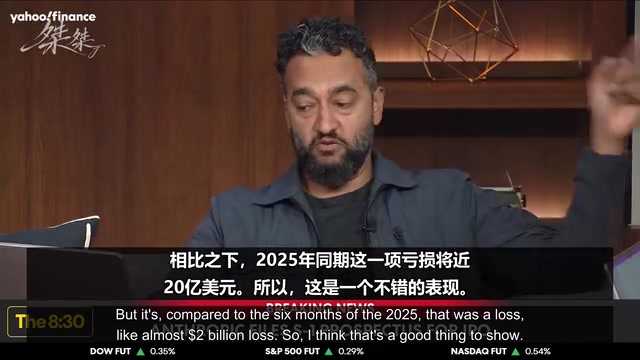
A closer look reveals the twist: of the $80.7 billion net loss, about $72 billion is non-cash accounting expense stemming from changes in the value of convertible notes and similar instruments. Excluding that item, the company actually generated positive adjusted free cash flow and positive adjusted EBITDA in the first half. Compared with a loss of nearly $2 billion in the same period a year earlier, this shift was seen by analysts on the call as a positive signal.
The problem is that the "adjusted" framing itself plants the seeds of controversy. Some on the call said outright: we don't actually know what it adjusted for. For a company about to face quarterly public-market scrutiny, the timing of revenue and expense recognition — what counts as operating cost, what goes under other line items — will become subjects investors repeatedly probe.
Non-cash accounting expense refers to expenses or losses recognized on the income statement solely because accounting rules require it, without any actual cash outflow. Common sources include stock-based compensation, asset impairment, and fair-value changes in financial instruments such as convertible notes. Take convertible notes: when a company's valuation rises, the fair value of embedded conversion rights or derivative clauses rises with it, which accounting rules require to be recognized as an increase in liabilities or a loss, directly depressing net income — even though the company never actually pays that money. As a result, "net loss" and "cash flow" can diverge sharply: a company can post a huge book loss while operating cash flow is positive. This is why Anthropic emphasizes that after excluding roughly $72 billion in non-cash expenses, adjusted free cash flow and adjusted EBITDA turned positive. Investors need to distinguish "accounting loss" from "cash burn rate," but should also be wary of companies using "adjusted" metrics to play down real costs.
Compute: Rented Infrastructure and Massive Commitments
In the risk factors section, Anthropic addresses compute very bluntly: if it cannot secure enough compute, or cannot allocate compute efficiently across workloads, the company may fail to train competitive models or fully serve customers.
This is not a new statement, but having the company put it in black and white in its own prospectus carries different weight. It acknowledges that competition in the compute market is "extremely intense," with rivals including some of the world's best-capitalized tech giants — many of whom are both competitors and Anthropic investors. How this coopetition evolves is one of the market's focal points.
There is an easily overlooked detail in the cost structure: most of Anthropic's compute is rented rather than self-built, and the company does not own data centers, so the related spending is not fully reflected in capital expenditure line items. The prospectus shows full-year 2025 compute and infrastructure operating expenses of $7.3 billion — while the first half alone reached $8.9 billion.
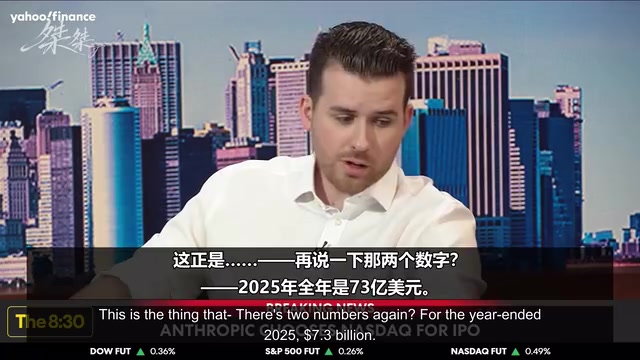
Analysts on the call extrapolated that the full year could approach the $20 billion range, and noted that this is precisely the answer to earlier outside questions about why compute spending "looked low" — the key lies in classification. At the same time, the company disclosed compute procurement commitments of up to $120.5 billion involving SpaceX AI and NVIDIA; total lease payments to Broadcom of $161.2 billion; and commitments to Google of $114.5 billion through 2033. Its revolving credit facility was also raised from $3.3 billion to $15 billion.
Purchase commitment is a company's contractual obligation to purchase a minimum amount over a future period, typically found in long-term cloud service, chip supply, or compute leasing agreements. It is not immediately expensed in the current period but disclosed as an off-balance-sheet or footnote commitment, recognized over time based on actual usage or the passage of time. For AI companies, massive purchase commitments mean certainty in locking down compute supply, but they also constitute a rigid expense burden: even if revenue falls short of expectations, the company must still fulfill its payment obligations. The prospectus discloses Anthropic's $120.5 billion compute procurement commitment to SpaceX AI and NVIDIA, $161.2 billion in lease payments to Broadcom, and $114.5 billion commitment to Google through 2033 — figures that reflect cash flow locked in for years to come, not current-period expenses. When analyzing valuation, these commitments should be weighed alongside expected revenue growth.
Enterprise Customers: Fast Growth, but Concentration Questions
The prospectus discloses Claude's enterprise adoption in detail for the first time. As of September 30, 2026, on a trailing-twelve-month basis: more than 11,900 customers contributed $100,000+ in annual revenue, more than 1,900 contributed $1 million+, and about 250 contributed $10 million+. The number of $100,000+ customers grew from 950 a year earlier to nearly 12,000 — a remarkable growth rate.
But Wall Street's follow-up question came quickly: how many of these customers are actually spending big on an ongoing basis? A company spending just a few thousand dollars a year has almost no impact on Anthropic's revenue curve. The discussion explicitly raised market concerns that "only a small subset of customers are spending big on tokens," and that broader adoption has yet to be proven. This customer concentration issue could become an unavoidable challenge during the IPO roadshow.
Customer concentration measures how much a company's revenue depends on a small number of large customers. Common metrics include the share of revenue from the top ten customers, or the distribution of customers by spending tier. High concentration means less stable revenue: if a few large customers cut purchases or switch to competitors, revenue can fall quickly. Anthropic discloses nearly 12,000 customers contributing $100,000+ annually, but only about 1,900 spending $1 million+ and about 250 spending $10 million+ — a classic long-tail structure. The market worry is that many customers may only be small trials or pilots that have not yet formed sustained large-scale spending; and the few customers that truly drive most revenue — their willingness to renew and bargaining power will directly determine the revenue curve. In IPO roadshows, investors typically press on customer retention rate, net dollar retention (NDR), and large-customer contract terms.
Valuation: No Perfect Comparable, First-Mover Advantage
Avery Marquez, Director of Investment Strategy at Renaissance Capital, said on the call that it would be "absurd" to say there is no demand for this stock — it is the first pure-play generative AI company to list on the public market, with extremely high name recognition and predictable first-day demand. But the trajectory three months out will depend heavily on pricing. If the pricing already discounts years of flawless execution, investors will demand delivery in the very first earnings season.
On valuation anchors, she admitted there is no perfect comparable company, only multiples from high-growth, disruptive tech companies. Interestingly, Anthropic's discussed private-market valuation has already been marked down from the $2 trillion range to the $1.5 trillion range — interpreted as the company itself seeking more reasonable pricing for the current market environment.
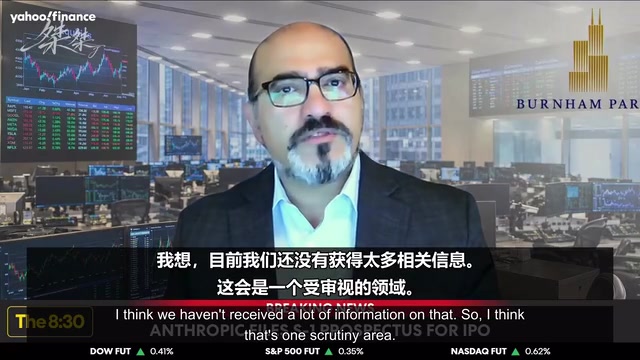
Rohit Kulkarni of Burnham Park Capital added several positives: the gross margin trend line, measured as compute infrastructure as a share of revenue, is encouraging, with revenue per incremental unit of compute improving; the company does not need to spend heavily on sales and marketing the way many tech companies do; and the CEO's healthcare background and wet-lab plans point to new markets such as vertical AI. But he also flagged areas needing scrutiny: the public benefit corporation (PBC) structure, what the 5% new-share trading provision actually means for equity investors, and insufficient disclosure on token pricing.
Public Benefit Corporation (PBC) is a special U.S. corporate form that requires a company to consider the public benefit mission stated in its charter alongside shareholder financial returns, and to balance shareholder interests with public benefit in major decisions. A PBC is not a charity and still must be profitable, but its board has a legal duty to the public benefit mission and can in theory reject purely profit-driven short-term actions on that basis. For public-market investors, the practical implications of PBC status include: the company may sacrifice short-term profit to fulfill its mission in certain business decisions; hostile takeovers are harder; and disclosure must regularly report on public benefit progress. Investors need to assess whether this governance structure is compatible with their return expectations, and what special arrangements such as the 5% new-share trading provision actually mean for equity liquidity and control.
Risk Narrative: Doomerism or Product Liability?
The prospectus devotes substantial space to discussing the existential and catastrophic risks AI may pose, continuing CEO Dario Amodei's long-standing public stance. This is quite rare in an IPO document and has prompted two interpretations among analysts.
Kulkarni sees it as a kind of "narrative violation," and would prefer the company reframe from doomsday scenarios to product liability — that is, how to price potential lawsuits and fines. In his view, framing risk through a product liability lens is more constructive for investors' valuation judgments. Marquez said outright that some of the doomsday rhetoric carries pre-IPO exaggeration, and quoted Jensen Huang's retort: if this technology is truly so destructive, why are we still pushing it forward?
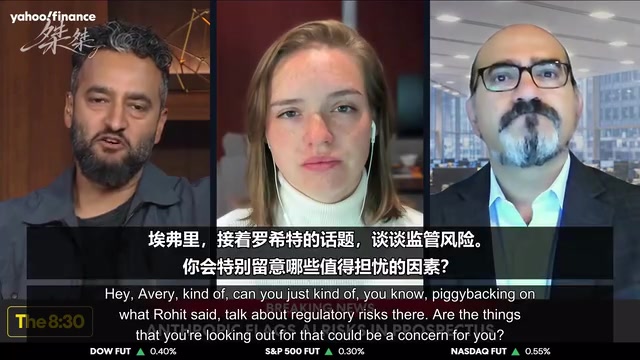
Regulatory risk was also mentioned. The company operates in multiple countries, each with its own regulatory framework, which will be a variable investors continue to assess.
The First Mover's Chips
Anthropic going public ahead of OpenAI is widely seen as a strategic window. Marquez noted that the two are the most recognizable names in the field, and whichever lists first can set the benchmark for investors — metric definitions, growth expectations, valuation multiples. When OpenAI later enters, it will have to face this reference frame: if its performance falls short of Anthropic's, it could be especially awkward against a "perfect comparable."
One line in the prospectus was also caught on the call: Anthropic admitted it had "significantly underestimated compute demand" in the past. Compute bulls will take it as evidence that infrastructure investment will keep expanding; bears will read something else — underestimating compute demand also means underestimating how much money will need to be spent. When revenue catches up with spending, and when ROI materializes — the document offers no answer.
For the public market, Anthropic's S-1 is a stress test: not only of the company, but of whether Wall Street is ready to digest — through the traditional financial reporting framework — an AI model company whose revenue recognition cadence and cost classification are both quite unusual.
One-line Summary
Anthropic files S-1 to sprint toward IPO, with revenue surging but massive non-cash losses and compute commitments prompting valuation scrutiny.
Paragraph Summary
Anthropic has officially filed its S-1 under ticker ANT, becoming the first pure-play generative AI company to list on the public market, with Goldman Sachs and Morgan Stanley leading the underwriting. The prospectus shows first-half revenue of $16.3 billion and a net loss of $80.7 billion, but about $72 billion is non-cash accounting expense; excluding it, adjusted free cash flow and EBITDA turned positive. Compute costs are the focus: most compute is rented, first-half compute and infrastructure operating expenses reached $8.9 billion, and the company disclosed over $100 billion in procurement and lease commitments. Enterprise customers are growing fast, but concentration among large-spending customers is in question. Analysts believe listing first lets Anthropic set the valuation benchmark for OpenAI, but whether pricing already discounts future execution remains the core risk.
Related articles
 Tech Frontiers
Coldframe: A Honeypot Disguised as a Supermarket Freezer Controller
Coldframe is a honeypot disguised as Danfoss AK-SM 800A and Dixell XWEB freezer controllers, built as a single Python file that detects CVE-2025-41450 attempts and is identified as real devices on Shodan.
 Tech Frontiers
GRFNet: A Lightweight PyTorch Model Designed for Multichannel Time-Series Classification
GRFNet is a lightweight PyTorch model for multichannel time-series classification, originating from EEG decoding research. With only 3,847 parameters, it is based on the ROCKET architecture, combining random convolution kernels with learnable spatial filters, supports arbitrary input lengths, and will soon be evaluated on the PhysioNet dataset.
 Tech Frontiers
CUDA-Accelerated Rocket League Simulator: A Player-Made Hardcore Experiment
A Reddit post shows a "100% Accurate" Rocket League simulator accelerated with CUDA. We analyze its technical context, CUDA's value in game physics simulation, and the significance and limitations of such community projects.