Anthropic Formally Files for IPO: High Growth, High Losses, and a Distinctive Governance Structure

Anthropic files for IPO, combining high growth with high losses and a distinctive governance structure.
Anthropic has formally filed for an IPO, becoming one of the few leading large-model companies to enter the listing process. Disclosures show the profile of a fast-expanding AI company: revenue is soaring but losses are widening, reflecting the high computing and R&D costs of frontier models; enterprise adoption has risen significantly, with APIs and cloud partnerships providing a relatively stable revenue source; and an unusual governance structure is designed to preserve founder control and the AI safety mission. The article argues that the IPO will test whether the high-growth story can offset loss concerns, whether the special governance structure will be accepted by investors, and will provide a rare valuation anchor for foundation model companies.
Event Overview: An AI Safety Star Steps into Public Markets
According to RSS reports, AI company Anthropic has officially filed for an IPO, taking a key step toward going public. The move makes it one of the few leading large-model companies to enter the listing process.
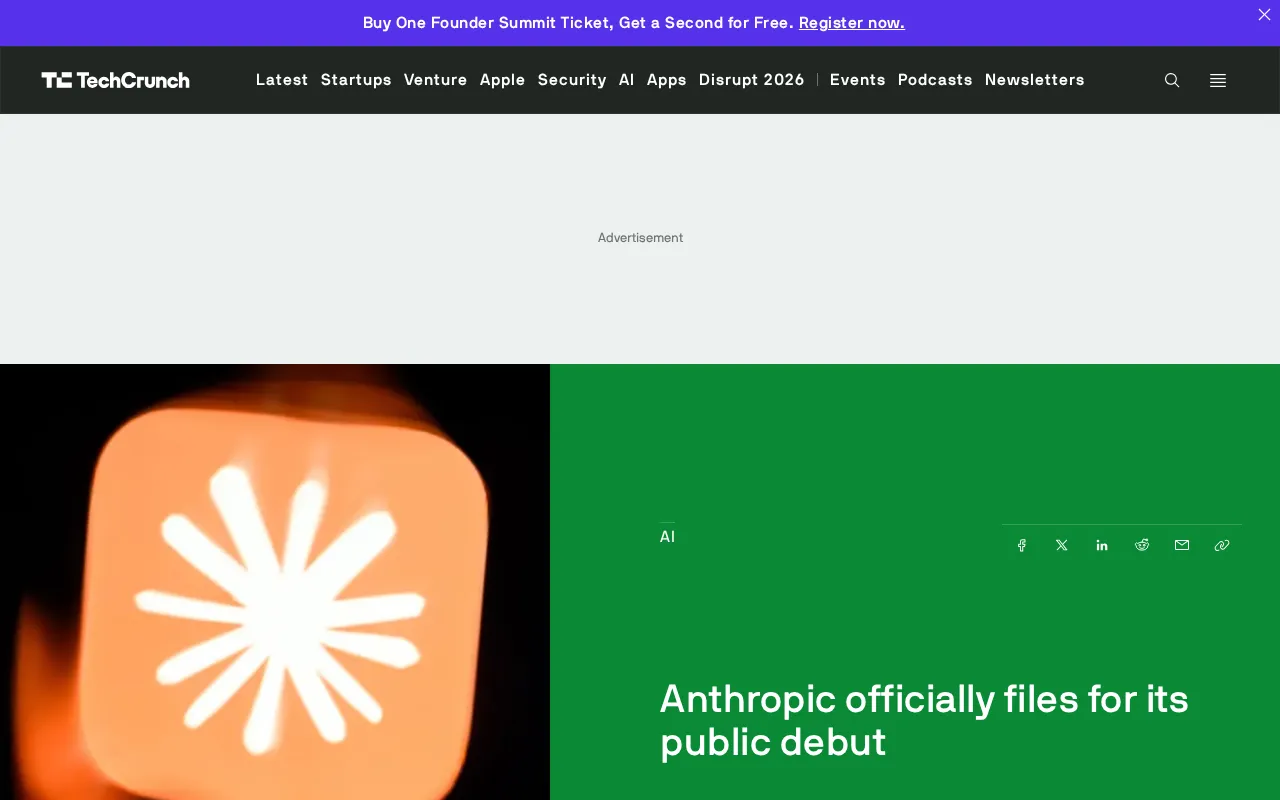
Based on the disclosed information, Anthropic presents a typical profile of an AI company in a phase of rapid expansion: soaring revenue, widening losses, significantly higher enterprise adoption, and a distinctive governance structure designed to preserve founder control and the AI safety mission. These four dimensions form the core framework for understanding this IPO.
Two Sides of the Financials: Soaring Revenue and Mounting Losses
The most striking aspect of the filing is the two-sided nature of Anthropic's financial performance. On one hand, the company's revenue is soaring, reflecting strong commercial demand for its large-model products; on the other hand, losses are mounting in tandem, indicating that high computing costs, R&D investment, and market expansion are still consuming large amounts of cash.
This pattern of "growing revenue without growing profit" is not uncommon among foundation model companies. Training frontier models requires continuous investment in massive computing power, while commercialization is still at an early stage, with pricing and cost structures yet to reach balance. Anthropic's decision to pursue an IPO at this stage can be seen both as a show of confidence in its growth trajectory and as a sign that it needs public-market capital to replenish its resources.
Why foundation model companies commonly see "revenue growth without profit growth"
Foundation model companies have a cost structure with significant upfront scale requirements: training a frontier model once requires thousands to tens of thousands of GPUs running for extended periods, with a single training run costing tens of millions to over a hundred million dollars; at the inference stage, costs grow linearly with usage, as every API request corresponds to real computing expenses. At the same time, to maintain model leadership, companies must continuously invest in R&D for next-generation models, creating an intensive capital cycle of "train—release—retrain." Although revenue is growing rapidly, pricing is often constrained by competition, and enterprise customers typically demand discounts and long-term contracts. Therefore, soaring revenue alongside widening losses is not a management failure but a structural feature of this sector at its current stage; the core metrics watched by capital markets accordingly shift from net profit to gross margin trends, the inference cost decline curve, and cash burn rate.
Enterprise Adoption Becomes the Growth Engine
Another key point disclosed in the filing is major enterprise adoption—widespread uptake by enterprise customers. For Anthropic, the enterprise market is the key battleground that differentiates it from consumer-facing chatbots. Through APIs and cloud platform partnerships, its models are integrated into various enterprise workflows, forming a relatively stable source of revenue.
Rising enterprise adoption also indirectly confirms market demand for reliable, controllable AI models. Compared with raw user numbers, enterprise customers' willingness to pay and retention rates are better able to support long-term revenue expectations, which is also what Anthropic emphasizes in its IPO narrative.
API and cloud platform distribution model
Model companies such as Anthropic enter the enterprise market mainly not through their own consumer applications, but by embedding model capabilities into customer systems through APIs and distributing them via major cloud platforms (such as AWS Bedrock and Google Vertex AI). The advantage of this model is that cloud vendors already have established enterprise customer relationships, compliance qualifications, and billing systems, allowing model companies to quickly reach large numbers of organizations without building their own sales networks; token-based API revenue is also relatively predictable. The cost is that revenue must be shared with cloud partners, and customer relationships are partly held by channel partners, limiting bargaining power. Therefore, when evaluating "enterprise adoption," investors usually distinguish between total customer count, net revenue retention, and revenue concentration from a single cloud partner, rather than looking only at the number of signed enterprise customers.
Distinctive Governance Structure: Dual Safeguards for Control and the Safety Mission
The most differentiated information in the IPO disclosure is that Anthropic designed an unusual governance structure aimed at preserving founder control and maintaining its AI safety mission.
For a company positioned around AI safety as its core identity, the governance structure itself is an extension of its product logic. Through special equity arrangements or voting rights designs, the founding team can continue to lead the company's direction after going public, preventing short-term capital market pressure from eroding long-term safety goals. This arrangement is not unprecedented among tech companies, but in the context of AI safety it carries stronger symbolic significance and may also become an important variable for investors assessing long-term risk.
What is a dual-class share structure
A common tool for tech companies to preserve founder control at IPO is the dual-class share structure, in which the company issues two or more classes of shares with different voting rights. A typical arrangement is that founders hold Class B shares with multiple votes per share, while public investors hold Class A shares with one vote per share, allowing voting control to be maintained even after equity dilution. Companies such as Google, Meta, and Snap have used similar designs. The benefit of such structures is that founding teams can withstand short-term performance pressure from capital markets and adhere to long-term strategy; the controversy is that they weaken ordinary shareholders' influence over company decisions, and some index providers and governance advisors remain cautious about them. For a company like Anthropic with an AI safety mission, dual-class shares may also be combined with mission-lock provisions (such as a public benefit corporation (PBC) structure or an independent safety committee), making safety goals harder to override by commercial interests after listing.
Opportunities and Scrutiny on the Road to Listing
Anthropic's formal IPO filing marks the beginning of leading AI companies submitting to public-market pricing and scrutiny. Whether the high-growth story can offset concerns about continued losses, whether the distinctive governance structure will be accepted by investors, and whether enterprise adoption can translate into sustainable profits are all core points to watch in subsequent prospectus details and the roadshow stage.
For the industry, this IPO will also provide a rare valuation anchor, helping outsiders recalibrate their understanding of the business models of foundation model companies.
Related articles

LangChain Retry Middleware Configuration: Practices and Selection Guide
Based on Reddit community discussion, this article analyzes LangChain ModelRetryMiddleware retry parameter configuration practices, covering the selection logic and alternatives for key options like max_retries, backoff_factor, and jitter.

Texas Senate Race in Trouble: Why Are Republicans Nervous?
Texas Senate race stirs Republican anxiety. Based on street interviews, this article analyzes the Democratic offensive in funding, organization, and running everywhere, and how Republicans are defending "Texas, Texas" amid the political pendulum effect.

Gemini Chat Now Generates and Edits Google Docs Directly, a New Breakthrough in Office Productivity
Google Gemini's chat interface now generates and edits PDF, Google Docs, Sheets, Slides, Markdown, TXT, and code files. Available to all users; web supports all formats, mobile only PDF for now.