Anthropic IPO Prospectus Breakdown: The Truth Behind the $80.7 Billion Loss and the Lockup Trap

Anthropic files S-1 to raise up to $100B; its $80.7B net loss is largely accounting charges—reading five key sections and the lockup is what matters.
Anthropic publicly filed its S-1 to list on Nasdaq under ticker ANT, aiming to raise up to $100 billion per Reuters—potentially one of the largest IPOs ever. But the most telling part is its books: a first-half net loss of $80.7 billion, about $72 billion of which comes from accounting charges tied to valuation changes, while Reuters' operating loss figure is just $693 million on $16.29 billion in revenue. Using this as an example, the article explains how to read a prospectus like a professional: understand the nature of S-1 and SEC review, closely read the summary, risk factors, use of proceeds, dividend policy, and dilution sections, compare net loss with operating loss and return to MD&A and notes, and finally search the document for "lockup" to calculate the expiration date—the date that could tank the stock months after listing.
Anthropic has filed its S-1 prospectus, planning to list on Nasdaq under the ticker ANT. Reuters reports it aims to raise up to $100 billion, which if realized would make it one of the largest IPOs in history. But what truly makes this document worth reading isn't the raise amount—it's what its own books say: a net loss of $80.7 billion over six months.
Looking at just that one number, you'd completely misjudge this company. This article breaks down how to read a prospectus like a professional, which five sections to focus on, and a date that could tank the stock price months after listing.
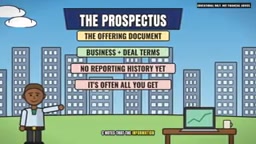
1. First, Get Clear: What S-1 Is—and SEC Review Is Not an Endorsement
According to the SEC's investor bulletin, an IPO refers to a company selling shares to the public for the first time. Federal securities law requires companies to register with the SEC before legally offering stock, unless an exemption applies. The registration document is typically Form S-1, whose core is the prospectus—a document describing the company's business, the terms of the offering, and the information needed to make an investment decision.
Newly public companies usually have no historical reporting record to check. The SEC explicitly states that the information you need is often only found in the prospectus. All S-1s and amendments (S-1/A) are publicly available in the SEC's free EDGAR database. Always read the latest version, because the prospectus is continually revised throughout the process. After pricing, companies typically file a final prospectus labeled 424B3 or 424B4, which states the final offering price.
Here's a common misconception: SEC review does not mean the SEC endorses the investment. SEC staff review whether disclosures are compliant and often request changes, but the agency explicitly states that review does not guarantee the disclosure is complete or accurate, nor does it judge whether the IPO is a good investment for anyone.
EDGAR (Electronic Data Gathering, Analysis, and Retrieval) is the SEC's electronic filing and retrieval system. Since the 1990s, it has gradually become mandatory for all public companies and registered issuers to submit statutory filings through it. Anyone can search company names or tickers for free at sec.gov/edgar to access full texts and historical versions of S-1, 10-K, 10-Q, 8-K, and other documents. For IPO research, EDGAR's value lies in version traceability: the same S-1 may go through multiple S-1/A amendments, and versions from different dates reflect changes made after regulatory inquiries, newly added risk disclosures, or updated financial data. In practice, prioritize the latest amended version and compare it against earlier versions to see which statements were deleted or softened—this is often a window into the company's real concerns.
424B filings are the final prospectus after pricing. 424B3 applies to routine offerings without new material information, while 424B4 is used for IPOs and other scenarios requiring supplementary pricing information. The key difference from the S-1 is that 424B states the final offering price, underwriting discounts, actual number of shares issued, and other transaction terms, whereas at the S-1 stage these numbers are typically left blank or given as ranges. So read the S-1 to research investment value, and read the 424B to confirm transaction terms.
2. Five Sections You Must Read First
Prospectus summary: A condensed version of the business, strategy, use of proceeds, and transaction terms.
Risk factors: The risks management itself lists that could seriously harm the business or your investment. Read this section slowly—it's the company writing about its own weaknesses.
Use of proceeds: Is the money for growth, debt repayment, or cashing out early investors? The SEC notes that if existing shareholders' shares are included in the offering registration, they can sell in the IPO—so figure out whose stock is actually being sold.
Dividend policy: Historical record and future plans.
Dilution: This section is the most surprising. The SEC explains that it shows the often-significant gap between the IPO price you pay and two numbers—the book value of those shares and the average price paid by existing shareholders (founders, executives, early investors). Simply put, the price you pay per share may be far higher than what insiders paid years ago.
Imagine a fictional company, Lantern Labs: founders and early backers paid an average of about $2 per share over the years, the IPO is priced at $20, and the gap is 10x. The dilution section puts this gap on the table. It doesn't tell you whether the stock is good or bad—it tells you who took the risk and at what price.
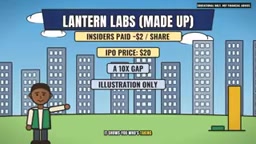
Dilution is formally defined in the SEC's registration form instructions: it measures the difference between the offering price per share paid by new investors and the average price per share paid by existing shareholders, as well as the change in net tangible book value per share after the offering. The prospectus typically presents a table with three numbers—net tangible book value per share before the offering, adjusted net tangible book value per share after the offering, and the price per share paid by new investors—and the gap between them is the dilution amount.
Two types of dilution need to be distinguished: economic dilution, where newly issued shares dilute existing shareholders' ownership percentage and earnings per share; and price dilution, where new investors pay a price above the book value of assets, with that premium recorded in capital surplus—effectively transferring value to existing shareholders. The prospectus's dilution section primarily discloses the latter. For early investors, buying in at a low price means their paper returns could be several times the offering price once the company lists; for new investors, it means you're paying a higher price for the same per-share assets. Understanding this table tells you more directly about the risk-return distribution than any analyst rating.
3. The $80.7 Billion Loss: You Need MD&A and Financial Notes to Understand It
This is exactly why you must read Management's Discussion and Analysis (MD&A) and the financial statements with notes.
According to CNBC, about $72 billion of Anthropic's first-half net loss came from accounting charges related to changes in consumer valuation, which the company ties to its own rising valuation. The underlying figures reported by Reuters are completely different: operating loss for the first half of 2026 was $693 million, narrowed from $2.14 billion in the same period last year. Revenue for the period was $16.29 billion, up from $1.16 billion a year earlier.
Same company, vastly different headlines. The lesson here applies to any document: net loss includes everything, including accounting charges not from day-to-day operations; operating loss is closer to actual business performance. Looking at either one alone is incomplete—read both, then read the notes explaining the difference. This habit works for IPOs, 10-Ks, or the small business you're thinking of buying.
Costs are also worth a close look. Reuters describes the listing as a test of whether investors will pay for the company's bills, against a backdrop of rising concerns about debt-driven massive AI spending. CNBC reports that the S-1 mentions operating margins are expected to fluctuate over time, especially when large amounts of new computing capacity are delivered. That sentence is worth highlighting.
The difference between operating loss and net loss stems from the hierarchical structure of the income statement. Operating loss sits at the top, deducting only costs directly related to the core business—revenue minus cost of revenue, R&D, and selling and administrative expenses—reflecting whether day-to-day operations are profitable. Net loss sits at the bottom, adding or subtracting interest income and expense, investment gains, asset disposal gains and losses, income tax, and non-operating one-time items on top of operating loss.
When the gap between the two is large, it usually means there are significant non-operating items. Common sources include: fair value changes in convertible preferred stock or warrants (when the company's valuation rises, the book value of these liabilities rises and is recognized as an accounting expense, but it doesn't consume cash); impairment of goodwill or intangible assets; restructuring and litigation accruals. These charges are often called "non-cash charges" or mark-to-market accounting results, unrelated to operating efficiency. The professional approach is to first look at operating loss to judge business health, then look at the gap between net loss and operating loss, return to the notes to confirm each component of the difference, and finally combine with operating cash flow from the cash flow statement to determine how much of the loss actually drained cash.
4. Can You Buy at the Offering Price? Usually Not
The SEC explains that if you're a client of an underwriter, you may receive an allocation at the offering price. But underwriters typically allocate most IPO shares to institutions and wealthy clients—mutual funds, pension funds, insurance companies. For individuals, the more common path is to buy after the stock starts trading.
How is the offering price set? The SEC describes it as a mix of market conditions, analysis, and negotiation. Underwriters collect indications of interest to form an order book, and their compensation is typically a percentage of the offering price. Underpricing helps them sell out the shares and may boost first-day gains—buyers are happy, but the company could have raised more.

There's also a part of first-day trading most people don't know: the SEC notes that underwriters can support the trading price in the first few days, including by buying shares, usually to prevent the price from falling far below the offering price. Once support ends, the price may drop significantly. Shortly after an IPO, it's not unusual for the stock to trade significantly above or below the offering price.
Why is early volatility so intense? Limited supply. The SEC explains that on the first day, generally only the shares sold in the IPO are trading; shares held by founders, employees, and early investors are typically restricted, and underwriters may also discourage immediate resale. In hot deals, limited supply meets high demand and drives prices very high.
5. The Lockup Trap: The Date That Can Tank the Stock Months Later
Insiders typically sign lockup agreements prohibiting sales for a certain period—the SEC says most are 180 days. Shares that can't yet be traded are sometimes called a market overhang. The SEC warns that when the lockup expires, if a large number of shares flood the market at once, the price may drop significantly—and some stocks even fall before expiration in anticipation.
So find that date. Companies using lockups must disclose the terms in their registration documents, including the prospectus. Search for "lockup" in the S-1, note the period, and calculate the approximate expiration date. The SEC's advice is simple: if you're considering a newly listed stock, first figure out whether there's a lockup and when it expires.
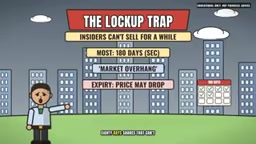
Market overhang refers to the potential supply pressure on a stock from shares that exist but haven't yet entered circulation. It doesn't necessarily only take effect on the unlock date—as long as the market knows a large number of shares could be sold in the future, current buyers will demand a discount, and the price may start weakening before expiration. The size of the overhang can be measured by "the proportion of tradeable shares to total shares outstanding after the offering"; the higher the proportion and the more concentrated the unlock, the greater the pressure.
Lockup terms are not one-size-fits-all. Beyond the standard 180-day blanket lockup, investment banks often negotiate staggered lockups with insiders (e.g., partial release 90 days after listing, the remainder at 180 days), or grant early waivers to early investors. Some agreements also include piggyback rights and demand rights, allowing existing shareholders to require the company to register their shares for sale after the lockup period. These details are usually in the "Principal Shareholders" section of the prospectus or the underwriting agreement summary; search for keywords like lock-up, lockup, and 180 days to locate them. When assessing unlock impact, also look at the holder structure of the unlocked shares: if concentrated among a few venture capital funds nearing their exit period, the willingness to sell is typically stronger.
Your IPO Checklist
Read the latest S-1, not the headlines; remember SEC review is not approval; read risk factors, use of proceeds, and dilution; compare net loss with operating performance and read the notes; know that most individuals buy after trading starts and prices can be highly volatile; mark the lockup expiration date. None of this tells you whether to buy, but it tells you what you're actually buying.
One thing you can do tonight: pick an IPO you're curious about, open its S-1 on EDGAR, and find three things—the biggest risk factor, the dilution number, and the lockup period. Write them down before you read any hot takes.
Related articles
 Tech Frontiers
Coldframe: A Honeypot Disguised as a Supermarket Freezer Controller
Coldframe is a honeypot disguised as Danfoss AK-SM 800A and Dixell XWEB freezer controllers, built as a single Python file that detects CVE-2025-41450 attempts and is identified as real devices on Shodan.
 Tech Frontiers
GRFNet: A Lightweight PyTorch Model Designed for Multichannel Time-Series Classification
GRFNet is a lightweight PyTorch model for multichannel time-series classification, originating from EEG decoding research. With only 3,847 parameters, it is based on the ROCKET architecture, combining random convolution kernels with learnable spatial filters, supports arbitrary input lengths, and will soon be evaluated on the PhysioNet dataset.
 Tech Frontiers
CUDA-Accelerated Rocket League Simulator: A Player-Made Hardcore Experiment
A Reddit post shows a "100% Accurate" Rocket League simulator accelerated with CUDA. We analyze its technical context, CUDA's value in game physics simulation, and the significance and limitations of such community projects.