Anthropic Launches Claude Duet: A 24/7 Cloud-Based Personal Assistant
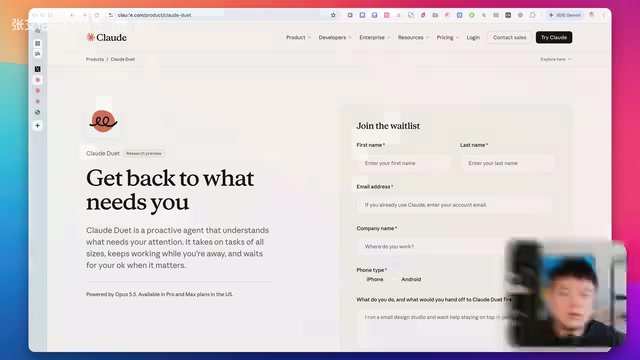
Anthropic launches Claude Duet, an always-on cloud personal agent focused on proactive reminders and cross-app collaboration.
Anthropic has released Claude Duet research preview, a Personal Agent whose core capability is a 24/7 cloud computer that keeps executing tasks and delivering results even when local devices are off. Powered by Opus 5.5 and able to read memory and skills from Claude accounts, it's positioned as a proactive assistant that flags high-priority items but requires user consent before acting. Currently available only to US Pro and Max users via waitlist, it runs as a standalone app. On security, it never directly touches passwords or tokens and can connect to Gmail, Slack, Stripe, and LinkedIn. Anthropic acknowledges early-version judgment errors and a work-focused bias with weaker personal-task support. The launch is seen as tied to competitors like Grubot, OpenAI Dots, and Meta Muse, with the Personal Agent race just beginning.
What Is Claude Duet?
Anthropic has officially launched Claude Duet as a research preview of its Personal Agent product. Like similar offerings such as Grubot, OpenAI Dots, and Meta Muse, Claude Duet's core capability is a cloud computer that runs 24/7: once a task is submitted, execution and result delivery continue even if your local device is powered off.
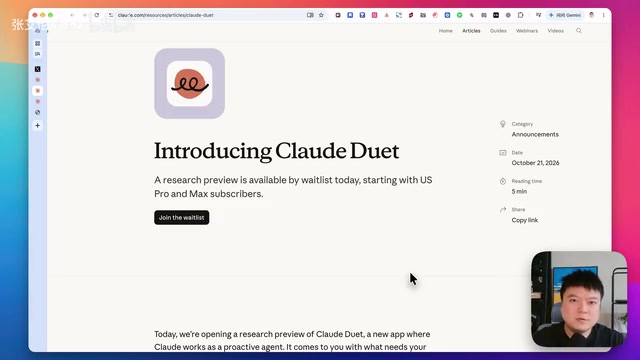
Claude Duet is currently available only to Pro and Max users in the United States, and requires joining a waitlist—fill out the form on the designated page, and once approved you can use it on the web or mobile (iPhone / Android). It runs independently of the main Claude app, though whether the two will eventually merge remains undecided. Given the earlier integration path of Claude Cowork and Claude Design, it's highly likely that an entry point for Duet will be provided within Claude.
Personal Agent is a category of AI product distinct from conversational assistants: rather than just answering questions, it has its own runtime environment and tool-calling permissions, enabling it to continuously execute complex cross-application tasks on the user's behalf. Its representative architecture is "cloud virtual machine + persistent memory + third-party app connections": tasks progress asynchronously on the server side, users don't need to stay online in the foreground, and results are returned via push notifications or messages. The key challenge of this form factor isn't the model itself, but long-task state management, failure retries, permission boundaries, and when to request human confirmation. Grubot, OpenAI Dots, Meta Muse, and Claude Duet all compete in this space, and the focus of competition is shifting from "how smart the model is" to "how many end-to-end tasks it can complete for the user."
Powered by Opus 5.5, with Memory and Skills Ready Out of the Box
Claude Duet is powered by the Opus 5.5 model and can directly read the memory and skills in your Claude account, requiring almost no additional configuration. Its target users are professionals or small business owners with too much on their plate to juggle everything.
Officially, it's defined as a "proactive assistant": it proactively reminds users of things that need attention, but obtains user consent before taking any action. Since it's already connected to a wealth of application information through Claude, it has a deeper understanding of the user; and Opus 5.5's model capabilities help it judge priorities—which matters need immediate handling, which can be deferred, and in what situations user authorization is mandatory.
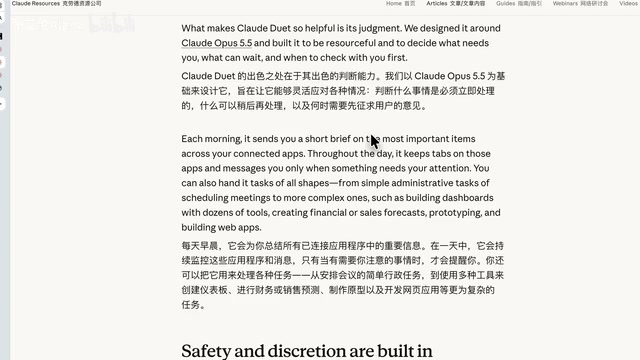
The official examples are quite telling: a user named Jazz gets the latest information from Claude Duet every morning, and one day Duet pointed out that a date on the schedule for a certain property was incorrect; another user, Mayer, had a prospective client call scheduled, and Duet noticed that the call time was very close to his flight departure time, so it proactively reminded him. This ability to "know everything about you and find the highest-priority items among many tasks" is fundamentally different from a simple scheduled reminder—it can help users brainstorm and spot time conflicts or easily overlooked details.
Proactive Agent is the counterpart to traditional "passive responsive" assistants. The latter only outputs content when the user asks, whereas the former continuously perceives information in the background, assesses priorities, and proactively initiates reminders or suggestions. Proactivity rests on three prerequisites: first, continuous grasp of user context (long-term memory of schedules, emails, messages, etc.); second, the ability to judge "what is worth interrupting the user for," typically relying on the model's reasoning about urgency and relevance; and third, an explicit authorization mechanism, meaning operations with external side effects (sending emails, rescheduling, making payments) must be confirmed first. Proactive design can significantly boost value in low-information-density scenarios, but it also brings risks of nuisance false alarms and unauthorized actions, which is why "get consent first" is nearly a universal safety baseline for all such products.
Security Design and Plugin Ecosystem
In scenarios requiring human takeover, Claude Duet will prompt the user to step in; it also has a strict security design for handling credentials, never directly touching users' passwords or tokens.
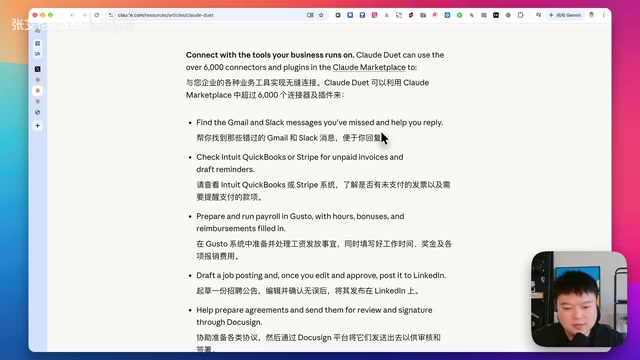
On the plugin front, Claude Duet can connect to services such as Gmail, Slack, Stripe, and LinkedIn, leaving considerable room for imagination.
Credential Isolation is a common security design in agent products: users' passwords and access tokens are never directly exposed to the model; instead, they're stored by a separate credential vault, and the model can only make authorized calls through restricted interfaces, subject to scope and time limits. This mitigates two risks: prompt injection attacks tricking the model into leaking keys, and high-privilege side effects from model errors. It's usually paired with a human confirmation step—inserting a confirmation before sensitive actions like sending emails, modifying schedules, or initiating payments. For agents connected to services like Gmail and Stripe that contain large amounts of private and financial information, credential isolation and the principle of least privilege are key prerequisites for enterprise adoption.
Limitations of the Early Version
Officially, Anthropic acknowledges that as an early version, Claude Duet may have judgment biases or errors. In addition, it's primarily designed around work scenarios, with relatively weak handling of personal matters—features like booking tickets may not yet be fully polished. Claude Duet is currently a standalone app, separate from the main Claude app; Anthropic says it will coordinate how the two work together based on early user feedback, with no decision yet on a future merger.
Why Launch Now? An Inevitable Choice Under Competitive Pressure
Anthropic's launch of a Personal Agent at this time is most likely driven by competitors' pace—Grubot in August, OpenAI Dots in September, and Meta Muse are all validating the Personal Agent design concept.
For heavy Claude users, context information and usage habits are already stored in the Claude ecosystem, so Duet is likely to be the preferred choice. But whether to switch, and which scenarios to hand over to Duet, will still depend on real-world experience.
Competition in Personal Agents has only just begun—which one do you use most right now? Feel free to share in the comments.
Related articles
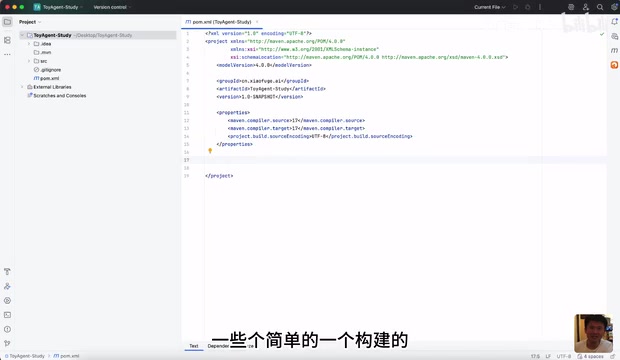
Learn AI Agent Development for Free: Build a Minimal Conversational Agent from Scratch
Based on Xiao Fu Ge's free Bilibili course, this lesson covers the five-stage AI Agent learning path, OpenAI protocol integration, a lightweight Java project, and building a minimal conversational agent.

Zero-Code AI God Sandbox: Is This Reddit User's Wild Idea Feasible?
A Reddit user wants 3-4 AI agents to play gods in a sandbox world for friends to interact with. Is this zero-code idea technically feasible? We break down the barriers.
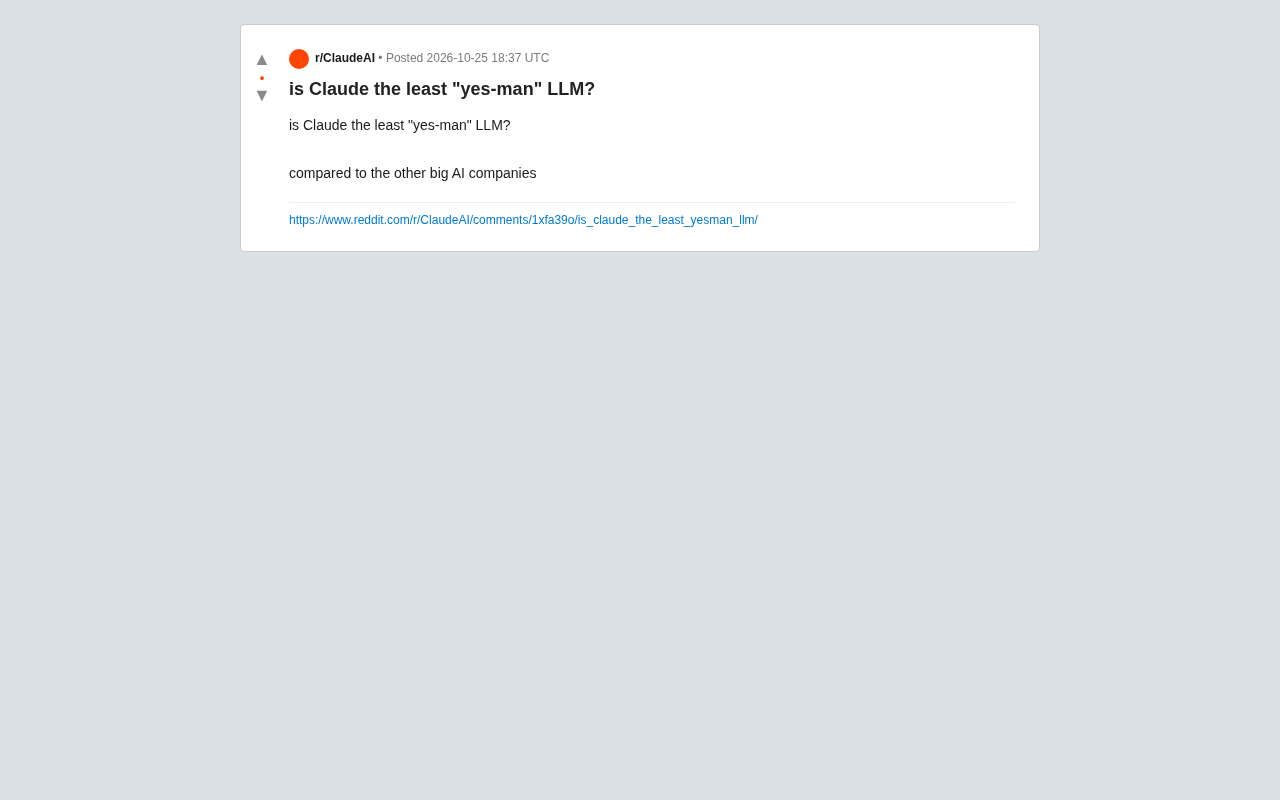
Is Claude the AI That Refuses to Be a "Yes-Man"? A Reddit Discussion
Reddit discusses whether Claude is the least "yes-man" LLM. This article analyzes Claude's honesty design, comparisons with other models, and users' real attitudes toward AI people-pleasing.