Anthropic Launches Claude Duet: An In-Depth Look at the Personal AI Agent

Anthropic launches Claude Duet, a proactive personal AI agent entering the always-on assistant race.
Anthropic has released Claude Duet, a personal AI agent for busy professionals and small business owners, available as a standalone iOS/Android app and on the web, currently US-only with a waitlist. It shifts from passive Q&A to proactive intervention: daily briefings, all-day monitoring of connected apps, and per-action approval for sensitive operations. Compared with Grokbot, Duet favors a single continuous thread and closed-loop ecosystem integration, with shared quota a key real-world constraint.
Anthropic has officially launched its personal AI agent Claude Duet (also referred to as ClawDuet in the video voiceover), stepping directly into the arena occupied by Grokbot, ChaChaPityDots, and Metamuse. This is not just another chatbot — it's a persistent assistant that aims to insert itself into your workflow as a "teammate." Here's a breakdown of the launch across four dimensions: features, competitive differentiation, security mechanisms, and real-world limitations.
Product Positioning: For Busy Operators, Not Developers
Anthropic's official article is clear on positioning: Claude Duet targets professionals and small business owners who are juggling many things and struggling to keep track of progress. It's a standalone iOS/Android app, also available on the web, which distinguishes it from the developer-oriented Claude Code.
Access requirements are worth noting. During the product research preview phase, Duet is included in the Pro and Max subscription plans, so existing paying subscribers don't need to pay extra. But it's currently limited to the US and requires joining a waitlist. This means most users won't be able to try it directly in the near term.
Claude Code is Anthropic's previously launched developer-oriented agent product, running primarily in the command line or IDE and focused on code writing, debugging, and repository-level tasks. It's not aimed at general office scenarios; rather, it packages large model capabilities into a development assistant that can call local tools and execute multi-step programming tasks. The article uses Claude Code as a reference point to illustrate the fundamental difference between Duet and it in terms of target users and interaction form: the former serves engineers' coding flows, the latter serves operators' business flows. This also explains why Duet uses standalone mobile and web apps rather than being embedded in a development environment. For users already familiar with Claude Code, one of Duet's selling points is precisely that it shares the same account system and memory, lowering the barrier to switching into daily task management scenarios.
Proactive Workflow: From "You Ask, It Answers" to "It Reminds You First"
Duet's core design shift is from passive response to proactive intervention. Every morning it pushes a briefing summarizing the most critical tasks across your connected apps; throughout the day it keeps an eye on those apps and only messages you when your input is genuinely needed.
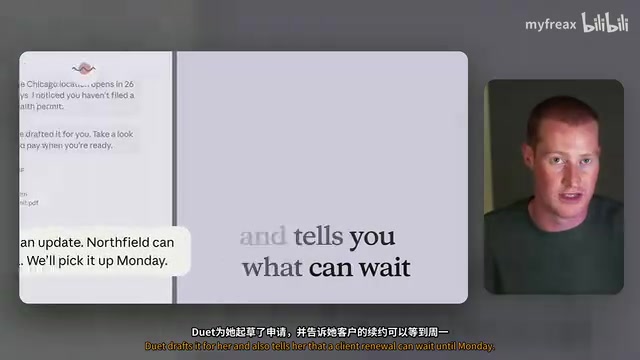
In Anthropic's official demo, there's a case involving a coffee shop owner: the system discovered his new store was opening in 26 days but the health permit hadn't been applied for yet, so it proactively drafted the application materials and also noted that client renewals could wait until next Monday.
For larger-grained tasks, Duet can build dashboards, sales forecasts, and even web apps. To be objective: ChaChaPityDots, Grokbot, and Metamuse already have similar capabilities. Duet's differentiation lies in being directly embedded in the Anthropic and Claude ecosystem — if you're already a heavy user of Claude Code or other Claude products, the migration cost is close to zero.
How It Works: Inherited Memory, a Cloud Computer, and Approval Steps
Duet inherits memory, skills, and connected apps from your Claude account, so existing users basically don't need to reconfigure anything. Interaction happens in a single continuous conversation thread, supporting both typing and voice, with everything from quick questions to multi-week projects continuing within the same context.
It has a cloud computer with its own browser, so it can keep working even when your phone or laptop is off — consistent with the direction of competitors like Grokbot and Metamuse. To avoid burning through quota too quickly, it checks connected accounts every few hours rather than polling continuously.

Before any action like sending a message, making a payment, signing a document, or deleting something, Duet shows the specific action and waits for approval. Some operations are prohibited even with approval, such as trading stocks or transferring money between accounts. It supports over 6,000 connectors and plugins, covering scenarios like checking unpaid invoices and drafting payment reminders in QuickBooks, preparing payroll in Gusto, and preparing contracts for signature in DocuSign.
Connectors refer to standardized interfaces through which agents access external apps and data sources, typically established via OAuth authorization or official APIs, enabling the model to read information from email, calendars, and financial software, and to perform write operations within the authorized scope. The article mentions that Duet supports over 6,000 connectors and plugins, covering commonly used enterprise systems like QuickBooks, Gusto, and DocuSign — meaning its capability boundary depends heavily on the breadth and stability of these third-party integrations. The connector mechanism also forms the foundation of the security design: the agent doesn't directly hold user passwords but accesses services through authorization tokens, and revoking authorization cuts off access. Understanding this helps assess Duet's usability and data governance risks in real enterprise environments.
Security Design: No Passwords in Sight, Sensitive Information Requires Explicit Authorization
For an agent that reads email and data from various apps, security is an unavoidable issue. Anthropic's explanation: Duet doesn't directly touch your passwords or login tokens; checks have been added to refuse sharing information like credit card numbers and government IDs; sensitive information such as health status and personal finances is only sent externally when you explicitly instruct it to. Anthropic has also invited external organizations to conduct red team attack testing. For users planning to hand over their inbox, this mechanism provides a baseline level of trustworthiness, but the red team results haven't been disclosed in detail, so the actual strength of protection remains to be seen.
Red team testing is an adversarial security assessment method in which independent security researchers simulate real attackers' techniques, attempting to induce the agent to leak sensitive information, perform unauthorized operations, or bypass approval flows. Anthropic inviting external organizations to conduct red team attack testing on Duet is a common practice before releasing current large model products, aimed at discovering prompt injection, privilege escalation, and other vulnerabilities before open access. It's worth noting that red team conclusions usually exist as internal reports with limited public disclosure; the article also points out that specific results haven't been made public in detail. So while such testing demonstrates that the vendor has security awareness, it cannot replace users' own risk assessment in actual deployment.
Early User Feedback: Reviewing Checklists on Walks, Wrong Dates Flagged in Advance
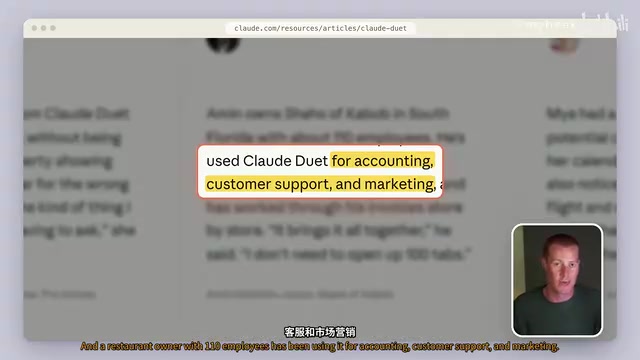
The more valuable part of the launch article is the real-world scenarios from early users. Boris, the creator of Claude Code, goes through his to-do list with Duet while on walks rather than saving it all up for his desk; a real estate agent mentioned that one morning Duet flagged a showing on her calendar with the wrong date without being asked; a restaurant owner with 110 employees uses it for accounting, customer service, and marketing. These cases all point to the same shift: AI is moving from "a tool you invoke" to "a collaborator that's always present."
Key Differences from Grokbot: Multi-Agent and Model Choice
The original video's author points out a divergence worth examining. Grokbot allows setting up specialized agents for specific tasks and having them communicate and collaborate — for example, routing invoice processing to an invoice agent — so different conversations don't get mixed together. Duet is currently a single continuous thread, and whether multi-agent collaboration will be allowed is unclear.
Another difference is at the model layer. Elon stated on social media that Grokbot would call different models for different tasks, mentioning Claude Opus 5.5, but that's the only official source and the specific implementation is unverified. The author suspects Anthropic won't open up third-party models in Duet. If that holds true, Duet's model flexibility will be weaker than Grokbot's, but in exchange it gets deeper integration with the Claude ecosystem. The two represent different product philosophies: open orchestration vs. closed-loop experience.
A Limitation Not to Ignore: Shared Quota
Duet shares usage quota with other Claude products, and background checks also count toward consumption. Heavy tasks like creating presentations and financial models burn through tokens faster, so users near their limit may run out of quota sooner. Of course, if Opus 5.5's token efficiency has improved significantly as the author suggests, the actual impact may be smaller than expected — but that depends on the specific workload.
Competitive Landscape and Selection Advice
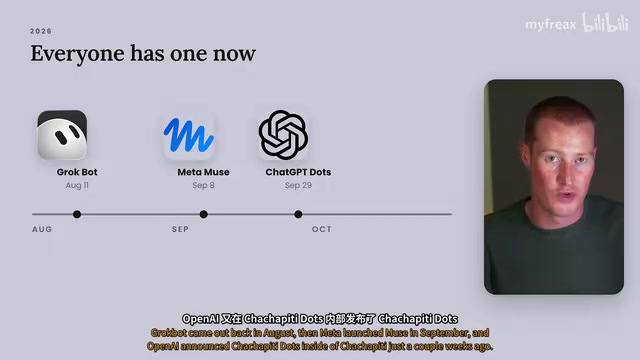
Looking at the timeline: Grokbot launched in August, Meta released Muse in September, OpenAI launched a similar feature within ChaChaPityDots, and now Anthropic brings Duet. The always-on pocket assistant is becoming the mainstream form of AI products — you can make progress without sitting at a computer.
For users, the choice depends on three variables: whether you're deeply invested in the Claude ecosystem (which determines Duet's migration cost), whether you need multi-agent task decomposition (Grokbot's advantage), and how much you value model choice. The author himself has used Grokbot for two months, mainly for handling email, and explicitly says he may not switch. This isn't a rejection of Duet — it just shows that with agent products, usage inertia and workflow fit often matter more than feature lists.
Duet is still in the waitlist phase, and the gap between the real experience and the official demo will need to be judged once open access arrives.
One-line Summary
Anthropic launches Claude Duet, a proactive personal AI agent entering the always-on assistant race.
Paragraph Summary
Anthropic has officially released its personal AI agent Claude Duet, targeting busy professionals and small business owners, offered as a standalone iOS/Android app and on the web, currently limited to the US with a waitlist. Its core shift is from passive Q&A to proactive intervention: a daily briefing, all-day monitoring of connected apps, alerts only when needed, and the ability to build dashboards, sales forecasts, and even web apps. Duet inherits memory and skills from your Claude account, has its own cloud browser, requires per-action approval for payments, contracts, and deletions, and prohibits stock trading and transfers even with approval. Compared with Grokbot, Duet leans toward a single continuous thread and closed-loop ecosystem integration, with multi-agent collaboration and third-party model choice still unclear. Shared quota is an important constraint in real-world use.
Related articles

LangChain Retry Middleware Configuration: Practices and Selection Guide
Based on Reddit community discussion, this article analyzes LangChain ModelRetryMiddleware retry parameter configuration practices, covering the selection logic and alternatives for key options like max_retries, backoff_factor, and jitter.

Texas Senate Race in Trouble: Why Are Republicans Nervous?
Texas Senate race stirs Republican anxiety. Based on street interviews, this article analyzes the Democratic offensive in funding, organization, and running everywhere, and how Republicans are defending "Texas, Texas" amid the political pendulum effect.

Gemini Chat Now Generates and Edits Google Docs Directly, a New Breakthrough in Office Productivity
Google Gemini's chat interface now generates and edits PDF, Google Docs, Sheets, Slides, Markdown, TXT, and code files. Available to all users; web supports all formats, mobile only PDF for now.