Anthropic Launches Claude Duet: The Era of Proactive AI Agents Arrives

Anthropic launches proactive agent Claude Duet, entering the new space with judgment and approval boundaries.
Anthropic released the research preview product Claude Duet, powered by Claude Opus 5.5 and running on a separate computer in the cloud, transforming from a passive chatbot into an AI agent that proactively pushes briefings and reminders. It sends briefings at multiple points daily but only interrupts when needed; it must wait for user approval before emails or payments, separating autonomous execution from irreversible actions. Anthropic emphasizes judgment as its core value. Meanwhile, Meta Muse and OpenAI Dots are emerging密集ly, and proactive agents have become a multi-vendor bet. The article also highlights an overlooked cost: Duet shares subscription usage limits, with background checks counting too, so heavy users may hit caps faster. Currently available to US Pro and Max users via waitlist.
Anthropic recently released a new app called Claude Duet, transforming its large model from a passive, response-driven chatbot into a proactive AI agent that comes to you. Powered by Claude Opus 5.5 and running on a separate computer in the cloud, it proactively pushes briefings and reminders to users—marking an evolution in AI assistant product form from "you ask, I answer" to "I think ahead for you."
How the Proactive Agent Works
The core logic of Claude Duet is the exact opposite of a typical chat product. According to Anthropic, it sends users briefings every morning and at multiple points throughout the day, but only proactively messages when something genuinely requires the user's attention—rather than flooding them with every detail.
More critically, there are permission boundaries: before sending an email or making a payment, Claude Duet stops and waits for user approval. This shows that Anthropic deliberately separates "autonomous execution" from "irreversible actions" in its design—the agent can proactively assess and proactively remind, but still needs human oversight when it comes to external actions.
Anthropic believes the real value of this product lies in its "judgment"—the ability to distinguish which matters need user intervention and which can wait. This actually points to the hardest technical challenge for proactive agents: not whether it can do something, but whether it knows whether it should, and when.
Research Preview is a common staged format in AI product launches: vendors open features still under validation to a limited set of users, aiming to observe model behavior and collect feedback in real-world usage environments rather than pushing it directly to market as a mature product. Similar terms to research preview include "experimental feature" and "beta test." Its key characteristics are: features may be adjusted or discontinued at any time, terms of service and data usage policies often have separate provisions, and users should not assume its behavior is already stable. For Anthropic, many of Claude's capabilities have previously been released in a similar limited fashion first, with decisions on broader availability made based on actual performance. Therefore, understanding Duet within a "research preview" framework explains why it is only available to Pro and Max users in the US and requires access through a waitlist—this is a means for the vendor to control its risk exposure.
Competition in the Proactive Agent Space Is Heating Up
The timing of Claude Duet's release is quite delicate. According to the video content, Meta's Muse and OpenAI's Dots were both launched after early September, along with other products like Grogbot. In other words, proactive AI agents have moved from proof of concept to a direction that multiple vendors are simultaneously betting on.
The product logic behind this is not hard to understand: pure conversational AI has become highly commoditized, and the breakthrough for user retention and willingness to pay lies in having AI take on more responsibility for "proactively discovering and handling matters." Whoever can get judgment right can turn agents from toys into everyday infrastructure.

The commoditization of conversational AI is the premise for understanding this round of proactive agent competition. As the general conversational capabilities of various foundation models gradually converge, the pure "chat" interaction form can hardly constitute differentiation anymore: users can switch between different products at low cost, and willingness to pay is accordingly diluted. Vendors therefore began looking for new value anchors, shifting competition from "how well the model answers" to "how much the product can accomplish on behalf of the user." Proactive agents have become the direction in this context—they transform AI from a tool that is invoked into a service that continuously runs in the background, thereby creating higher usage stickiness and clearer reasons to pay. This also explains why Meta, OpenAI, and Anthropic密集 launched similar products in a similar time window: what they are competing for is not the quality of any single conversation, but who users entrust with "keeping an eye on and handling things for me" in their daily lives.
A Limitation That Should Not Be Overlooked: Shared Usage Limits
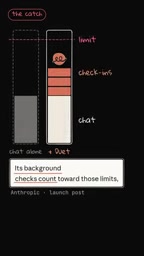
Claude Duet has an easily overlooked cost issue. According to the video, Duet shares usage limits with your current subscription plan, and its periodic background checks also count toward the quota. This means users of Duet may hit usage caps faster than those using only chat features.
For heavy users, this is no small issue. The value of a proactive agent lies precisely in continuously running in the background, frequently assessing and checking—and these actions all consume quota. The more "diligent" the product, the faster the quota is consumed, and users need to weigh the agent's proactivity against cost.

Usage limits are a common cost-control mechanism in subscription-based AI products: vendors set a cap on the amount of computation that can be consumed within a given period for each subscription plan, usually measured in number of messages, token count, or number of calls within a time window. Once the limit is reached, users must wait for a reset or upgrade their plan. For chat products, quota consumption is basically proportional to the number of conversations the user actively initiates, making it relatively easy to estimate. But proactive agents change this model—the periodic checks, assessments, and briefing generation they perform in the background also call the model. These calls are not directly triggered by the user, yet they genuinely consume compute. Thus the quota shifts from being "a function of user behavior" to "a function of product behavior," and users' control over the pace of consumption decreases. This is why agent products generally need to strike a delicate balance between proactivity, check frequency, and subscription cost.
Release Scope and Key Things to Watch
Claude Duet is currently in research preview, available to Pro and Max subscribers in the US through a waitlist. This arrangement is consistent with Anthropic's一贯 cautious style: first validate product behavior on a small scale, then decide whether to expand.
The key things to watch next are clear: how well its judgment actually performs in real-world scenarios. Anthropic touts "knowing what should interrupt you" as its core selling point, but this is also the hardest part to quantify and the easiest to get wrong—too few reminders and it loses the meaning of a proactive agent; too many and it becomes noise. User feedback during the research preview phase will directly determine whether such products can go from novelty to the norm.
From a broader perspective, Claude Duet represents a shift in product paradigm: AI no longer waits for instructions but proactively intervenes in workflows with judgment. The barrier in this direction is not model capability but boundary design—when to speak, when to wait for approval, and when to stay silent. Anthropic's answer is "humans retain final approval authority," which may well become the industry default rule for proactive agents.
One-line Summary
Anthropic launches proactive agent Claude Duet, entering the new space with judgment and approval boundaries.
Paragraph Summary
Anthropic released the research preview product Claude Duet, powered by Claude Opus 5.5 and running on a separate computer in the cloud, transforming from a passive response-driven chatbot into an AI agent that proactively pushes briefings and reminders. It sends briefings at multiple points throughout the day but only interrupts users when something genuinely needs attention; it must wait for user approval before sending emails or making payments, clearly separating autonomous execution from irreversible actions. Anthropic emphasizes that its core value is judgment—distinguishing what needs intervention from what can wait. Meanwhile, similar products like Meta Muse and OpenAI Dots are appearing密集ly, and proactive agents have become a direction multiple vendors are betting on simultaneously. The article also highlights an easily overlooked cost: Duet shares usage limits with the subscription plan, and background checks also count, so heavy users may hit caps faster. The product is currently available to Pro and Max users in the US through a waitlist.
Related articles

Vibe Coding Full-Stack in Practice: AI Programming from Beginner to Enterprise Deployment
From Cursor to Claude Code, this Bilibili AI programming course uses four progressive projects to cover full-stack development, open-source secondary development, and team collaboration. The article analyzes the shock to frontend roles, the efficiency shift from 50 people to 5, and the methodology required for enterprise-grade projects.

David Blaine's Global Quest for Real Magic: From South Africa to Japan and India
David Blaine travels to South Africa, Japan, and India in his Do Not Attempt special, documenting Spinning drivers, black mamba rescuers, iaijutsu masters, and ascetics—exploring the boundary between magic and real human极限 challenges.

Is a Touchscreen MacBook Coming? Vergecast Reveals Apple Executive's Response
Vergecast podcast reveals a conversation between a reporter and Apple executive John Ternus about a touchscreen MacBook and Apple Pencil support. Ternus says iPad is the best device for a stylus, while the reporter bets MacBook will eventually support Apple Pencil.