Anthropic Launches Official Claude Code Plugin Directory: A Curated High-Quality Extension Ecosystem

Anthropic releases an officially curated Claude Code plugin directory to build a quality-first extension ecosystem.
Anthropic has launched claude-plugins-official, a curated directory of high-quality Claude Code plugins that has quickly gained over 33,000 GitHub stars. Unlike an open marketplace, this officially vetted collection ensures plugin trust, security, and compatibility. The move signals Anthropic's shift toward building an extensible developer ecosystem and reflects the broader AI coding industry's evolution from simple code completion tools to customizable productivity platforms.
Anthropic Launches Official Claude Code Plugin Directory
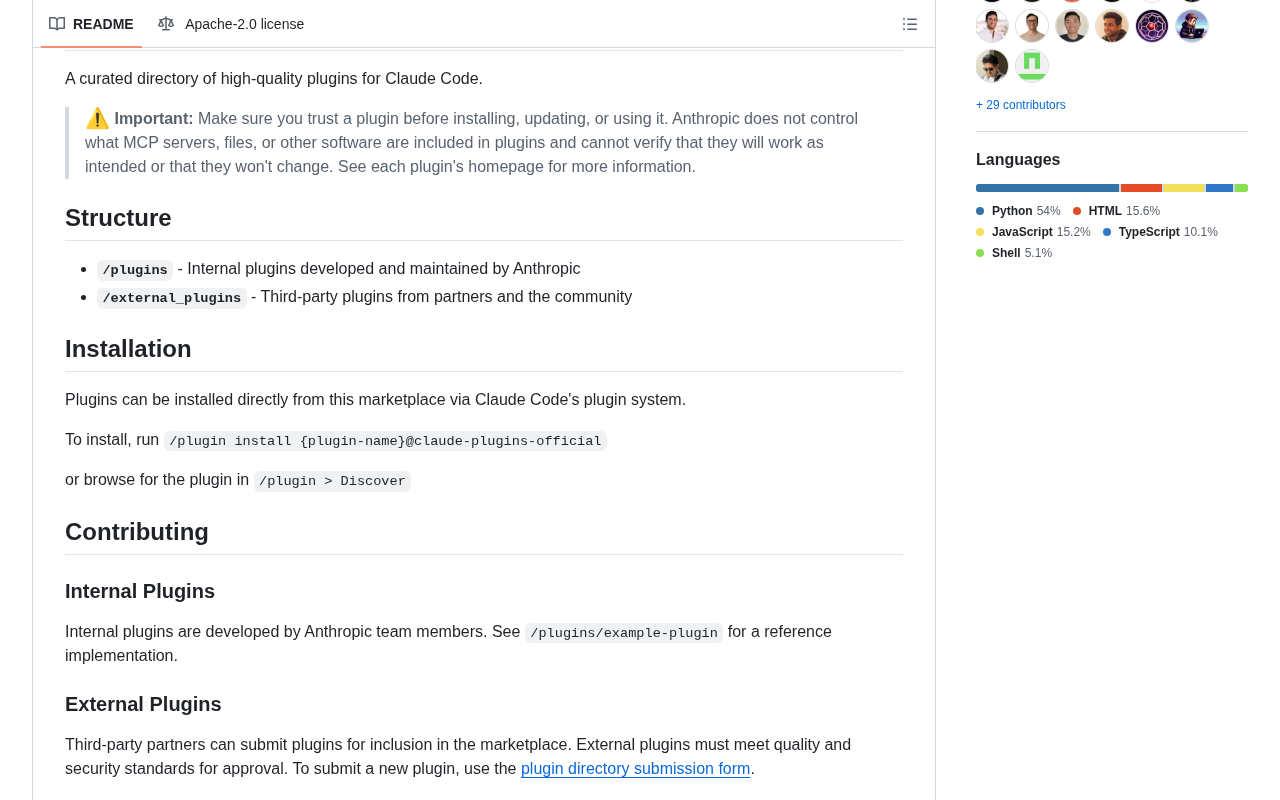
Anthropic recently released claude-plugins-official — an officially managed, carefully curated directory of high-quality Claude Code plugins. The project quickly garnered attention after launch, amassing over 33,945 stars and 3,864 forks on GitHub, with 47 new stars added on launch day alone — a clear signal of the developer community's strong demand for Claude Code ecosystem extensions.
This move marks Anthropic's transition from offering a standalone AI coding assistant to building an extensible, customizable developer ecosystem. For developers who have long relied on Claude Code for AI-assisted programming, the arrival of an official plugin directory means a more standardized and trustworthy source for plugins.
What Are Claude Code Plugins?
Claude Code is Anthropic's command-line AI coding tool that allows developers to invoke Claude models directly from the terminal to write, debug, and refactor code. Unlike traditional IDE-embedded AI assistants (such as GitHub Copilot integrated into VS Code), Claude Code runs natively in the terminal environment, interacting with developers through a command-line interface (CLI). It can read project file structures, execute shell commands, and directly modify code files. This design makes it a natural fit for DevOps pipeline integration, remote server development, and automation scripting. Under the hood, Claude Code uses carefully designed system prompts and a Tool Use mechanism to give Claude's large language models the ability to understand code context and execute multi-step programming tasks.
Plugins extend these capabilities further, enabling developers to add specific workflows, tool integrations, or domain expertise to Claude Code. From a technical standpoint, the plugin mechanism is a classic architectural pattern in software engineering. Its core idea is to allow third-party code to extend functionality without modifying the main program, through predefined interfaces (APIs) or hooks. In the context of AI coding tools, plugins typically enable several types of extensions: injecting custom system prompts to give the model domain-specific knowledge, connecting external tools and services (such as databases, CI/CD platforms, and project management tools), defining specific workflow templates (such as code review processes or test generation pipelines), and providing enhanced support for specific programming languages or frameworks. This mechanism essentially transforms the AI assistant from a "general-purpose conversationalist" into an "orchestrable intelligent agent."
Prior to this, a flood of third-party plugins had already emerged in the community, but quality varied widely and there was no unified review standard. The core value of the official directory lies in its "official curation" and "quality filtering" — all listed plugins have been evaluated by the Anthropic team, reducing the trust overhead and security risks developers face when selecting plugins.
The Significance and Positioning of the Official Claude Code Plugin Directory
As the project description makes clear, claude-plugins-official has a very specific positioning: it is not an open plugin marketplace, but rather a curated directory endorsed by Anthropic. This model is similar to Apple's App Store review process or VS Code's officially recommended extensions list — using official curation to ensure overall ecosystem quality.
It's worth understanding this more deeply. Apple's "Walled Garden" strategy sets admission thresholds across security, performance, and user experience through a rigorous app review process. While this sacrifices some openness, it significantly improves overall ecosystem quality and user trust. In the developer tools space, VS Code's extension marketplace employs a relatively lenient review mechanism, resulting in widely varying extension quality, while JetBrains' plugin marketplace falls somewhere in between. Anthropic's choice of a "curated directory" over an "open marketplace" reflects a strategic decision to prioritize quality over quantity in the early stages of its ecosystem.
Interestingly, the project uses Python as its primary language. This suggests that the directory's management tools, validation scripts, and possible plugin registration mechanisms are all built on Python. Python's dominance in the AI toolchain is no accident — it boasts the richest ecosystem of AI-related libraries (such as PyTorch, TensorFlow, LangChain, Transformers, etc.), its mature package management systems (pip/conda) provide ready-made infrastructure for plugin distribution, its dynamic typing and flexible metaprogramming capabilities make it ideal for building plugin frameworks and registration mechanisms, and since the vast majority of AI model API SDKs launch Python-first, Python-based plugins can most easily connect to various AI services.
The Value the Official Plugin Directory Brings to Developers
For teams and individual developers who use Claude Code daily, the official plugin directory addresses several key pain points:
- Trust and Security: Official review means plugins won't contain malicious code or improper data collection practices — especially critical for enterprise users. In an era of growing supply chain security concerns (with frequent incidents like npm package poisoning and malicious PyPI packages), an officially endorsed plugin source provides developers with an important security barrier.
- Discovery Efficiency: No more searching for needles in a haystack across scattered third-party repositories — developers can pick from verified plugins directly in the official directory.
- Compatibility Assurance: Officially listed plugins are more likely to stay in sync with the latest version of Claude Code, reducing functionality breakage caused by version upgrades.
The Evolution of the AI Coding Tool Ecosystem
Anthropic's move also reflects the broader direction of the entire AI coding tool landscape. As competition among GitHub Copilot, Cursor, Claude Code, and others intensifies, simple "code completion" or "conversational coding" is no longer enough to build a moat. Extensibility and ecosystem vitality are becoming the core competitive advantages for these tools.
The competitive landscape in the AI coding tool space is evolving rapidly. GitHub Copilot leverages GitHub's developer ecosystem and Microsoft's resources to maintain its first-mover market share. Cursor differentiates itself with an "AI-native IDE" positioning, deeply integrating AI capabilities into the editor experience. Google's Gemini Code Assist and Amazon's CodeWhisperer are each building on their respective cloud ecosystems. Claude Code's choice of a command-line tool plus plugin ecosystem is fundamentally a play to capture the "developer workflow entry point" — entering through the terminal, the interface developers use most frequently, and gradually covering the entire lifecycle from coding to deployment through an extensible plugin system. The endgame of this competition may not hinge on which tool has the most accurate code completion, but on who can build the most vibrant and sticky developer ecosystem.
By opening up the plugin mechanism and providing an official directory, Anthropic is effectively doing two things: encouraging community-driven innovation so Claude Code can cover more niche use cases, while maintaining a quality baseline through official oversight to prevent the ecosystem from spiraling due to low-quality plugins. This dual-track strategy of "openness + review" is an important hallmark of platform product maturity.
The Signal Behind the High Attention
The data — 47 stars on launch day and a cumulative total exceeding 33,000 — indicates that Claude Code has already built a substantial base of loyal users. These developers have clear expectations for official ecosystem development — they don't just want to use AI coding tools, they want to deeply customize them to fit their own workflows.
Behind this high level of attention lies a transformation: AI coding is moving from "novelty" to "productivity tool." AI coding tools are undergoing a critical transition from "tech toy" to "productivity infrastructure." Early adopters experimented with AI code generation mainly out of curiosity, with scattered use cases. But once these tools enter production environments, enterprises and teams impose fundamentally different requirements: reliability (they can't fail at critical moments), auditability (the origin and quality of AI-generated code must be traceable), customizability (they must adapt to specific tech stacks and coding standards), and security compliance (code cannot leak externally and must meet industry regulations). A plugin-based architecture is precisely the key mechanism for addressing these production-grade needs — through plugins, enterprises can inject their internal coding standards, security policies, and domain knowledge into the AI assistant, turning it into a truly customized productivity tool for their team. When developers begin seriously incorporating AI assistants into their daily workflows, extensibility through plugins and modular architecture becomes indispensable.
Summary and Outlook
The launch of claude-plugins-official is a significant step in Anthropic's AI coding ecosystem strategy. It not only provides developers with a trustworthy source of plugins but also lays the foundation for the healthy growth of the entire Claude Code ecosystem.
Looking ahead, as more high-quality plugins are added, Claude Code has the potential to evolve from a general-purpose coding assistant into a development platform that can be flexibly configured for different tech stacks and industry scenarios. For developers following the AI coding space, keeping up with updates to this official directory will be an important window into understanding the expanding boundaries of Claude Code's capabilities.
For developers who want to contribute to the ecosystem, the directory's openness also represents a new opportunity: having a plugin accepted into the Anthropic-curated collection could become an effective path to building influence in the AI coding community.
Related articles

Chain of Thought Isn't Just for AI: How Humans Can Use CoT to Improve Thinking Quality
Chain of Thought isn't just a prompt trick for large models. Starting from a Hacker News discussion, this article analyzes why CoT works for human thinking too, breaks down actionable ways to transfer it, and highlights the key differences between human CoT and machine CoT.
Cloudflare Teams Up with OpenAI: Closi…
Cloudflare Teams Up with OpenAI: Closing the Loop from Vulnerability Discovery to Defense with AI
Cloudflare uses OpenAI Daybreak to investigate security vulnerabilities and generate reviewable remediation plans, while developers use Codex to boost coding efficiency and quality.

Orca Multi-Agent Orchestration in Practice: A Guide to Parallel Collaboration with Claude and Codex
Orca is Stable AI's free open-source agent workbench supporting 34 agents like Claude Code and Codex in parallel. Learn its Git worktree isolation, multi-model orchestration, and mobile management.