Anthropic Launches Proactive AI Agent Claude Duet: Always-On in the Cloud, Takes Initiative

Anthropic launches the always-on cloud-based proactive agent Claude Duet, marking AI's shift from tool to digital employee.
Anthropic's Claude Duet is an agent running in the cloud, online 24/7, proactively seeking work, unlike passive Q&A tools. Its workflow: sync context and bind 6,000+ office systems, periodic background inspection, proactive reporting with confirmation before key operations. Features include one-time virtual card payments, restrained notifications, and hard safety red lines. Limitations: insufficient timeliness, misjudgment risk, and trust barriers for granting permissions. It signals AI's shift from command-answering tools to proactive digital employees, with evaluation shifting from answer quality to task results.
Anthropic has released an AI product of a completely different form—Claude Duet. It is no longer a Q&A tool that waits for you to type a question before speaking, but an agent that runs in the cloud, stays online 24/7, and proactively seeks out work to do. This shift may seem like just a change in interaction style, but it actually touches on the most fundamental positioning question for AI products: Is AI a tool, or a colleague?
From "You Ask, It Answers" to "It Finds Work to Do"
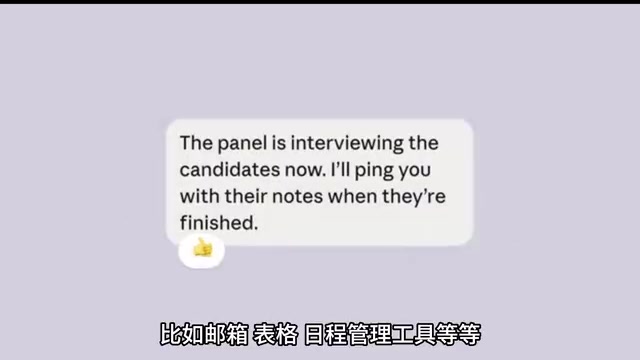
The ChatGPT, Gemini, and even Claude we've known in the past are all essentially passive response systems. When you close your laptop, their work stops; if you don't ask, they won't act. According to a Bilibili video, Claude Duet's underlying logic is completely different—it runs on an independent virtual machine in the cloud, so even if you shut down and go to sleep, it continues processing tasks in the background.
The direct result of this "offline always-on" capability is that, for the first time, AI has temporal continuity. It is no longer a one-off session, but a continuously existing execution entity. The video's author used a very apt analogy—past AI was a co-pilot, with the steering wheel always in your hands; Claude Duet is more like a trusted assistant: you give it a goal, it finds its own path to completion in the background, and only comes to you for sign-off at key junctures.
Agent is the key concept for understanding Claude Duet's positioning. In the AI field, an agent refers to a system that can perceive its environment, plan autonomously, and invoke tools to execute multi-step tasks to achieve a goal. Unlike traditional Q&A models, agents are goal-oriented, environment-interactive, and autonomous in action. Claude Duet, residing on a cloud virtual machine, proactively inspecting and reporting, is a typical embodiment of the agent paradigm—it no longer merely generates text, but actually changes work states by calling external system interfaces. This paradigm shift requires models to have stronger planning, tool-use, and error-recovery capabilities.
Three-Step Workflow: Connect, Inspect, Report
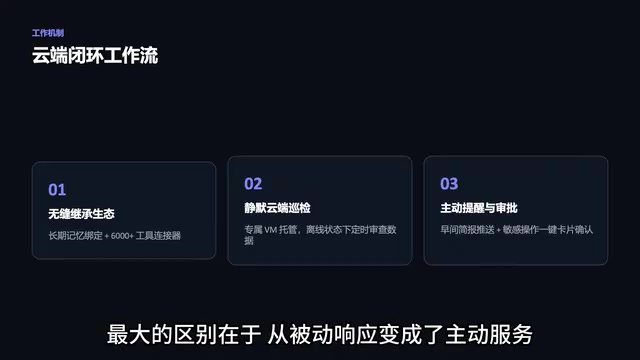
Claude Duet's operating mechanism can be broken down into three steps, with fairly clear logic.
The first step is connecting context. It syncs your past conversation memory and operating habits, and binds to over 6,000 everyday office and business systems, covering email, spreadsheets, schedule management tools, and more. This step determines whether it can truly understand your work scenarios rather than giving generic advice.
The second step is periodic background inspection. Like a butler, it automatically checks the data status of each system every few hours—whether there are urgent emails, unpaid bills, or abnormal fluctuations in business metrics.
The third step is proactive reporting and requesting instructions. Every morning it pushes a work briefing listing the day's most important appointments and items to note. If it encounters something requiring cross-system operations—such as sending an email, making a payment, or signing a document—it first does the preparatory work in the background, then pushes a confirmation card to your phone; only after you tap confirm once does it officially execute.
The key to this process design is the retention of a "human-machine confirmation point." AI handles the heavy preparation and inspection, humans make the key decisions, and the boundary of responsibility is not blurred.
Human-in-the-loop is the core mechanism for ensuring safety and controllability in the design of proactive agents. It refers to inserting human confirmation at key decision points in automated processes, with the human giving final authorization. Claude Duet pushing confirmation cards before operations such as sending emails, making payments, or signing documents is exactly an application of this mechanism. Its value lies in: retaining AI's efficient preparation and execution capabilities while returning the responsibility and decision-making power for irreversible operations to humans, thereby striking a balance between automation and safety. Fully automated agents without confirmation points are extremely risky when funds or sensitive data are involved.
Several Notable Features
Beyond the main workflow, Claude Duet has several design aspects worth discussing separately.
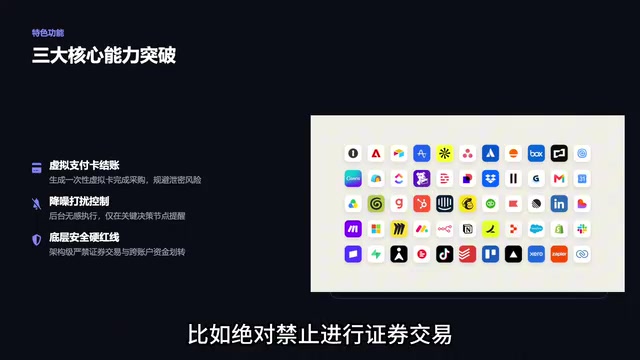
Virtual card payments. If it needs to buy software or procure items online for you, it can generate a one-time virtual payment card to complete checkout. This achieves an automated closed loop while avoiding the risk of exposing your main card number—a compromise between security and convenience.
Interruption control. The product emphasizes "quiet by default, alert only when necessary," and won't push frequent notifications just to appear present. Behind this choice is a direct response to information anxiety—if an always-on background AI keeps interrupting you, its value quickly turns into a negative asset.
Hard safety red lines. The system has insurmountable restrictions at the底层 (底层) level, such as absolutely prohibiting securities trading or direct fund transfers between accounts. The significance of such hard constraints is to fundamentally reduce the probability of irreversible losses caused by AI misoperation.
Virtual card payment is a secure payment method that completes online transactions by generating a one-time or limit-capped virtual bank card number. Once isolated from the main card number, even if the virtual card information is leaked during a transaction, it cannot affect the security of the main account funds. Claude Duet integrates this into its agent workflow, enabling AI to complete closed-loop operations such as procurement within authorized limits while avoiding long-term exposure of real payment credentials. This design reflects the implementation of the "least privilege" principle in AI payment scenarios.
Limitations Are Equally Obvious: Timeliness, Misjudgment, and Authorization Barriers
The video author's analysis of limitations is fairly objective, and these points deserve serious consideration by potential users.
Timeliness and cost. Always-on cloud residency plus frequent polling consumes a lot of computing resources. Currently it cannot achieve true second-level response; it usually inspects once every few hours. This means it is suited to tasks that "do not require immediate feedback," rather than replacing real-time conversation.
Misjudgment risk. As long as it is AI, there remains the possibility of hallucination or misreading information. If it misses an urgent email or misjudges a business metric, the trouble it causes may be greater than the time it saves.
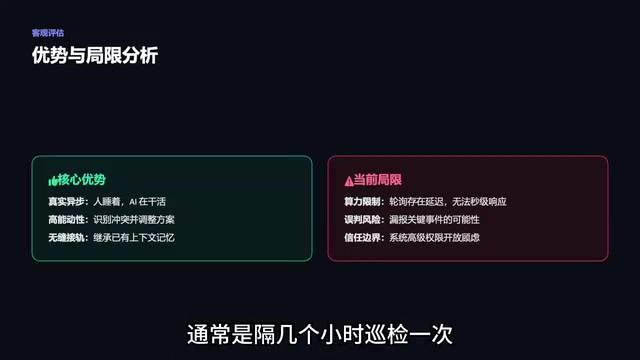
Security and trust authorization. To let it deliver maximum value, you must hand over permissions to your everyday office systems. How much permission dare you grant an AI? This is a psychological threshold every user must face, and the hardest hurdle for such products to overcome before large-scale adoption.
Polling is the technical basis of Claude Duet's background inspection, referring to the system actively querying each data source at fixed intervals to see whether there are updates. Compared with event-driven real-time push, polling is simple to implement but has latency, and frequent queries consume more computing power and API resources. This explains why it typically inspects every few hours rather than responding in seconds. The longer the polling interval, the more likely urgent events are missed; the shorter the interval, the higher the cost. This trade-off directly determines that the product is currently suited to non-immediate tasks.
A Signal of Product Form Shift
Claude Duet is still in preview testing, and limited by computing costs and security considerations, its capability boundaries are clearly visible. But the shift it represents is worth noting: AI products are moving from "tools that answer questions on command" toward "digital employees that can proactively share the workload."
The deeper meaning of this shift is that the standard for measuring AI value will change from "how well it answers" to "how much it has done for you." The former is an experience issue; the latter is a results issue. When AI begins to be responsible for results, the way people build trust in it, grant it permissions, and even evaluate it all need to be redesigned.
Whether the collaboration model of "people sleep while AI works" will become the norm in future office work is still undecided. But what is certain is that proactive agents have already put this question on the table.
One-line Summary
Anthropic launches the always-on cloud-based proactive agent Claude Duet, marking AI's shift from tool to digital employee.
Paragraph Summary
Anthropic's Claude Duet is an agent that runs in the cloud, stays online 24/7, and proactively seeks out work to do, completely different from passive traditional Q&A tools. Its workflow has three steps: syncing context and binding to over 6,000 office systems, periodic background inspection, and proactive reporting with confirmation requests before key operations. Notable features include one-time virtual card payments, restrained notifications, and hard safety red lines such as prohibiting securities trading. The main limitations are insufficient timeliness due to inspection intervals, AI misjudgment risk, and the trust barrier for users to grant system permissions. The article argues that this represents AI products moving from "tools that answer questions on command" toward "digital employees that can proactively share the workload," with evaluation standards shifting from answer quality to task completion results.
Related articles

Domestic AI Coding Plans Compared: How to Choose Between Zhipu, Kimi, and MiniMax
Compare Zhipu GLM Coding Plan, Kimi Code, and MiniMax M-Plan on pricing, points/quota rules, and model changes, plus scenario-based selection advice.

JetBrains Open-Sources AI IDE ThinkRail: Multi-Workspace Parallelism and Spec-Driven Development
ThinkRail is an open-source agentic IDE from the JetBrains Innovation Hub built on Pi, featuring multi-workspace parallelism, Git worktree isolation, spec-driven development, and diff review. Completely free under Apache 2.0.

Higgsfield: How AI Video Is Moving from the 1-Minute to the 10-Minute Era
Higgsfield shares AI video breakthroughs from 1 minute to over 10 minutes, covering Astra's text rendering, external tool use for 3D modeling, voice-to-movie, and productivity gains for small creative teams.