Anthropic Lists on Nasdaq: The Largest IPO in History and a $2 Trillion Valuation

Anthropic sets the record for the largest global IPO, raising $107.3 billion at a $2 trillion valuation, opening the public-market era for frontier AI labs.
Anthropic listed on Nasdaq, raising about $107.3 billion to set a global IPO record, opening at $111.50—more than 30% above its $83 offering price—at a valuation of roughly $2 trillion. CFO Krishna Rao said the company is under six years old, its annualized revenue run rate exceeds $81 billion, and it holds about $232 billion in cash, balancing compute investment and financial prudence via a "cone of uncertainty" framework across four accelerator platforms. Altimeter's Pauline Yang reflected on missing the early round before taking a heavy position, while Baillie Gifford's Peter Singlehurst pointed to model iteration and diffusion as growth engines. As the first listed frontier AI lab, its performance will shape the IPO timing of OpenAI and others, though quarterly results will likely swing sharply.
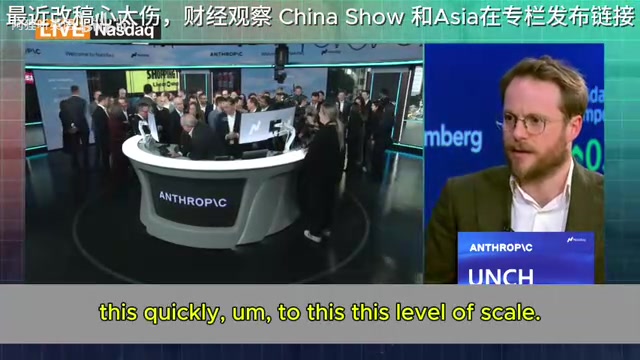
Bloomberg Tech broadcast live from the Nasdaq floor on Anthropic's first day of trading. The frontier lab, founded less than six years ago, set a global IPO record by raising approximately $107.3 billion, opening at $111.50—more than 30% above its $83 offering price—for a valuation of roughly $2 trillion. This is not just a milestone for one company; it is the first time the capital markets have priced a "pure-blooded" frontier AI lab.
A Compressed Sprint to Going Public
The timeline Anthropic CFO Krishna Rao laid out before the opening bell was striking: the company is not yet six years old, its first dollar of revenue arrived in Q1 2023, and by the month before listing its annualized revenue run rate had surpassed $81 billion. Going from zero to a hundred-billion-dollar scale took less than three years.
That growth rate also explains the frenzy of oversubscription. According to Bloomberg, the offering was nearly seven times oversubscribed. Nasdaq President Nelson Griggs said on the livestream that this was "the largest IPO ever," and noted that the retail allocation was about 13%, below the roughly 25% seen in SpaceX's earlier offering—demand was concentrated on the institutional side.
Pricing and first-day trading are equally worth recording: priced at $83, opened at $111.50, and traded in the $106–$110 range during the session. At $111.50, that is a premium of roughly 33% to 34% over the offering price.
Annualized Revenue Run Rate is a non-standard financial metric commonly used by SaaS and high-growth tech companies. It refers to the annualized figure obtained by multiplying the recurring revenue of the most recent month or quarter by 12, used to smooth seasonal fluctuations and reflect current growth momentum. It is not audited accounting revenue and does not represent a forecast of actual future revenue, so it is often criticized for overstating short-term performance. For an AI company like Anthropic with steep revenue growth, run rate directly conveys how fast the business is ramping—the journey from its first revenue in Q1 2023 to over $81 billion before listing is the most striking application of this metric; but investors still need to judge it alongside deferred revenue and the structure of contract terms.
The Financial Foundation Behind a $2 Trillion Valuation
Following the listing, Anthropic holds about $232 billion in cash and short-term investments. Rao disclosed that the company had previously held more than $130 billion in cash, and the IPO raised nearly another $120 billion. How to spend that money was the central topic of the entire interview.
Rao described the decision-making framework as a "cone of uncertainty": the further out you look, the more dispersed the distributions of compute demand for training and inference, business revenue, and model capability become. The investment strategy is therefore to "stay aggressive on compute within the cone, and conservative on the balance sheet."
Its compute approach also differs from some peers. Anthropic currently uses four different accelerator platforms, procuring compute through cloud partners as well as leasing data centers directly and renting chips separately through "Anthropic Direct." Rao emphasized that this diversified mix gives the compute pool a high degree of fungibility and resilience to market volatility.

Cone of Uncertainty originates in project management and forecasting, first proposed by software engineering scholar Barry Boehm to describe the pattern in which the error range of early project estimates first widens over time and then narrows as more information arrives. In the AI infrastructure context, CFO Rao adapted it into a decision-making framework: the further you extrapolate into the future, the wider the distribution ranges of model capability leaps, inference demand explosions, and revenue growth, making single-scenario forecasts nearly useless. Capital allocation should therefore not bet on one deterministic path, but rather maintain aggressive compute investment within the estimated range while keeping enough of a buffer on the balance sheet to handle the extreme cases at the upper and lower edges of the cone.
Accelerator platforms refer to specialized parallel computing chips used for training and inference of large models—most typically NVIDIA GPUs, but also Google TPUs, AMD Instinct, and various in-house ASICs. Different platforms vary greatly in instruction sets, memory bandwidth, interconnect topology, and software stacks (such as CUDA, ROCm, and XLA), and model code often requires targeted adaptation. Anthropic using four platforms simultaneously means its training and inference stack must be cross-platform portable; while this adds engineering complexity, it reduces dependence on any single supplier, allows flexible scheduling when supply is tight, and provides bargaining room in lease negotiations—this is the technical meaning of what Rao called "fungibility."
Investor Retrospective: From "Getting It Wrong" to a Heavy Bet
Altimeter partner Pauline Yang led the firm's private investment in Anthropic and participated in this IPO allocation. She offered a rare public retrospective on the early misjudgment.
In early 2023, Altimeter looked at an Anthropic round at a valuation of about $4 billion and ultimately passed. There were two doubts at the time: first, whether the team was truly willing to commercialize—Claude was already deployable but was held back from release, while ChatGPT got there first; second, gross margins were "shockingly bad in 2023 and 2024."
"We were proven completely wrong," Yang said. The team did an excellent job identifying coding as a high-ROI early market, and Altimeter subsequently entered with large positions in recent rounds. She also offered growth expectations: relative to the roughly 4x to 10x growth in the third quarter, growth next year is expected to slow to about 2.5x.
Three Variables to Watch After the IPO
Peter Singlehurst, head of private companies at Baillie Gifford, framed the listing as "a moment, but only one step." He identified two growth engines for understanding the company:
Model iteration. Each new model release brings a step-function jump in revenue while pushing up training compute investment, causing quarter-to-quarter data volatility.
Diffusion. Quoting William Gibson's famous line—"The future is already here—it's just not evenly distributed"—he argued that distributing existing capabilities across industries itself constitutes substantial growth headroom. He mentioned one detail: among Fortune 500 companies already using Anthropic technology, their combined spending accounts for only about 0.1% of their total, leaving enormous room for penetration.
As a long-term shareholder, Yang said she will focus on four metrics: revenue growth, compute and infrastructure as a share of revenue, gross margin, adjusted operating profit, as well as the performance of the top five customers and net retention rate. She expects this to be "a wildly volatile stock," but is bullish long term.
Net Revenue Retention (NRR) measures the change in revenue generated by an existing customer base over a year, including the net effect of upsells, cross-sells, churn, and downgrades. It is a core metric for assessing the health of an enterprise subscription business. An NRR above 100% means revenue can grow organically even without acquiring new customers. For Anthropic, this metric can reveal whether enterprise customers truly expand their Claude deployments after pilots or remain stuck in small-scale trials; combined with an observation of top-five customer concentration, it can also indicate whether revenue is overly dependent on a small number of very large customers—particularly critical to valuation stability after going public.
What It Means for a Frontier Lab to Go Public
This is the first company to enter the public markets as a pure frontier AI lab, and OpenAI is widely expected to be next. Singlehurst believes Anthropic's healthy debut "will, all else being equal, bring more IPOs."
But the public markets also bring constraints that did not exist in the private phase. Yang acknowledged that as a private company you could pick your shareholders, whereas after going public you face a shareholder base mixing long- and short-term capital along with market pressure. More challenging is the dual objective: the prospectus explicitly puts AI's existential risk to humanity at the top, while acknowledging that safety-related decisions may weigh on growth.
Yang's stance on this is supportive: if the company judges a model too powerful to release, as a shareholder she not only accepts it but agrees it serves the long-term interest. When asked whether he would use the new funds to acquire distressed cloud assets, Rao remained characteristically restrained—the company "has the capability, but will wait for the right moment."
Editorial Perspective
A $2 trillion valuation means the market has simultaneously priced in two things: continued leadership in frontier model capability and continued expansion of enterprise penetration. The problem is that neither curve is smooth: model release cadence makes revenue step-shaped, compute procurement does not arrive linearly, and quarterly earnings are almost destined to be volatile. For Anthropic, the real test is not the first-day premium, but whether it can use its $232 billion in cash to convert every bet within the "cone of uncertainty" into the next generation of leadership. For secondary-market investors, this may be the first time they need to pay a premium for a "safety-first" operating philosophy—and accept the growth drag it brings.
One-line Summary
Anthropic sets the record for the largest global IPO, raising $107.3 billion at a valuation of about $2 trillion, ushering in the public-market era for frontier AI labs.
Paragraph Summary
Anthropic listed on Nasdaq, raising about $107.3 billion to set a global IPO record, opening at $111.50—more than 30% above its $83 offering price—for a valuation of roughly $2 trillion. CFO Krishna Rao disclosed that the company is less than six years old, its annualized revenue run rate has surpassed $81 billion, and it holds about $232 billion in cash after listing; it balances compute investment and financial prudence through a "cone of uncertainty" framework and runs four accelerator platforms in parallel. Altimeter partner Pauline Yang reflected on missing the early investment due to misjudgments about commercialization willingness and gross margins, and later took a heavy position. Baillie Gifford's Peter Singlehurst highlighted model iteration and diffusion as the two growth engines. As the first frontier AI lab to go public, its performance will influence the IPO timing of OpenAI and others, though quarterly results are expected to swing sharply with model releases and the timing of compute arrivals.
Related articles

Prospero: A Lightweight Native AI Coding Tool Built with ImGui
Prospero is a bloat-free native AI coding tool built with ImGui, emphasizing lightweight design, high performance, and low dependencies. This article analyzes its design philosophy, technical choices, and the divergence between platformization and toolization in AI coding tools.

WebRTC Abused: New Variant of Credit Card Skimming Scripts on Shopping Sites
Security researchers found skimming scripts on popular shopping sites using WebRTC data channels to exfiltrate credit card data. This article analyzes the technical原理, differences from traditional Magecart attacks, and defense strategies for e-commerce platforms in third-party script governance and CSP policies.

Single GB10 Card Hits 101 tok/s: Inkling 2 Mini Performance Tested on vLLM
A developer shared on Hacker News running Inkling 2 Mini with vLLM on a single GB10 at 101 tok/s. This article analyzes the technical context, the significance of vLLM with small models on single cards, and caveats for interpreting tok/s metrics.