Anthropic Lists on Nasdaq: The Signal Behind an AI Giant's IPO

Anthropic lists on Nasdaq as ANT, surging at the open to a roughly $1.5 trillion valuation.
Anthropic has officially listed on Nasdaq under ticker ANT, opening at $111.50—sharply above its $83 IPO price—at a valuation of about $1.5 trillion, less than a month after announcing its IPO plans. Its S-1 disclosed the business structure and risk factors. The first-day premium reflects strong demand for a leading AI company, but it also brings public-market pressures such as quarterly earnings and profit guidance. The article argues that Anthropic's listing provides a valuation anchor for other AI unicorns and marks generative AI's shift from venture-capital-driven to public-market pricing, with its balancing of safety narrative and commercial reality serving as an industry reference.
From S-1 to the Bell: Anthropic's Path to Going Public
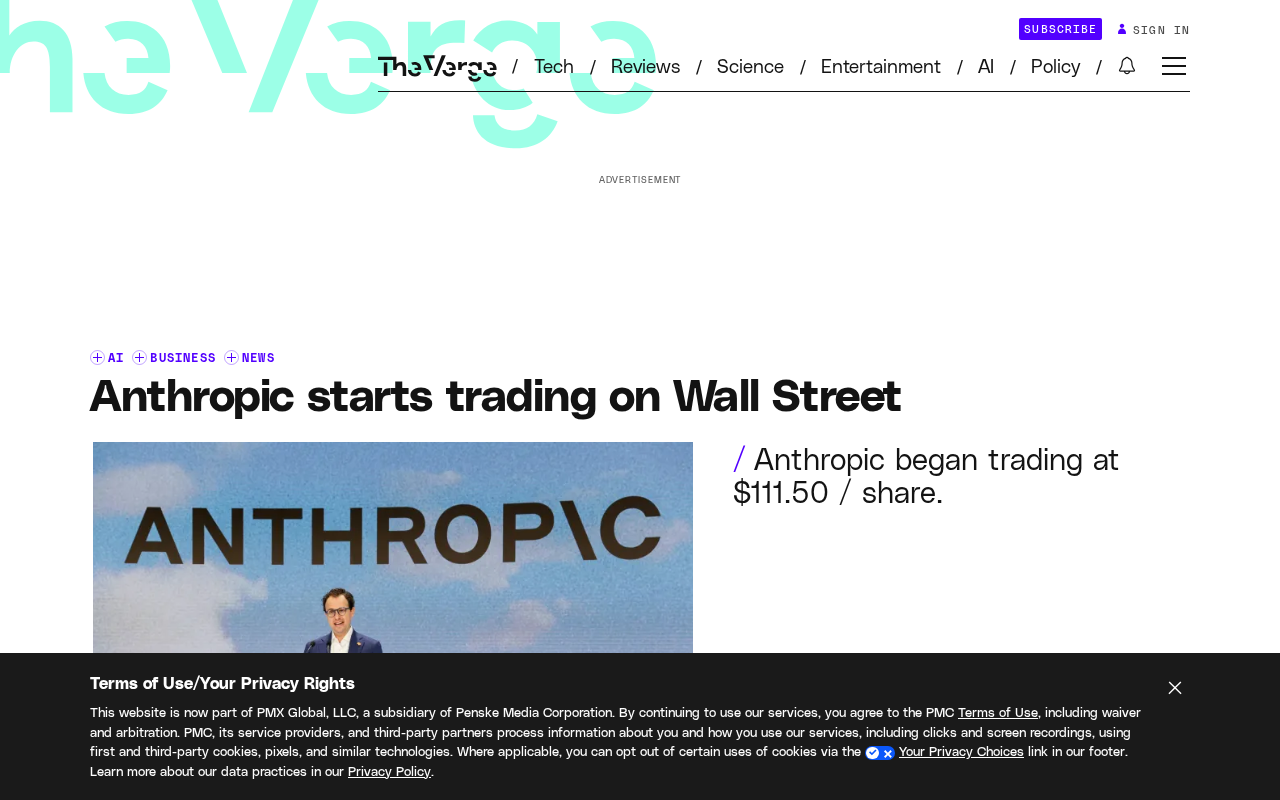
Anthropic has officially listed on Nasdaq under the ticker "ANT," opening at $111.50 per share—a sharp jump from its $83 initial public offering price—pushing the company's valuation to roughly $1.5 trillion. This moment comes less than a month after Anthropic made its listing plans public.
In its lengthy S-1 filing, the AI company known for its Claude series of models disclosed its business structure, financial performance, and risk factors to the public. Although the original report did not elaborate on the specifics of the S-1, the listing itself speaks volumes: a leading player in generative AI is moving from private markets to public capital markets, where it will face far more rigorous scrutiny.
An S-1 filing is the registration statement that the U.S. Securities and Exchange Commission (SEC) requires of companies planning to go public, and it is the most central disclosure document in the IPO process. It typically includes the company's business model, financial condition (audited income statements, balance sheets, and cash flow statements), management compensation, equity structure, use of proceeds, and detailed risk factors. Under the U.S. Securities Act of 1933, no roadshow or sale of securities may occur until the SEC declares the S-1 effective, so the period from public filing to the actual bell-ringing often takes weeks to months. For tech companies, the S-1 is not only a compliance step but also the first systematic public showcase of their growth logic and profitability prospects; disclosed metrics such as revenue growth, gross margin, and customer concentration directly influence IPO pricing.
What the Opening Surge Means
The opening price of $111.50 represents a significant premium over the $83 offering price. Such first-day performance typically reflects strong market demand for the stock, but it may also contain sentiment-driven elements. For Anthropic, a higher valuation means greater responsibility—pressures it never faced before, such as quarterly earnings reports, profit guidance, and shareholder returns, will soon follow.
From an industry perspective, Anthropic's listing provides a valuation anchor for other AI unicorns. When an AI company centered on safety research as its core philosophy can win market recognition on this scale, capital's confidence in the AI sector is plain to see.
The IPO offering price is determined by underwriters after the roadshow based on institutional investor demand, while the opening price is the price of the stock's first trade on the exchange, matched from buy and sell orders in the secondary market. A significant premium between the two is usually interpreted as relatively conservative offering pricing and strong market demand; but a first-day surge may also include retail sentiment and short-term speculation, and historically many hot tech stocks have pulled back after spiking on their first day. Valuation (such as the roughly $1.5 trillion cited here) is generally calculated as the offering price or market price multiplied by the fully diluted total share count; it is a paper market value that fluctuates substantially with the share price and is not the amount the company actually raised.
Balancing the Safety Narrative and Commercial Reality
Anthropic has long differentiated itself from competitors with a "responsible AI" positioning, and its S-1 filing is said to cover related governance content as well. After going public, this positioning will face the test of public markets: investors care about model capabilities and revenue growth, and they will also ask whether safety spending weighs on profit margins.
How to maintain a balance between safety ideals and commercial reality is the core question for Anthropic as a public company. Its choices will also serve as a reference for the entire industry—when AI companies must answer to public shareholders, how will the priority of safety commitments be ranked?
Responsible AI refers to a practice framework that systematically considers safety, fairness, transparency, and accountability in model development and deployment, with common methods including red-team testing, alignment research, usage policies, and model card disclosure. Anthropic is known for methods such as "Constitutional AI," which advocates constraining model behavior through principled rules. However, in the context of public markets, such investments appear as R&D expenses and compliance costs and are difficult to convert directly into revenue in the short term, so investors tend to focus on whether safety team size and incident response mechanisms are written into the governance structure, and whether safety commitments carry verifiable binding force rather than remaining mere vision statements.
Potential Impact on the AI Industry Landscape
Anthropic's arrival on Wall Street is more than a milestone for a single company. It marks generative AI's gradual transition from a stage driven by venture capital to a stage where public markets participate in pricing. The IPO paths, valuation logic, and even disclosure standards of other AI companies may all be redefined as a result.
Of course, going public also means greater transparency. For the first time, the public will systematically see the revenue structure, cost composition, and growth curve of a leading AI company—data of reference value to researchers, developers, and competitors alike. Anthropic's share price trajectory may become a new indicator for gauging sentiment in the AI industry.
Related articles

Prompt Engineering for Beginners: From Writing Prompts to Engineering Thinking
Starting from the essence and four functions of prompts, this article systematically explains the six-step process, four success criteria, learning value, and practical limitations of prompt engineering to help you build a complete understanding.

Anthropic Launches Nasdaq IPO: AI Giant's Listing and Risk Disclosures
Anthropic officially launches its Nasdaq IPO under ticker ANT, with market valuation expected to potentially exceed SpaceX's record. The prospectus devotes nearly 100 pages to AI risks, while first-half revenue grew over 14x but net losses widened sharply, reigniting the AI bubble debate.

Rust cURL Clone Uses 4,832 unsafe Blocks—Is the Memory Safety Myth Broken?
A Rust cURL clone uses 4,832 unsafe keywords, challenging Rust's memory safety narrative. We analyze what unsafe really means, compare Fil-C, and examine rewrite motives.