Anthropic Open-Sources Agent Skills: A New Era of Modular and Reusable AI Agent Capabilities

Anthropic open-sources modular Agent Skills repository, enabling standardized and reusable AI agent capabilities.
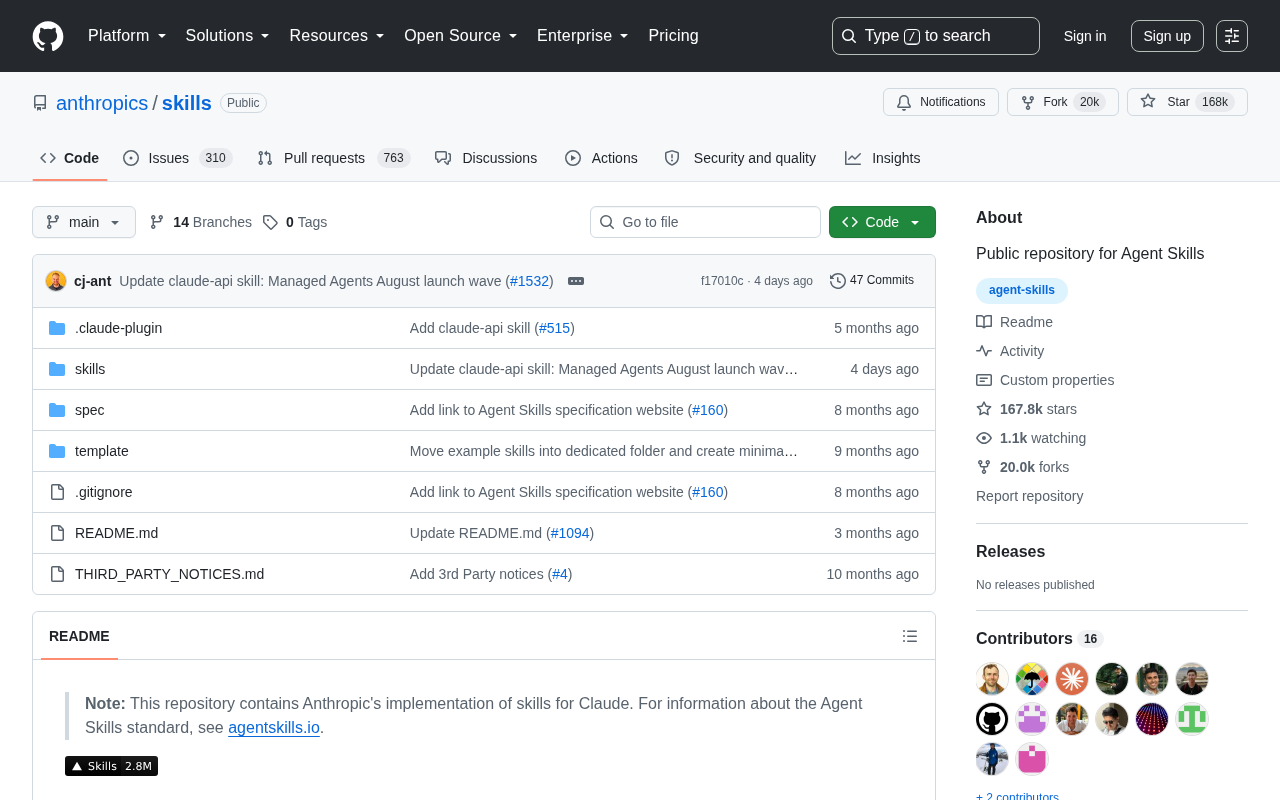
Anthropic has open-sourced the `anthropics/skills` repository on GitHub, providing standardized, pluggable skill packages for AI Agents. With over 167K stars, the Python-based project encapsulates tool invocations, prompts, and execution logic into reusable modules. This marks a shift toward modular agent development, addressing ecosystem fragmentation and lowering development barriers while potentially establishing an industry-standard skill specification.
Anthropic's Major Open-Source Release: Agent Skills
Anthropic recently open-sourced a public repository on GitHub called anthropics/skills, specifically designed to host Agent Skills. The project attracted enormous attention immediately upon release—it has accumulated over 167,000 stars to date, with 468 new stars in a single day, and forks exceeding 20,000. As the company behind Claude, every move Anthropic makes in the AI Agent space draws significant industry attention, and this open-source release signals that agent development is transitioning from "black-box invocations" to a new phase of "modular, reusable" capabilities.
What Are Agent Skills?
Simply put, Agent Skills are a set of capability modules that AI agents can invoke. To understand this concept, you first need to grasp the basic architecture of AI Agents: an AI Agent is an AI system that can autonomously perceive its environment, make decisions, and execute actions. Unlike traditional single-turn Q&A, Agents possess capabilities like Planning, Tool Use, Memory, and Reflection, enabling them to decompose complex tasks and complete them step by step. Current mainstream Agent architectures typically include a large language model as the "brain," working in coordination with external tool invocations and context management mechanisms.
Traditionally, when large language models face specific tasks, developers need to write prompts, tool-calling logic, and context management strategies from scratch. The core philosophy of Skills is to encapsulate these general capabilities into standardized, pluggable "skill packages" that agents can load and combine on demand. In essence, Skills package the combination of "tool invocation + prompt + execution logic" into reusable standard units.
This approach is highly consistent with "modularization" and "component reuse" in software engineering. Modular design has been one of the core principles in software engineering for decades—from the Unix philosophy of "do one thing well," to encapsulation and inheritance in object-oriented programming, to service decomposition in microservices architecture, modularity has always been the key means of managing complexity. In the AI Agent domain, skill modularization means encapsulating specific capabilities (such as "search the web," "analyze CSV files," "generate code") as independent components with well-defined interfaces, allowing different Agents to assemble these capabilities like LEGO bricks as needed. Developers no longer need to reinvent the wheel for every project—they can directly reference mature skills maintained by the community or officially, dramatically lowering the development barrier for Agent applications.
Why This Project Deserves Attention
Standardization Exploration for Agent Development
Over the past year, AI Agents have become a hot topic across the entire industry, but the ecosystem remains highly fragmented. As of 2025, dozens of frameworks and platforms have emerged in the AI Agent space, including LangChain/LangGraph, Microsoft AutoGen, CrewAI, OpenAI's Assistants API, Google's Vertex AI Agent Builder, and more. Each framework has its own tool definition format, memory storage approach, and execution flow design. For example, LangChain uses Tool decorators to define tools, AutoGen employs a multi-Agent conversation pattern, and OpenAI implements tool calling through the Function Calling interface. This fragmentation makes it difficult for developers to transfer experience accumulated in one framework to another, and makes community-contributed tools hard to reuse across platforms.
By open-sourcing Skills as a public repository, Anthropic is effectively attempting to establish a universal skill definition specification. Once this specification is widely adopted by the community, it means skills written by developers can flow between different Agents, forming an ecosystem similar to a "plugin marketplace." This has strategic significance for advancing the maturity of the entire agent industry.
Python-Centric Tech Stack
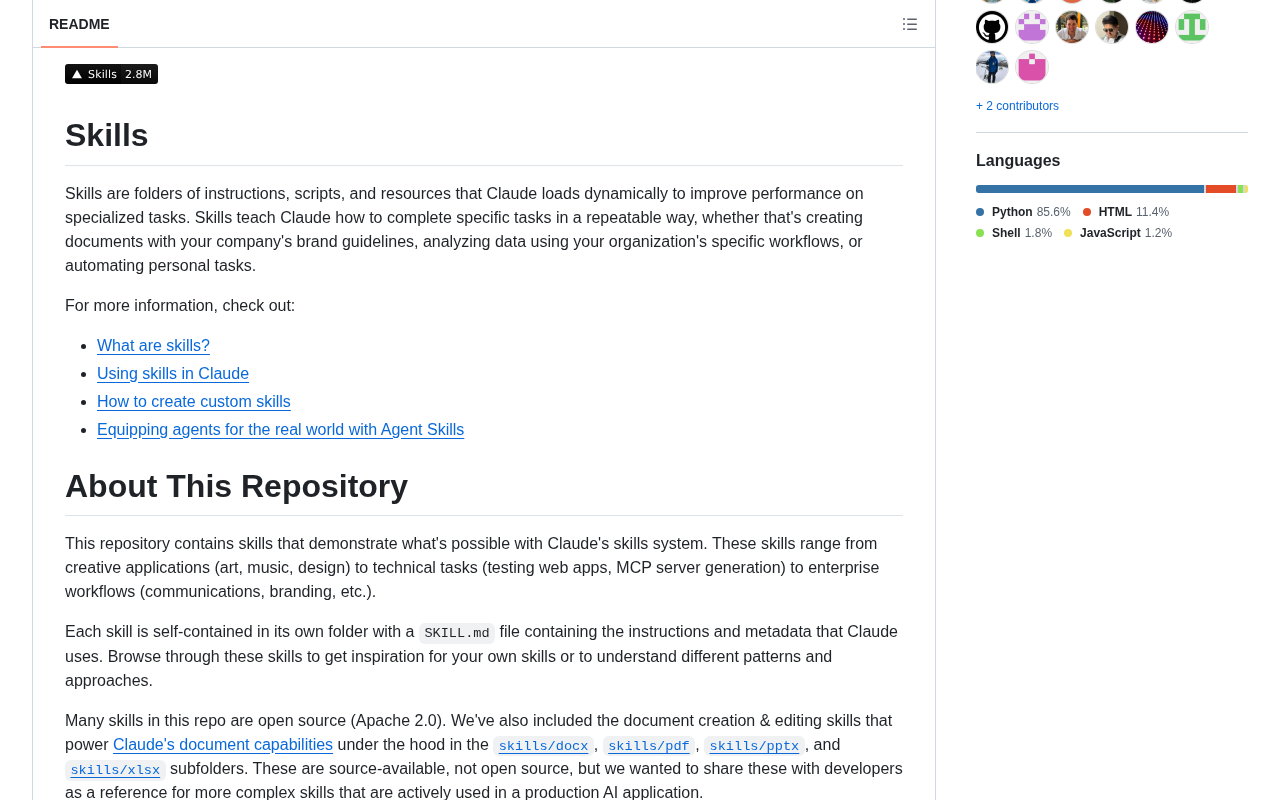
Based on the repository information, the project is primarily written in Python. This choice is unsurprising—Python is the de facto mainstream language in AI and machine learning, and the vast majority of Agent frameworks (such as LangChain, AutoGen, etc.) are built around Python. Python's dominance in AI stems from its rich scientific computing ecosystem (NumPy, Pandas), deep learning framework support (PyTorch, TensorFlow), and concise syntax that lowers the usage barrier for researchers outside computer science. Using Python means developers can seamlessly integrate these Skills into existing AI workflows, reducing migration and trial costs.
Trust Through Official Backing
It's worth emphasizing that this is an officially maintained Anthropic repository, not a community-driven project. As the developer of the Claude model series, Anthropic has deep understanding of model capability boundaries, context engineering, and safety.
Context Engineering is a concept that has gained increasing attention in AI development during 2024-2025. It refers to how to effectively manage, organize, and optimize the contextual information passed to large language models. This includes system prompt design, conversation history compression and retrieval, timing of external knowledge injection, and token budget allocation strategies. Anthropic has accumulated extensive context engineering best practices during Claude's development, and this experience directly influences Skills' design—each skill contains not only execution logic but also strategies for providing appropriate context to the model.
An officially produced skill library offers greater trustworthiness in terms of quality, compatibility, and long-term maintenance, which is an important reason why it accumulated such high attention in a short time.
What This Means for Developers
Lower Barriers to Agent Development
For developers looking to build AI Agent applications, the Skills repository provides a starting point that can be directly referenced or even reused. Whether it's document processing, code execution, or domain-specific tasks, developers can look for ready-made skill implementations rather than figuring out best practices from scratch.
Opportunities to Participate in the Open-Source Ecosystem
As a public repository, anthropics/skills welcomes community contributions. This means developers are not just users but can also become skill creators and maintainers. As more high-quality skills are contributed, this repository has the potential to grow into critical infrastructure for the Agent space.
A Rational View of Star Counts
A brief note: over 160,000 stars places this at the top tier among open-source projects, but star counts are often influenced by brand effects. When actually adopting the project, developers should still pay attention to documentation completeness, actual skill coverage, and community activity rather than making decisions based solely on hype. The project is still in its early stages, and whether its specifications can become an industry standard still requires time and practical validation.
Summary and Outlook
Anthropic's open-sourcing of Agent Skills reflects that the AI industry is shifting from pursuing stronger individual models to building a more complete agent application ecosystem. Modularization and reuse of skills is a critical step toward truly deploying AI in complex business scenarios.
If this skill specification achieves broad adoption, we may see an "agent skill ecosystem" gradually take shape, similar to npm or PyPI. npm (Node Package Manager) and PyPI (Python Package Index) are the package management platforms for the JavaScript and Python ecosystems respectively—npm has over 2 million packages, and PyPI has over 500,000 projects. Their success lies in providing standardized package definition formats, version management mechanisms, and dependency resolution capabilities. If Agent Skills can form a similar ecosystem, developers will be able to install and reference various agent skills through simple commands, ensuring compatibility through semantic versioning. However, Agent skills are more complex than traditional software packages because they also involve the uncertainty of model behavior and the management of safety boundaries.
Developers will be able to freely share, combine, and reuse various capabilities, making building powerful AI Agents as simple as assembling building blocks. For developers and teams focused on the AI Agent direction, this project is undoubtedly worth continuous tracking.
Related articles

Gmod TTT: Boba's Winning Streak and Game Design Insights
An in-depth analysis of Gmod TTT's role system, creative items, and social gameplay mechanics, exploring the relationship between randomness design and game balance through Boba's winning streak phenomenon.

FlexBudget: Fair Comparison of KV Cache Eviction Strategies Under a Unified Compute Budget
AMD engineer proposes FlexBudget at PyTorch Conference: a training-free fair comparison method for KV cache eviction rules using fixed kernels and memory budgets, all in core PyTorch.
