Anthropic Opens Applications for Two New Researcher Fellowships, Focusing on STEM and Conceptual Reasoning
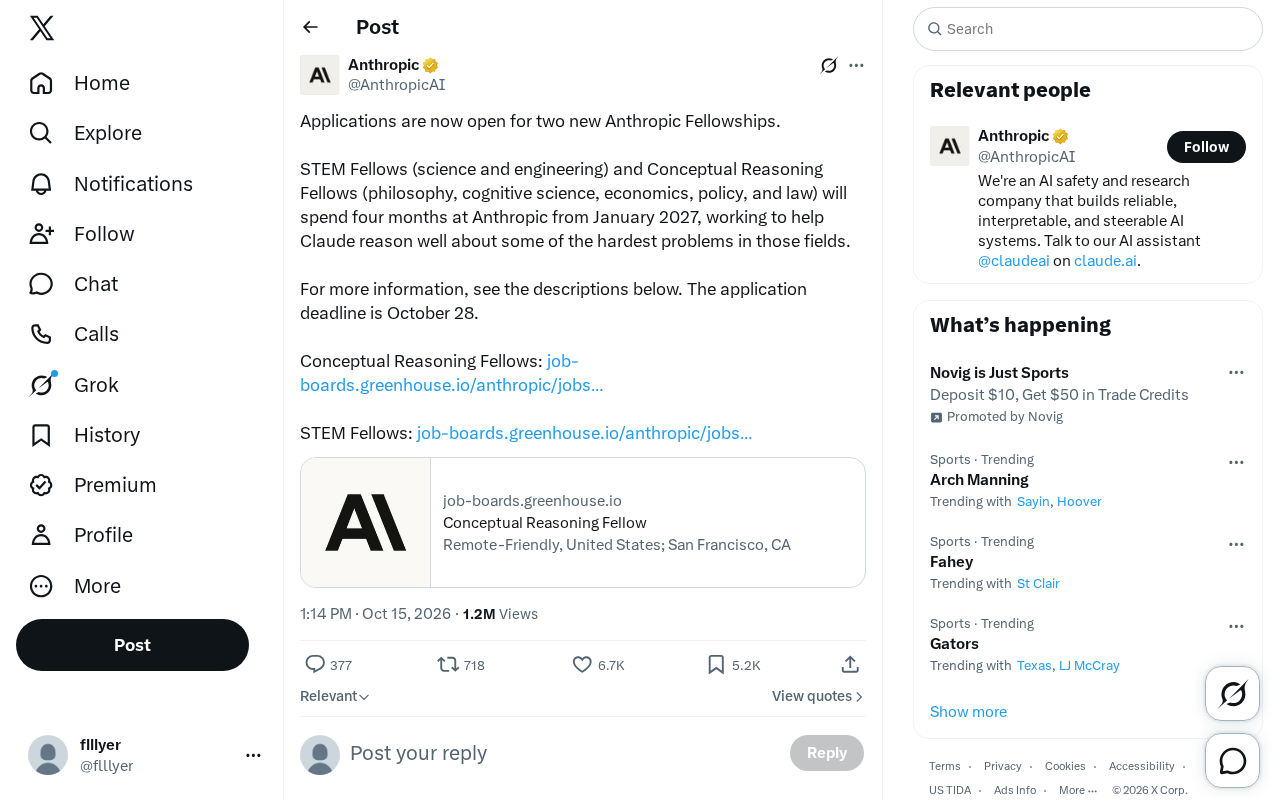
Anthropic opens STEM and conceptual reasoning fellowships; applications due October 28.
Anthropic has opened applications for two researcher fellowships: STEM Fellows for science and engineering backgrounds, and Conceptual Reasoning Fellows for philosophy, cognitive science, economics, policy, and law. Fellows will be in residence at Anthropic for four months starting January 2027 to improve Claude's reasoning on hard problems in their fields. The article argues that a separate conceptual reasoning track shows Anthropic treats humanities and social science reasoning as an independent research agenda on par with scientific and engineering reasoning. The deadline is October 28, with separate application portals for each track.
Anthropic recently announced on its official X account that applications are now open for two new researcher fellowship programs: STEM Fellows (science and engineering) and Conceptual Reasoning Fellows (conceptual reasoning). Selected fellows will conduct research at Anthropic for four months starting in January 2027, with the goal of helping Claude reason better about the hardest problems in their respective fields. The application deadline is October 28.
Two Fellowships: A Dual-Track Layout Spanning Technology and the Humanities
According to the official description, STEM Fellows targets researchers with backgrounds in science and engineering, while Conceptual Reasoning Fellows explicitly points to disciplines such as philosophy, cognitive science, economics, policy, and law. This dual-track design is no accident—it reflects a fundamental judgment by Anthropic about improving AI reasoning capabilities: making models reliable on hard scientific problems and keeping their reasoning clear in concept-dense domains like ethics, policy, and law are equally important capability dimensions.
You may not have noticed that the disciplines covered by the conceptual reasoning track happen to be areas traditionally regarded as "difficult to formalize." Argument structures in philosophy, modeling of thought processes in cognitive science, incentive analysis in economics, and rule interpretation in policy and law all pose challenges to a model's abstract reasoning and conceptual discrimination that differ from those of mathematics and programming. By establishing a separate fellowship track for these fields, Anthropic signals that internally it already treats "conceptual reasoning" as an independent research agenda on par with "scientific and engineering reasoning."
Conceptual Reasoning in AI research generally refers to the ability to handle abstract concepts, definitions, category boundaries, semantic relations, and normative judgments, as distinct from mathematical reasoning or symbolic reasoning, which center on numerical computation and formal derivation. It concerns whether a model can understand concepts such as "justice," "intention," and "responsibility" that have no unique formal definition, and maintain reasoning consistency across different contexts. Argument analysis in philosophy, rule interpretation and analogical reasoning in law, and modeling of incentives and preferences in economics are all typical conceptual reasoning tasks. Evaluation of such tasks often lacks standard answers and must rely on the judgment of domain experts, which makes it a weak spot in current large-model reasoning benchmarks.
Four-Month Residency, with a Timeline Pointing to 2027
The program runs for four months, starting in January 2027. This means there is a relatively long preparation period between the application deadline and the program's start, and it also suggests that Anthropic is building up personnel for a cross-year research initiative. A four-month residency is on the medium-to-long side among visiting scholar programs at AI labs—long enough for fellows to engage deeply in specific topics rather than remaining at the level of short-term exchange.
Applicants need to use the two official links provided to learn the specific requirements for each track. Because the official tweet did not disclose further details (such as salary, number of positions, or specific research topics), interested applicants should consult the program description pages directly.
Resident/Fellow programs are a common talent mechanism at AI labs: external researchers join the lab for a fixed term, participate in specific research projects, and meanwhile retain their original academic affiliations. Unlike short-term visits or full-time employment, residency programs usually fall somewhere in between—they allow outside experts to engage deeply in the model development process without requiring an immediate long-term career commitment. For labs, this is a low-cost way to bring in interdisciplinary perspectives; for researchers, it is a window into internal information and computational resources at the frontier of model development. Four months is a relatively long cycle for such programs, and fellows are typically expected to produce deliverable research outputs.
Why It Matters: A Signal About the Division of Labor in AI Reasoning Research
This fellowship program sends an intriguing signal. At present, the AI industry's investment in reasoning capabilities is concentrated mainly on mathematics, code, and scientific benchmarks, yet Anthropic has opened a dedicated fellowship channel for conceptual reasoning. This indicates that it believes the shortcomings in model reasoning in philosophy, law, policy, and other fields cannot be automatically filled by progress in scientific reasoning.
From the perspective of research organization, inviting external fellows for four-month residencies is also a mechanism for injecting domain expertise into model training and evaluation processes. Scholars in philosophy, cognitive science, law, and related fields have judgment criteria for "what counts as good reasoning" that differ from those of engineers, and such criteria are precisely the scarcest resource when evaluating the quality of model reasoning.
For students and researchers interested in the direction of AI reasoning research, this is a clear timeline: deadline on October 28, start in January 2027. The application portals for the two tracks are independent, and applicants need to choose the corresponding link based on their own backgrounds when submitting materials.
(Note: The information in this article comes from Anthropic's official tweet; please refer to the official program pages for specific project details.)
Reasoning benchmarks are standardized evaluation sets for measuring a model's reasoning ability. Current mainstream benchmarks such as MATH, GSM8K, and HumanEval cover mathematics, elementary school math word problems, and code generation, respectively, and all of these tasks have objectively verifiable answers. The field of conceptual reasoning, by contrast, lacks benchmarks with the same degree of consensus: the quality of philosophical argumentation, the reasonableness of legal rule application, and the coherence of policy analysis often require expert scoring or manual comparison and are difficult to automate at scale. This lack of evaluation infrastructure is one of the deeper reasons Anthropic established an independent fellowship channel—domain experts need to participate in building evaluation standards rather than relying solely on expanding scientific benchmarks.
One-line Summary
Anthropic launches two researcher fellowships in STEM and conceptual reasoning, with applications due October 28.
Paragraph Summary
Anthropic has announced that applications are open for two researcher fellowships: STEM Fellows for those with backgrounds in science and engineering, and Conceptual Reasoning Fellows for disciplines such as philosophy, cognitive science, economics, policy, and law. Selected fellows will be in residence at Anthropic for four months starting in January 2027, with the goal of improving Claude's reasoning on difficult problems in their respective fields. The article argues that establishing conceptual reasoning as a separate track shows that Anthropic regards reasoning capabilities in the humanities and social sciences as an independent research agenda on par with scientific and engineering reasoning, rather than expecting them to be filled automatically by progress in scientific reasoning. The application deadline is October 28, and the two tracks have separate application portals.
Related articles

Claude Reportedly Able to Hide Secret Messages in Benign Images
A Reddit post claims Claude Fable 5.1 can hide secret messages in benign images. This article reviews the background, image steganography principles, and potential security risks, and suggests a testing path from rumor to verification.

Federal Government Awards $85 Million; CFS to Develop Fusion-Specific Semiconductors
The federal government awards $85 million to Commonwealth Fusion Systems to develop conductors and power semiconductors for fusion plants. This article analyzes the significance of this funding for the fusion supply chain and commercialization path.

When Should AI Assistants Proactively Suggest? Timing Is Everything
When should AI assistants proactively suggest? Reddit discussion reveals: the same suggestion feels different at different times. This article analyzes the dual nature of proactive suggestions, the boundary of user expectations, and design principles, exploring how to balance automation and user control.