Anthropic Races Toward IPO: How Claude Makes Money — and the Catch

Breaking down Anthropic's token-based intelligence business, efficiency metrics, the truth behind accounting losses, and valuation logic.
Anthropic has filed for an IPO, with valuation discussions reaching the trillion-dollar level. The article breaks down its business model: renting compute, training models, and selling intelligence by the token, with quarterly revenue growing from under $500 million to near $10 billion in 18 months. The core efficiency metric — revenue per dollar of compute — rose from 40 cents to over $2, and Q2 saw the first operating profit. The widely circulated $80 billion loss stems mainly from accounting revaluation of Amazon's notes; cash flow is positive, not an operating cash burn. The core risk is the time mismatch between elastic on-demand revenue and long-term compute commitments extending to 2045. The founder's single share retains 50.1% voting power, so control remains unchanged post-IPO. The valuation is about 53x trailing 12-month revenue and about 10x the 2028 revenue target; if the target is met, the valuation is reasonable.
Anthropic has officially filed for an IPO, with the ticker symbol set as A-N-T. Market discussions around its valuation reach as high as the trillion-dollar range — a figure striking enough to make any tech observer take notice. But setting aside the hype, a more fundamental question deserves scrutiny: How exactly does Claude make money? And what price is hidden inside its business model?
Breaking Down the Business Model: Selling "Units of Measurable Intelligence"
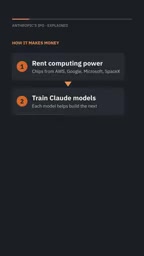
Anthropic's business chain can be summed up in one sentence: rent compute, train Claude, then sell Claude's output by the token.
The key to this model is the inherent elasticity of pay-as-you-go pricing. Customers pay for exactly as much intelligence as they use — no heavy subscription barrier, no rigid one-time buyout. For API callers, costs scale with the business; for Anthropic, revenue grows with usage. Materials show that quarterly revenue climbed from under $500 million to near the $10 billion level in 18 months — a growth rate extremely rare in the history of enterprise software.
But the flip side of rapid growth is a rigid cost structure. Renting compute is not an asset-light game — behind every dollar of revenue sits real GPU-hours.
Tokens and pay-as-you-go billing: A token is the basic unit of text processed by large language models, roughly a word fragment or character combination — both the input the model reads (the prompt) and the output it generates are counted in tokens. The API business model therefore naturally has a "unit of measurement" quality: customers pay for the tokens actually consumed rather than buying fixed seats or subscription periods. This billing method ties costs directly to business volume, but it also means revenue depends entirely on customers' actual usage, lacking the stability of subscription revenue. For model providers, the token is both a product unit and a cost unit — every inference consumes GPU compute, so the spread between "price per token" and "inference cost per token" is where the real gross margin lies.
Enterprise Software: Software products sold to enterprise customers, typically charged via subscription (SaaS) or licensing. Its typical features are high upfront customer acquisition costs, stable renewal revenue later on, and gross margins generally above 70%. The article compares Anthropic against "a growth rate extremely rare in the history of enterprise software" precisely to show how far its growth curve exceeds the normal pace of traditional SaaS — while also hinting that pay-as-you-go AI companies differ fundamentally from traditional subscription businesses in revenue stability.
The Metric That Really Matters: How Much Revenue Each Dollar of Compute Returns
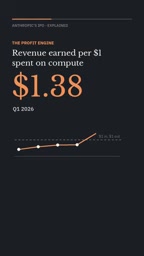
One number repeatedly emphasized in the materials is more informative than absolute revenue: revenue per dollar of compute spend. This metric rose from 40 cents to over $2, and the company achieved its first operating profit in the second quarter.
These figures tell two things. First, model efficiency is improving — the same compute can produce more sellable tokens, or inference costs are falling. Second, pricing power remains with Anthropic — customers are willing to pay a premium for Claude's output.
For anyone watching AI commercialization, the direction of this ratio is more worth tracking than revenue growth. Revenue can be bought with price cuts, but rising revenue per dollar of compute genuinely reflects a model company's operating leverage.
What's the Deal with That "$80 Billion Loss"?
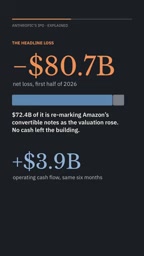
The eye-catching loss figures circulating externally need to be broken down. The materials explicitly point out that the vast majority is accounting-level treatment — specifically, about $72 billion comes from remarking Amazon's notes. This is not an operating cash outflow.
The more critical signal: cash flow is positive.
This changes the narrative frame. A company with positive cash flow, even with a huge book loss, has a different survival capacity and fundraising rhythm from the typical "burn cash for growth" startup. Accounting losses and operating cash burn are two different concepts, and conflating them easily leads to wrong conclusions.
Accounting revaluation and book losses: "Remarking" Amazon's notes is a non-cash accounting adjustment. When a company holds convertible notes or strategic investments, their fair value is revalued as market conditions or contract terms change, with the difference recorded in the income statement but generating no actual cash flow. Such losses therefore inflate book net losses without affecting operating cash flow. To judge a company's financial health, one should distinguish "operating cash flow" (money actually moving in and out) from "accounting profit" (including non-cash items) — the former reflects survival capacity, while the latter is heavily influenced by accounting treatment. The article's emphasis that "cash flow is positive" is precisely meant to pull the narrative from "huge losses" back to operating reality.
The Cost: Elastic On-Demand Revenue vs. Rigid Long-Term Compute Commitments
The most alarming aspect of the business model is the mismatch in time structure between the revenue side and the cost side.
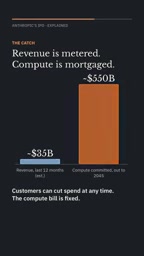
Revenue is pay-as-you-go — customers can reduce usage at any time. But Anthropic has already committed to massive compute spending stretching out to 2045. The materials put the scale of these commitments in the hundreds of billions of dollars.
What does this mean? If AI demand growth slows, or competitors drive inference prices lower, Anthropic's revenue side comes under immediate pressure, but the cost-side commitments will not shrink in tandem. This "short revenue, long spending" mismatch is a structural risk shared by all asset-heavy AI companies.
Control Design: One Founder Share Equals Fifty Votes
There's another easily overlooked detail in the IPO filing: public shares carry voting rights, but the founder's single share always carries 50.1% of the voting weight.
This is a typical variant of dual-class shares, ensuring the founding team retains control of the company's direction after going public. For investors bullish on Anthropic's long-term mission (AI safety-oriented), this is a safeguard; for shareholders hoping to influence company decisions with capital, it is a limitation. The materials don't elaborate on further governance details, but this one point is enough: buying Anthropic stock means buying financial exposure, not control.
Dual-class share structure and 50.1% voting power: Dual-class shares refer to a company issuing multiple classes of stock with different voting rights, commonly designed with founders holding high-voting shares (e.g., 10 or 20 votes per share) and public investors holding low-voting shares (1 vote per share). The "single share carrying 50.1% of voting weight" described in the article is a more extreme variant — no matter how much total equity is diluted, the one share held by the founder always represents a majority of voting power, thereby firmly holding control after going public. This structure is not uncommon among tech companies; its cost is that public shareholders can hardly influence company decisions through voting, and buying the stock yields financial exposure rather than governance voice.
Understanding the Valuation: 53x Revenue, 10x Forward Target
The materials provide a concise valuation anchor: at a trillion-dollar valuation, that's roughly 53 times trailing 12-month revenue. At the same time, this valuation is about 10 times the company's own 2028 revenue target.
The two multiples tell two sides of the same story. 53x historical revenue is high for SaaS, but AI infrastructure companies generally enjoy a growth premium; 10x the forward target suggests that if the 2028 target is met, the current valuation is not unreasonable — provided the target is met.
Price-to-sales (P/S) and forward valuation: P/S is market cap divided by trailing 12-month revenue, commonly used to value high-growth companies that are not yet profitable or whose earnings are volatile. A 53x P/S is extremely high in traditional SaaS (mature SaaS typically trades at 5-15x), but AI infrastructure companies command higher premiums due to strong growth expectations. Discounting valuation using a "forward revenue target" assumes future revenue will materialize, thereby judging whether the current price is reasonable — essentially a bet on growth certainty. The gap between the two multiples (53x historical revenue and 10x the 2028 target) precisely quantifies the risk premium the market is paying on the question of "whether growth will materialize."
Key Takeaways
- Anthropic's business model is renting compute, training models, and selling intelligence by the token; quarterly revenue grew from under $500 million to near the $10 billion level in 18 months.
- Revenue per dollar of compute rose from 40 cents to over $2, with the first operating profit achieved in Q2 — a more critical efficiency metric than revenue growth.
- The huge book loss comes mainly from accounting revaluation of Amazon's notes; cash flow is positive, and there is no operating cash burn.
- The core risk is the time mismatch between elastic on-demand revenue and long-term compute commitments.
- The founder's single share retains 50.1% voting power, so control remains unchanged after the IPO; investors gain financial exposure.
(The above content is compiled from public discussion and does not constitute investment advice.)
Related articles

Anthropic's IPO Crisis: Why $16.8B in Revenue Can't Buy a High Valuation
Anthropic posted $16.8B in Q3 revenue with 85% gross margin yet faces a cut to its IPO valuation. A deep dive into halved growth, the token price war, circular financing, and the clash between safety ideals and capital reality.

Anthropic Races Toward the Largest IPO in History: Can a $100 Billion Raise Ignite the AI Investment Boom?
Anthropic may file its prospectus as early as October 23, aiming to raise up to $100 billion at a valuation of up to $2 trillion, potentially the largest IPO ever. Q3 revenue hit $16.8 billion, up nearly 50% quarter over quarter, with adjusted profitability, but slowing growth has led some investors to cut valuation to $1.5 trillion. The IPO is a key test of whether the AI investment boom can continue.

Bessemer Partner on Anthropic IPO: The Public's First Direct Investment in AI Software
Bessemer partner Byron Theta on the Anthropic IPO: why it's called the moment everyone's been waiting for, the $650M four-round investment, the LP liquidity bind, and expectations of a 2027 IPO wave—plus open-source model pricing pressure, existential risk disclosures, and what the founders' 50.1% voting structure means for ordinary investors.