Anthropic Releases AI Economic Impact Model: Projecting Growth and Employment Trends Through 2030
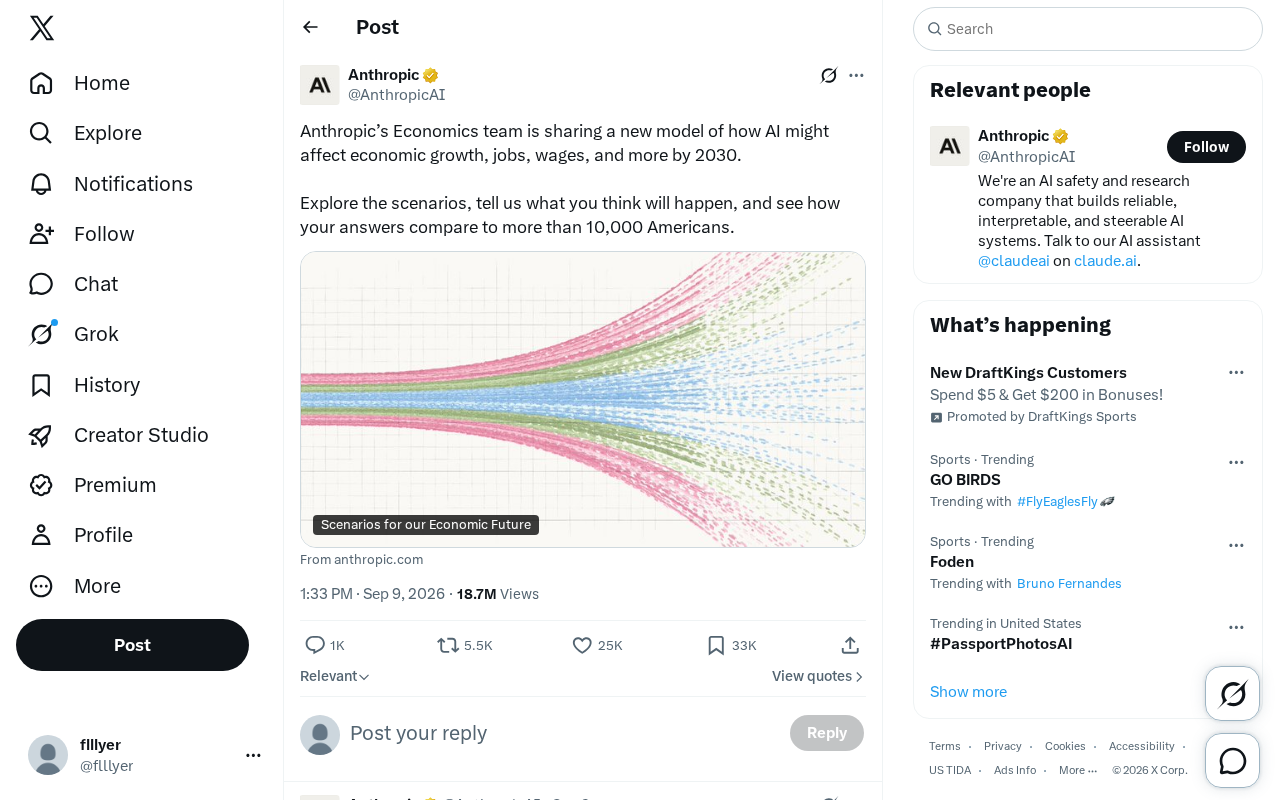
Anthropic launches an interactive AI economic model with multi-scenario projections for growth and employment through 2030.
Anthropic's economics team has released an interactive economic modeling tool projecting AI's impact on growth, employment, and wages through 2030. Rather than offering single-point predictions, the model uses a multi-scenario framework to capture uncertainty, and includes a public participation feature where users can share their own forecasts and compare them against those of more than 10,000 American respondents. This design both democratizes a typically expert-only topic and generates large-scale data on public AI expectations. Consistent with its AI safety mission, Anthropic frames the tool's value as clarifying variable relationships and key assumptions — not predicting the future with precision.
Anthropic's economics team has unveiled a new economic model designed to answer an increasingly pressing question: at key milestones through the end of this decade, how exactly will artificial intelligence reshape economic growth, employment, and wages? This isn't just a research report — it's an interactive scenario-exploration tool that invites the public to make their own predictions and compare them against the views of more than 10,000 Americans.
A Forward-Looking Economic Modeling Framework
Unlike most AI impact analyses that focus on the present, Anthropic has extended the timeline out to 2030, covering multiple macroeconomic dimensions including economic growth, jobs, and wages. The value of this approach lies in translating abstract discussions about AI into quantifiable, comparable scenarios — where different assumptions produce different outcome branches.
Economists have long been sharply divided on AI's long-term effects. Optimists believe AI will drive productivity leaps and create entirely new job categories, while pessimists worry about large-scale job displacement and wage stagnation. Rather than delivering a single definitive answer, Anthropic's model uses a multi-scenario approach to surface the uncertainty itself — which is, in its own right, a more honest way to handle a complex problem.
Making the Public a Participant, Not Just an Observer
The most noteworthy design feature of this tool is its interactive nature. Users aren't passively reading research conclusions — they're invited to explore different scenarios, express their own views about the future, and then see how their answers compare to the collective expectations of more than 10,000 American survey respondents.
This design serves a dual purpose. On one hand, it brings the topic of AI's economic impact — traditionally confined to expert circles — down to a level that ordinary people can understand and engage with. On the other hand, collecting large-scale public expectation data is itself valuable research material: it reflects society's confidence in AI's future, the degree of anxiety around it, and cognitive biases at play. When the judgments of more than ten thousand people are aggregated and placed alongside the model's projections, we can see exactly where the gap lies between professional models and popular intuition.
Why Anthropic Is Doing This
As a frontier lab with AI safety at the core of its mission, Anthropic's foray into economic impact research is no coincidence. Understanding AI's disruption of labor markets and economic structures is an essential component of assessing the technology's societal risks. The company has previously tracked AI usage in real-world work contexts through initiatives like the Anthropic Economic Index; this modeling effort can be seen as an extension from "current usage patterns" toward "future structural impacts."
For policymakers, business decision-makers, and even individuals planning their careers, a data-driven framework built on explicit assumptions offers far more practical value than sweeping claims like "AI will replace/create jobs." It at least provides a common baseline for discussion — one that allows people with different views to engage around the same variables and scenarios.
Understanding the Limits of This Kind of Forecast
It's worth maintaining a clear head: any economic forecast targeting 2030 rests on a large number of assumptions. The pace of technological development, the direction of regulation, the speed of enterprise adoption, and the global macroeconomic environment can all cause actual outcomes to diverge from the model's projected paths. The value of a model lies not in its ability to predict the future with precision, but in helping us clarify the relationships between variables — identifying which assumptions matter most and which outcomes are most sensitive to change.
From this perspective, Anthropic's emphasis on "scenario exploration" rather than "definitive prediction" reflects a pragmatic stance. It encourages users to think through the causal chain between conditions and outcomes, rather than simply memorizing an isolated number. For readers who follow AI economics, engaging with this tool firsthand and comparing your own expectations to others' may be more illuminating than any secondhand summary.
Related articles
Gluetun VPN Disconnection Troubleshooting: Version-Pinned Users Should Upgrade to v3.41.3
Gluetun version-pinned users may face silent VPN disconnections breaking their arr stack. Learn how upgrading to v3.41.3 fixes the issue and tips to avoid it.
Trump Downplays AI Extinction Risk: 'Whoever Wins AI Wins' Sparks Controversy
Trump downplays AI extinction risks with 'Whoever wins AI wins,' sparking fierce debate over whether AI safety is an urgent reality or a future hypothetical.

David Sacks on AI Regulation: Frontier Models Don't Need Mandatory Legislative Constraints
David Sacks argues OpenAI and Anthropic can self-regulate frontier model development without external legislation. A look at the logic, controversy, and governance dilemmas involved.