Anthropic Releases Claude Sonnet 5.5: A Faster, More Cost-Efficient Model for Everyday Productivity

Anthropic's Claude Sonnet 5.5 delivers 30% faster speeds, up to 30% cost savings, and new cybersecurity safeguards.
Anthropic has launched Claude Sonnet 5.5, the second model in the Claude 5.5 family, positioned as a cost-efficient everyday productivity tool. It runs 30%+ faster than Sonnet 5 and achieves up to 30% cost savings by using fewer tokens per task — without changing per-token pricing. The model excels at fixing code, generating documents and presentations, and is the first Sonnet to feature cybersecurity safeguards, with improved alignment and honesty metrics that don't interfere with standard development workflows. Sonnet 5.5 is live across all platforms, with Claude Haiku 5.5 set to follow in the coming weeks.
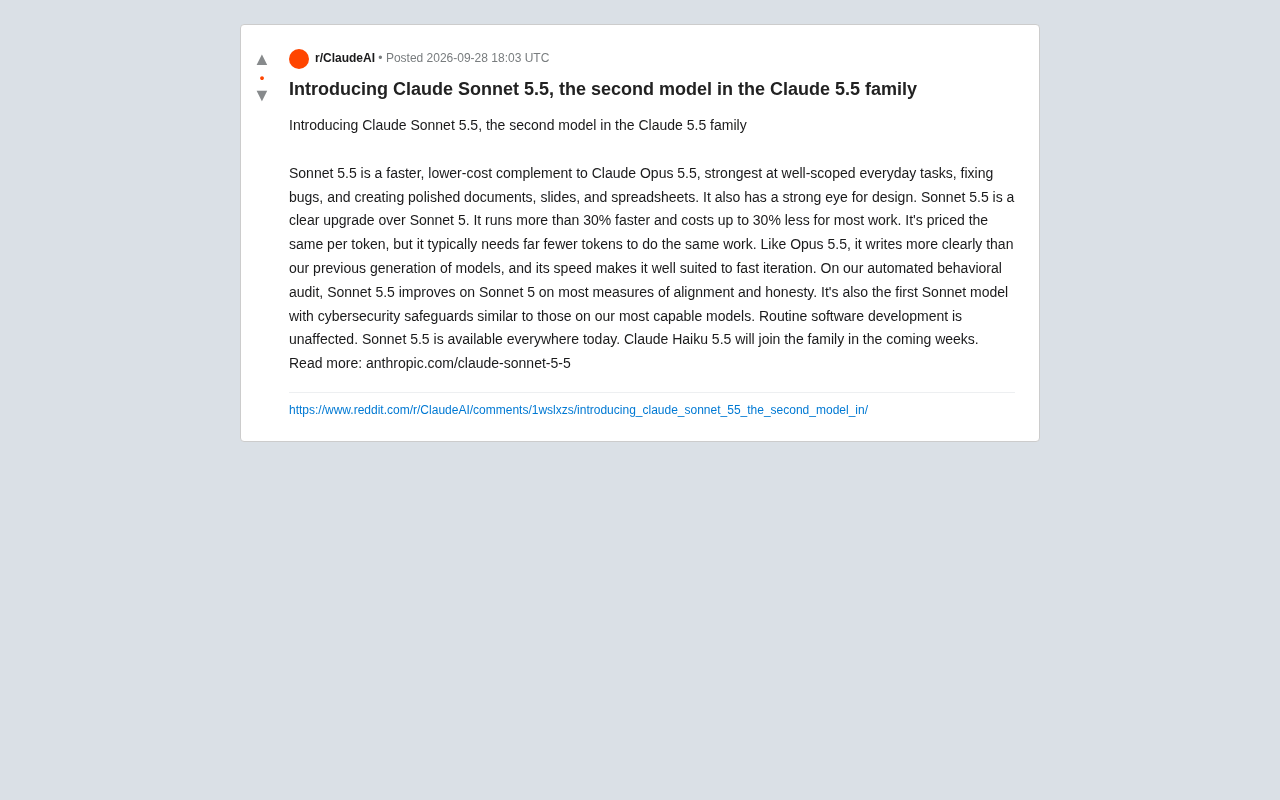
Anthropic has officially launched Claude Sonnet 5.5, the second model in the Claude 5.5 family. Designed as a lightweight complement to Claude Opus 5.5, Sonnet 5.5 prioritizes speed and cost-efficiency, targeting well-defined everyday tasks — from fixing code bugs to generating polished documents, presentations, and spreadsheets.
Core Upgrades Over Sonnet 5
Anthropic describes Sonnet 5.5 as a "clear upgrade" over its predecessor, Sonnet 5. The most immediate improvement is efficiency: the new model runs more than 30% faster and can reduce costs by up to 30% across most workloads.
The cost optimization logic is worth noting. Anthropic has made clear that the per-token price for Sonnet 5.5 remains unchanged from the previous generation — the savings come from the fact that the model typically requires fewer tokens to complete the same tasks. This means the cost reduction isn't driven by a price cut, but by a more refined reasoning and expression process that reaches the same result via a shorter path.
This "less is more" efficiency strategy may deliver more meaningful savings for developers and enterprise users who make high-frequency API calls than a straightforward price reduction would.
In large language model billing, a token is the basic unit of text measurement — roughly 1–1.5 tokens per English word. API costs are calculated based on the total number of input and output tokens consumed. Anthropic's approach of keeping per-token pricing constant while reducing token consumption essentially lowers user costs by improving the model's expressive efficiency: for the same task, Sonnet 5.5 produces more concise, accurate responses with fewer redundant reasoning steps and repetitive phrasing, consuming fewer output tokens. For enterprise users making thousands of API calls per day, the absolute cost savings from this efficiency gain can far exceed what a simple per-token price cut would achieve — because the higher the usage volume, the greater the compounding effect.
Positioning: Everyday Tasks and Rapid Iteration
Sonnet 5.5's capabilities are clearly scoped to "well-defined everyday tasks." It excels at structured, goal-specific work — fixing software bugs, writing clear documentation, building presentations and spreadsheets. Anthropic specifically noted that the model has "a sharp eye for design," making it particularly strong when generating visually formatted content.
Like Opus 5.5, Sonnet 5.5 communicates more clearly than its predecessor. Its faster response times make it especially well-suited for iterative workflows that require frequent revisions and rapid experimentation.
This also reflects Anthropic's broader product line strategy: Opus handles the most complex, deeply reasoning-intensive tasks, while Sonnet covers the vast majority of high-value, everyday productivity use cases.
Alignment, Honesty, and Safety Safeguards
Sonnet 5.5 also marks meaningful progress on the safety front. According to Anthropic's automated behavioral audits, the new model outperforms Sonnet 5 on most alignment and honesty metrics.
More notably, Sonnet 5.5 is the first Sonnet-series model to feature cybersecurity safeguards, at a protection level approaching Anthropic's most powerful models. Anthropic clarified that these safety mechanisms do not interfere with standard software development work — meaning the security hardening is balanced against a smooth developer experience.
This signals a broader trend at Anthropic: extending advanced safety capabilities to mid-tier models, rather than reserving them exclusively for flagship releases.
Alignment refers to the field of AI research focused on ensuring a model's behavior remains consistent with human intent and values. A well-aligned model faithfully executes reasonable user instructions, refuses harmful requests, and does not deceive or manipulate users. Honesty is a subset of alignment, measuring whether a model accurately represents its own uncertainty, avoids fabricating information (i.e., hallucinations), and refrains from using misleading language. Anthropic treats both as core safety metrics, using automated audit pipelines to systematically evaluate model behavior across large samples of conversations and track improvements between versions in a quantifiable way. Cybersecurity safeguards represent a separate dimension — preventing the model from being used to generate malicious code, assist with intrusion attacks, or provide vulnerability exploitation guidance. Extending this level of protection to the mid-tier Sonnet series reflects Anthropic's strategic goal of "democratizing safety" — ensuring high-grade protection isn't exclusive to flagship models.
Availability and Family Roadmap
Sonnet 5.5 is available across all platforms starting today. Anthropic also previewed that Claude Haiku 5.5, the next member of the Claude 5.5 family, will arrive within the coming weeks, completing the full product lineup from lightweight to flagship.
Overall, Sonnet 5.5 continues Anthropic's strategy of balancing capability, cost, and safety. It may not be the most powerful model in the family, but thanks to its speed, cost-efficiency, and practical coverage of everyday use cases, it is likely to become the default choice for most users and developers.
Related articles

Cursor Can Now Control Your Computer: AI Agents Can Drive Desktop Apps for Testing
Cursor adds desktop control: AI agents can drive desktop apps like the iOS Simulator to test their own features. We analyze the impact on dev workflows, possible technical approaches, and reliability concerns.

Vibecoding a Custom Inference Engine: High Hopes, Harsh Reality
A Reddit developer shares the real experience of vibecoding a custom inference engine: running GGUF Q4 models in the browser with WebGL2 and GLSL, only to fall into tokenizer debugging hell. This article analyzes the engineering challenges of browser-side LLM inference and why cloning llama.cpp is the more rational choice.

How High Are Anthropic's Early Investor Paper Returns Ahead of IPO?
Anthropic's early investor paper returns draw attention ahead of IPO. This article analyzes sources of book gains, capital structure, pre-IPO games and risks, and implications for the AI startup ecosystem.