Anthropic Releases Streamlined Version of GRH Lean Verification
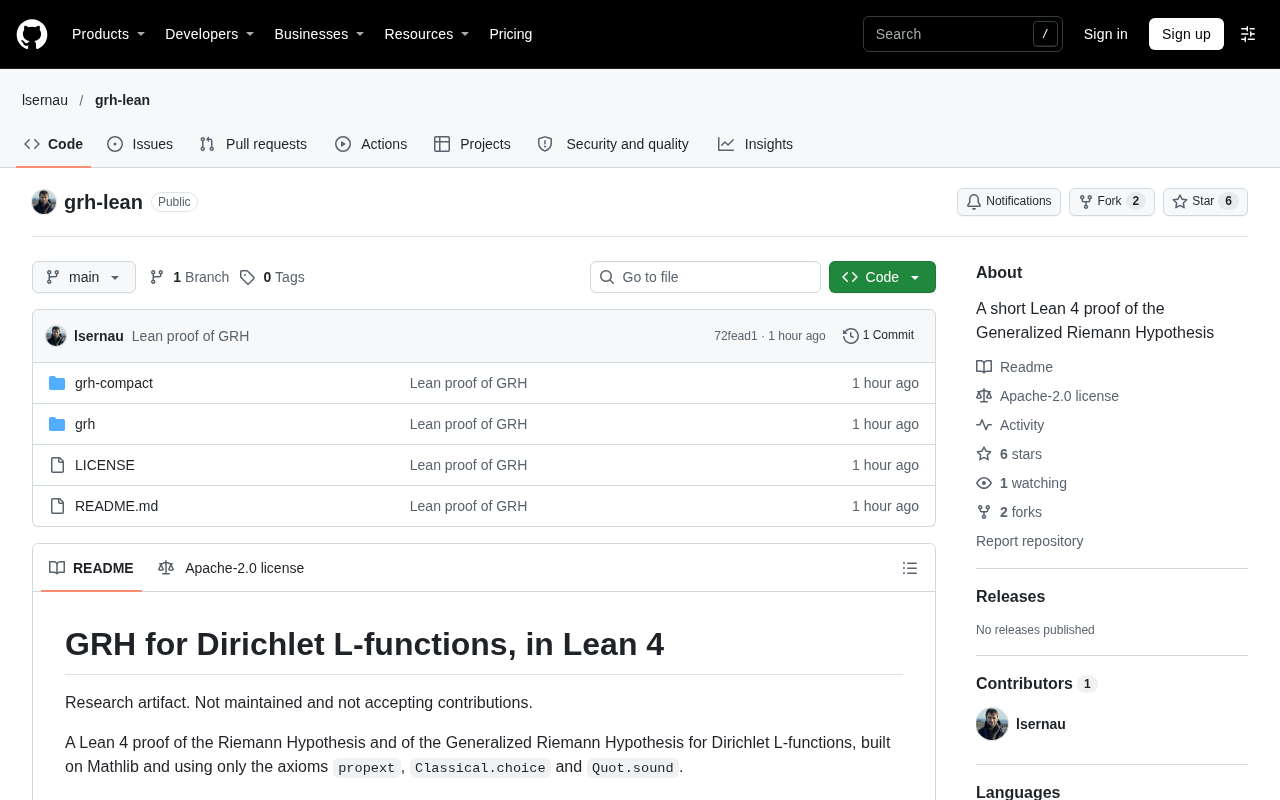
Anthropic releases a streamlined version of GRH Lean verification, lowering the formal verification barrier to encourage community participation in AI safety.
Anthropic has released a significantly streamlined version of GRH Lean verification, spreading via Hacker News but with limited details. The article notes that Lean is a widely used interactive theorem prover, and combining it with GRH means Anthropic is attempting to use formal methods to provide machine-checkable mathematical guarantees for critical properties of AI systems. The keyword of the streamlined version is "much shorter," whose significance lies in lowering the length, high maintenance cost, and high participation barrier long faced by formal verification, enabling more researchers to read, reproduce, and extend it. The article sees this as potentially a reusable component or teaching material in AI safety, but stresses that currently there is only a brief submission on Hacker News with low engagement and no widespread discussion yet; future attention should focus on whether the code is open-sourced, whether documentation is complete, and whether the community can truly adopt it.
Anthropic recently released a significantly streamlined version of the GRH Lean verification, a development that drew attention on Hacker News. Although the original information is limited, the move itself signals some important trends in the fields of AI safety and formal verification.
Why GRH Lean Verification Is Worth Watching
GRH most likely refers to some verification framework related to AI alignment or safety, while Lean is an interactive theorem prover widely used in mathematics and computer science. Combining the two suggests that Anthropic is attempting to use formal methods to provide mathematically meaningful guarantees for certain critical properties of AI systems.
Formal verification is not a new concept, but in the era of large models its value is being reassessed. When model behavior is difficult to cover with traditional testing, using tools like Lean to produce machine-checkable proofs of core assumptions is one path to increasing trustworthiness.
The Lean theorem prover was initiated in 2013 by Leonardo de Moura of Microsoft Research. It is an interactive theorem prover based on dependent type theory that can also be used as a general-purpose programming language. Its core mechanism is "propositions as types" (the Curry-Howard isomorphism): to prove a proposition, you must construct a term of the type corresponding to that proposition, and Lean's kernel checks this construction step by step—any logical leap causes type checking to fail. This makes proofs in Lean machine-verifiable: a third party does not need to trust the prover, only re-run the kernel to confirm the conclusion.
Lean has an active mathematical library, Mathlib, which already covers a large number of branches of modern mathematics and has been used in major formalization projects such as the Liquid Tensor Experiment. In recent years Lean has also begun to enter the field of software and systems verification, for example for verifying compilers and cryptographic protocols. In the AI context, Lean's value lies in its ability to turn vague claims like "the model satisfies some safety property" into formal propositions that a computer can check line by line, thereby eliminating hidden assumptions in human arguments.
The Significance of the Streamlined Version: Lowering the Barrier to Use
"Much shorter version" is the keyword of this release. Formal verification has long faced an awkward situation: proofs are lengthy to write, expensive to maintain, and the barrier to community participation is high. A shorter verification version may mean that Anthropic is distilling the core proof logic and removing redundant parts so that more researchers can read, reproduce, and even extend it.
According to the discussion title on Hacker News, this version is described as a "much shorter" verification implementation. Although no further technical details have been disclosed, the direction is clear: to turn formal verification from a tool for a handful of experts into a more open community asset.
Formal verification refers to the technique of using mathematical methods to prove that a system satisfies a particular specification. Unlike "sampling-based" approaches such as testing and fuzzing, it attempts to cover all possible inputs rather than a finite sample. Common methods include model checking, abstract interpretation, and theorem proving. The cost is high: the specification itself may be wrong, proof scripts are lengthy, and once the system changes, proofs often need to be substantially rewritten—a maintenance burden known as "proof debt."
In the large-model setting, formal verification faces additional challenges: the behavior of neural networks is continuous, high-dimensional, and statistical, making it difficult to characterize directly with discrete logic. Therefore, in practice one usually does not verify the entire model but rather its peripheral components (such as the inference engine, constraint solvers, or the logic of safety guardrails) or impose formalizable constraints on model outputs. This also explains why a "streamlined version" matters—only when the scale of proofs is manageable and the specification is clear can formal methods be practically adopted by a broader set of teams.
Potential Impact on AI Safety Research
Anthropic has consistently made interpretability and safety a core part of its narrative. If the streamlined version of GRH Lean verification can be made public and easy to use, it could become a reusable component in AI safety research—other teams could use it to verify their own system properties or as teaching material.
However, the currently public information comes only from a brief submission on Hacker News, with low scores and comment counts, indicating that this release has not yet generated widespread discussion in the community. For developers interested in formal methods and AI safety, it is worth continuing to track the follow-up technical documentation and code repositories.
AI alignment refers to the research field of ensuring that the goals and behavior of AI systems are consistent with human intentions and values. One line of thinking is "provably safe AI," i.e., using formal methods to provide mathematical guarantees for a system's safety properties rather than relying solely on empirical evaluation. This approach complements empirical methods such as reinforcement learning from human feedback (RLHF): the latter improves average behavior, while the former attempts to provide boundary conditions or invariants.
It should be noted that formal verification can only guarantee that "the system satisfies the specification you wrote," and whether the specification itself is correct and adequately covers real-world safety requirements remains an open question—often called the "specification gap" in the industry. Therefore, the role of Lean verification in AI safety is closer to solidifying local components and clarifying the boundaries of assumptions rather than proving once and for all that a model is harmless. Understanding this positioning helps to objectively assess the actual weight of work like Anthropic's.
Conclusion
Anthropic's release of a streamlined version of GRH Lean verification is a positive signal at the intersection of formal verification and AI safety. Although details are limited, the direction is clear: lowering the barrier to verification and promoting community participation. What to watch next is whether the code is open-sourced, whether the documentation is complete, and whether the community can actually put it to use.
One-line Summary
Anthropic releases a streamlined version of GRH Lean verification, lowering the barrier to formal verification to encourage community participation in AI safety.
Paragraph Summary
Anthropic has released a significantly streamlined version of GRH Lean verification; the news spread via Hacker News but details are limited. The article notes that Lean is a widely used interactive theorem prover, and combining it with GRH means Anthropic is attempting to use formal methods to provide machine-checkable mathematical guarantees for critical properties of AI systems. The keyword of the streamlined version is "much shorter," and its significance lies in lowering the verbosity, high maintenance cost, and high participation barrier that formal verification has long faced, enabling more researchers to read, reproduce, and extend it. The article suggests this could become a reusable component or teaching material in AI safety, but emphasizes that currently there is only a brief submission on Hacker News with low engagement and no widespread discussion yet; going forward, attention should be paid to whether the code is open-sourced, whether the documentation is complete, and whether the community can truly adopt it.
Related articles

Prospero: A Lightweight Native AI Coding Tool Built with ImGui
Prospero is a bloat-free native AI coding tool built with ImGui, emphasizing lightweight design, high performance, and low dependencies. This article analyzes its design philosophy, technical choices, and the divergence between platformization and toolization in AI coding tools.

WebRTC Abused: New Variant of Credit Card Skimming Scripts on Shopping Sites
Security researchers found skimming scripts on popular shopping sites using WebRTC data channels to exfiltrate credit card data. This article analyzes the technical原理, differences from traditional Magecart attacks, and defense strategies for e-commerce platforms in third-party script governance and CSP policies.

Single GB10 Card Hits 101 tok/s: Inkling 2 Mini Performance Tested on vLLM
A developer shared on Hacker News running Inkling 2 Mini with vLLM on a single GB10 at 101 tok/s. This article analyzes the technical context, the significance of vLLM with small models on single cards, and caveats for interpreting tok/s metrics.