Anthropic Reportedly Launches Largest IPO in History, Retail Investors Can Buy Shares but Get No Voting Rights

Reddit leak claims Anthropic launched the largest IPO in history, with retail investors able to buy shares but holding no voting rights, sparking debate on AI governance and investment risk.
The article centers on an unverified Reddit leak: Anthropic is said to have launched the "largest IPO in history," but ordinary investors can only buy non-voting shares and have no say in company decisions. The author analyzes that if true, it would mean capital markets' pricing of generative AI has entered a new phase, driven by the AI infrastructure arms race and the head effect. The article examines the pros and cons of retail investors "buying shares with zero say" under a dual-class structure: it opens a channel to participate in top-tier AI assets but also creates a structural asymmetry between rights and risks. If the IPO materializes, it would reset AI primary-market valuation anchors, attract incremental capital, and make governance structure and retail investor protection new regulatory topics. But the author emphasizes the news comes only from a community leak, and scale and terms should be treated cautiously until official prospectus disclosures emerge.
A "Historic IPO" First Exposed on Reddit
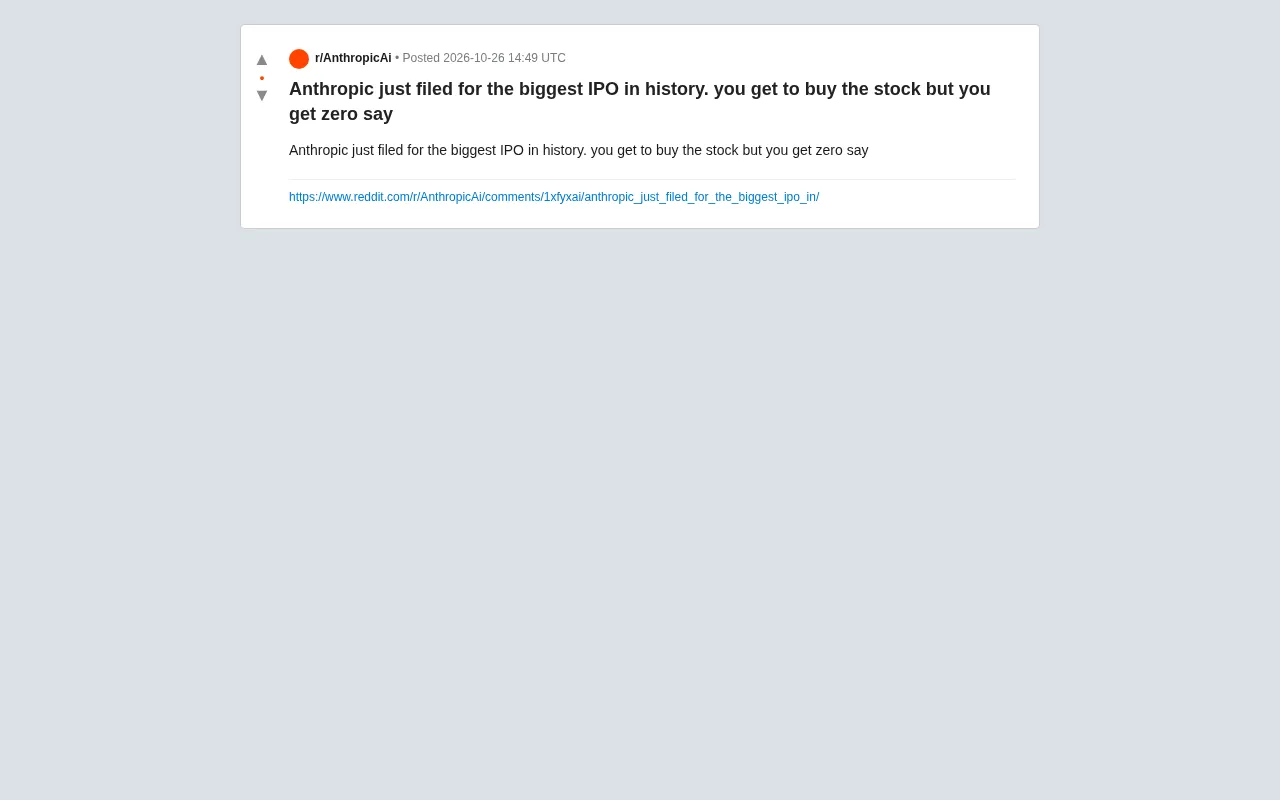
A Reddit post quickly ignited the tech and investment communities: "Anthropic just filed for the biggest IPO in history. you get to buy the stock but you get zero say."
The post points directly at two core tensions: scale—if true, it would be the "largest IPO in history"; and rights—ordinary investors can only buy shares but cannot influence company decisions. Against the backdrop of soaring AI company valuations and capital rushing in, this one-sentence leak puts retail investors' complex mindset toward AI giants on full display: they want a piece of the pie, but fear being the ones getting fleeced.
It should be noted that the information currently comes only from a Reddit community leak, with no official SEC filing or cross-verification from authoritative media. The analysis below is based on this lead, with unverified parts flagged.
What Does "Largest in History" Mean?
The phrase "largest IPO in history" alone is enough to make the market take notice. Historically, the record for the world's largest IPO has long been held by a handful of trillion-dollar giants, and if Anthropic, as an AI large-model company, were to enter public markets at such a scale, it would mean capital markets' pricing of generative AI has entered an entirely new phase.
There are two driving forces behind this. The first is the arms race in AI infrastructure: large-model training and inference costs are high, private financing can no longer meet expansion needs, and going public becomes a natural choice to replenish ammunition. The second is the head effect: capital tends to bet on the few players that have proven technical strength, and Anthropic, with the reputation built by its Claude series models, is a candidate to absorb this flood of capital.
However, the original leak provides no details on the specific size, offering valuation, or timetable of the "largest in history," and readers should remain cautious.
IPO (Initial Public Offering) refers to the process by which a private company first issues shares to the public and lists them for trading on a stock exchange. It is both a financing method for the company and an exit channel for early investors and employee shareholders. An IPO is typically accompanied by strict regulatory disclosure obligations: the company must submit an S-1 registration statement to the U.S. Securities and Exchange Commission (SEC), detailing its financial condition, risk factors, equity structure, and executive compensation, followed by a roadshow and pricing. Therefore, there is usually a gap of several months between "filing for an IPO" and "completing an IPO," and it may be delayed or withdrawn due to changes in market conditions. If the "IPO launch" claimed in the Reddit leak is true, it should manifest as a public submission of an S-1 filing, verifiable in the SEC's EDGAR database. This procedural knowledge explains why "official documents" are the key yardstick for judging the authenticity of the leak—no S-1, no verifiable IPO.
The Two Sides of Retail Investors "Buying Shares with Zero Say"
The second half of the post—"you get zero say"—is what really hits a nerve. It points to a common equity structure arrangement: the company issues non-voting or low-voting shares to the public market, while the founding team and early investors maintain control through high-voting shares.
For ordinary investors, there is a positive side. Retail investors have, for the first time, the opportunity to directly hold equity in a top-tier AI company and share in the industry's growth dividends, without having to go through the high threshold of the primary market or indirect vehicles in the secondary market. Liquidity and transparency are also somewhat improved compared with the private stage.
But the other side is equally obvious. "Buying stock" does not equal "being a shareholder"—on key decisions such as major strategy, management appointments, and mergers and acquisitions, the voice of outside investors is structurally weakened. When company interests and retail investors' interests diverge, investors lacking voting rights have almost no means of checks and balances. The wording of the original Reddit post is clearly sarcastic: you're invited aboard, but the steering wheel isn't in your hands.
This design is not uncommon among tech companies; founding teams use it to resist short-term capital pressure and stick to long-term technology roadmaps. The problem is that when an IPO's scale is labeled "largest in history," the asymmetry between the capital risk borne by ordinary investors and the rights they receive will be magnified under scrutiny.
Dual-Class Share Structure is the key background for understanding "zero say." This arrangement divides a company's stock into two or more classes, typically Class A shares with one vote per share issued to the public, and Class B shares with ten votes or more per share held by founders and early teams. U.S. exchanges that allow such structures (such as the NYSE and Nasdaq) require companies to disclose voting differences but do not mandate "one share, one vote." Tech companies such as Google (now Alphabet), Meta, and Snap have all adopted similar designs, and Snap even issued shares with no voting rights at all. Supporters argue this protects founding teams from short-term performance pressure and allows focus on long-term strategy; critics point out that it leaves outside shareholders with almost no ability to hold management accountable, influence major transactions, or weigh in on compensation plans. For AI companies, the high uncertainty of technology roadmaps further amplifies this governance risk—retail investors are essentially betting on the founding team's judgment but cannot correct course through voting when direction deviates.
Potential Impact on the AI Investment Landscape
If Anthropic's IPO materializes, its ripple effects could extend beyond a single company.
Primary-market valuation anchors will be reset. Public-market pricing will become a reference point for other AI unicorns, and the valuation logic of private rounds will face recalibration.
A channel for retail investors to participate in the AI wave will open. In the past, ordinary people had limited opportunities to access top-tier AI assets; a high-profile IPO will attract substantial incremental capital and may also intensify short-term volatility.
Governance structure will become a new topic. Discussion of "zero say" will prompt investors to pay more attention to AI companies' equity design and information disclosure, and regulators may also impose more requirements on retail investor protection under dual-class structures.
The direction and intensity of these effects depend on the actual terms of the IPO—and the terms are precisely what is most missing from the current leak.
Distinguishing the primary market and secondary market helps explain the meaning of "valuation anchor reset" in this article. The primary market is the private financing stage before a company goes public, with participants limited to institutional investors such as venture capital and hedge funds; transactions are private, liquidity is poor, and pricing depends on bilateral negotiation. The secondary market is public trading on stock exchanges, open to anyone, with prices formed in real time by supply and demand. The valuations of AI unicorns in the primary market are often based on negotiated pricing in private rounds and lack public benchmarks. Once a top-tier company completes an IPO, its secondary-market metrics such as price-to-earnings and price-to-sales ratios become public references, and the private valuations of other unlisted AI companies face pressure to "align with the public market"—if the multiples offered by the public market are lower than previous private valuations, it could trigger valuation cuts or even financing difficulties. This is the mechanism behind the so-called "anchor reset."
A Rational View: A Leak Is Not a Conclusion
Back to the information itself. The value of this Reddit post lies in raising the right questions: when AI giants go to public markets, are ordinary investors getting an opportunity, or a carefully packaged exposure to risk?
But it is also an uncross-verified community leak. Key statements such as "largest IPO in history" and "zero voting rights" need to wait for confirmation from official prospectus documents, regulatory disclosures, or authoritative financial media. Before then, any investment decision based on this news should be made with extra caution.
For readers following the AI industry, three signals are worth tracking: whether formal IPO documents emerge, the specific terms of the equity structure, and the market's reaction to non-voting shares. Together, these three will determine whether this IPO—first exposed by Reddit—is a capital feast or a public lesson on "rights and risks."
Related articles

Last Week Tonight Exposé: The Dangerous Ties Between Politicians and White Supremacy
Last Week Tonight investigates Georgia Senate candidate Mike Collins and Florida candidate Marshall Rawson, exposing their multiple ties to white supremacists and the Republican Party's silent response.
AI Buzz Weekly: GPT-6.5 Leak, New Claude Model, and MiniMax's Cost-Effectiveness
This week's AI buzz roundup: suspected GPT-6.5 leak, Microsoft configs showing GPT-6.1 Tera, Anthropic's new model that can identify entire classes of bugs, disappointing early Gemini 4 Carbon results, and MiniMax M3.1 Flash beating Claude Opus 5 and GPT-5.6 Sol in benchmarks at extremely low cost.

AI Briefing: Gemini 4 Carbon Released, Ant Open-Sources Ling-3.1
AI Briefing: Google releases Gemini 4 Carbon qubit model, claiming to surpass Opus 5.5 with half-price tokens; Ant open-sources Ling-3.1-1019 for real-task Personal Agents; domestic AI drug discovery succeeds in 18 of 19 projects, hitting all 6 GPCR targets; zero-revenue company valued at $20B raises another $1B; Sichuan convenience store robot sales fail.