Anthropic Research Residency Opens Applications: No ML Background Required

Anthropic opens applications for its paid Research Residency, no ML background required, aimed at academics, founders, and senior engineers.
Anthropic announced that applications for its Research Residency are open — a paid, fixed-term research program for academics, technical founders, and staff-level engineers. Most notably, the official notice explicitly requires no machine learning background, with the program valuing raw research ability, engineering judgment, and cross-disciplinary perspective. The article argues this is effectively a career transition channel rather than an ordinary internship, dropping hard thresholds around publication records and ML experience and acknowledging that AI safety needs multidisciplinary input. The application deadline is November 22, but the recruitment notice did not disclose program duration, salary, location, or specific research directions, so applicants should consult the full official instructions. The program reflects a rising real-world demand in AI safety research for interdisciplinary talent.
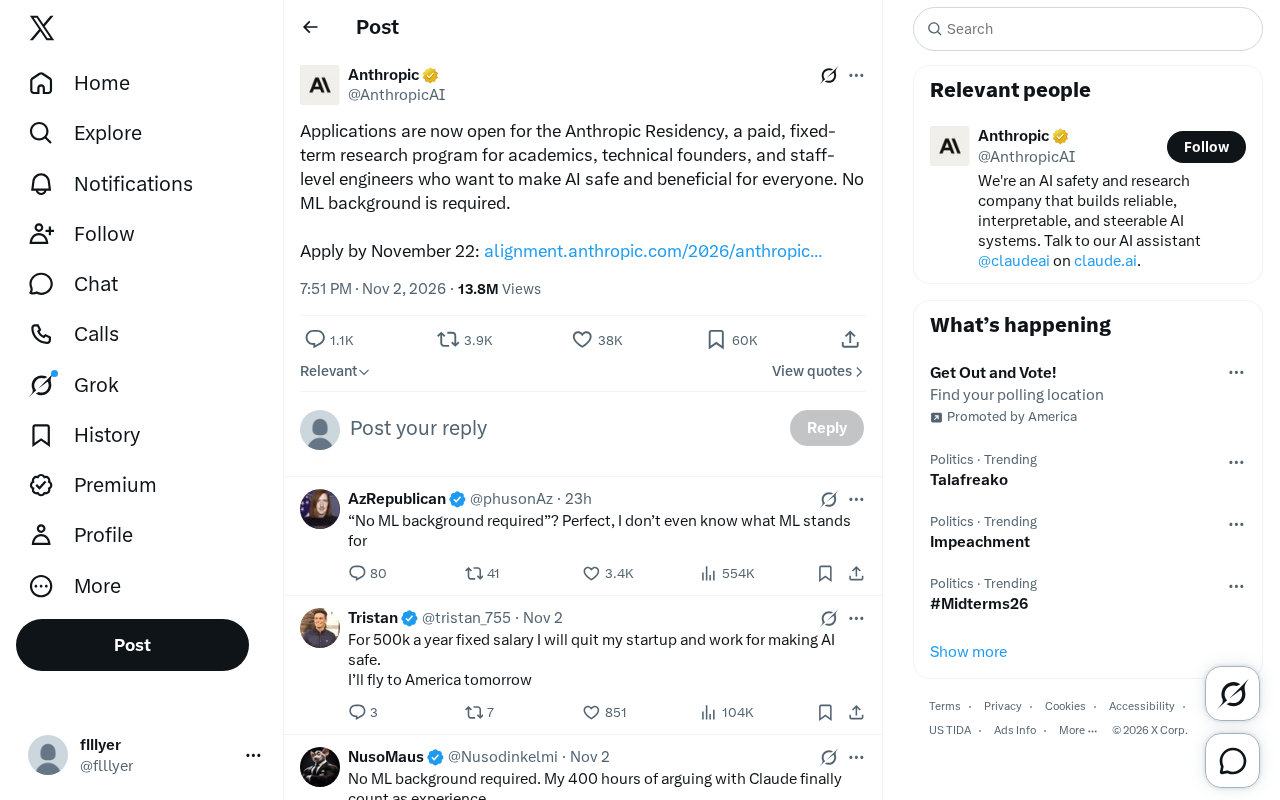
Anthropic recently announced on social media that applications for its Research Residency program are officially open. This is a paid, fixed-term research program aimed at academics, technical founders, and staff-level engineers, with the goal of attracting people who want to advance AI safety that benefits everyone.
The most notable point: no machine learning background is required to apply. This means the program values applicants' raw research ability, engineering judgment, and cross-disciplinary perspective rather than existing ML credentials. For people who have long worked in traditional academia or on the engineering front lines and want to pivot toward AI safety, this is an entry point where the bar has been deliberately lowered.
Program Positioning: A Career Transition Channel, Not an Ordinary Internship
From the official description, the Residency is worded as a "research program" rather than an internship. Paid, fixed-term, and aimed at academics and technical founders — together these three elements point to what is really a career transition channel: letting people who have already achieved something in their own fields spend a concentrated period entering AI safety research.
The value of this kind of design lies in its different screening logic. Conventional research hiring tends to filter candidates by publication records and ML project experience, while the Residency explicitly drops this threshold — effectively acknowledging that AI safety is a field requiring multidisciplinary input, where training in law, social science, and systems engineering can be equally valuable.
The "alignment" problem in AI safety research refers to how to make AI system behavior consistent with human intent and values. Over the past decade this concept has gradually moved from philosophical discussion into engineering practice, covering specific directions such as reward modeling in reinforcement learning, interpretability, and red teaming. Anthropic itself is known for alignment methods such as "Constitutional AI," and its research agenda emphasizes safeguarding safety while model capabilities improve. Understanding this helps grasp the Residency's positioning: it is not about training general-purpose ML engineers, but about bringing cross-disciplinary talent with perspectives from institutions, law, and systems engineering into alignment and safety research — because alignment problems often involve rule design and human behavioral constraints in deployment scenarios, which are hard to solve through model-level technology alone.
Who Should Apply
The three categories officially listed are worth breaking down one by one:
- Academics: not necessarily in computer science, but with solid research methodology.
- Technical founders: startup experience means practical judgment about technology deployment and risk — experience that is often scarce in safety research.
- Staff-level engineers: the emphasis on staff-level indicates the program expects applicants who can already independently own complex systems, not junior developers.
"No ML background is required" is the most weighty sentence in this recruitment message. It simultaneously lowers the application threshold and raises expectations for applicant diversity, so application materials are more likely to assess problem awareness and the quality of past work rather than keyword matching.
"Staff-level engineer" is a senior title in tech companies' engineering job ladders, typically sitting between junior levels and senior management, requiring engineers to independently own complex cross-team, cross-system projects and to have influence over technical decisions. By contrast, entry-level or mid-level engineers mostly execute tasks within established frameworks. Anthropic's emphasis on staff-level means the program expects applicants to already have mature engineering judgment and system design experience, able to quickly identify real risk points in AI deployment rather than learning programming or basic ML skills from scratch. This also explains why the program dares not to require an ML background: it selects people who have already reached equivalent maturity in other fields.
Application Details and Timeline
According to official information, the application deadline is November 22, with submissions made through the official link. The program is paid and fixed-term.
It is worth noting that the original recruitment information did not disclose details such as program duration, salary level, work location, specific research directions, number of accepted participants, or selection process. Interested applicants should consult the complete instructions on the official page before submitting, rather than making judgments based solely on a brief social media description.
Signals Worth Noting
From an industry perspective, a leading AI lab absorbing non-ML-background talent through a Residency format reflects a real and rising demand in AI safety research for interdisciplinary capabilities. Safety and alignment problems are hard to solve through model-level technical means alone; they involve institutional design, human behavior, and engineering constraints in deployment scenarios — exactly what academics, founders, and senior engineers have long been trained in.
For individuals, the significance of such a program is that it provides an organized research experience and direct feedback within the field, not a path that guarantees an outcome. Before applying, thinking clearly about which specific AI safety problem you can contribute a unique perspective on is more persuasive than broadly expressing that you "care about AI safety."
The application deadline is November 22; interested parties should keep an eye on the time window.
Related articles

World's First Humanoid Robot Company Agility Lists on Nasdaq: Buy or Not?
Agility becomes the world's first pure-play humanoid robot company to list on Nasdaq. This article analyzes what the landmark event means for the industry and investors, unpacking the commercialization test and investment framework for the pure humanoid robot sector.

Agent-Browser: A Browser Automation CLI for AI Agents
Vercel Labs open-sources agent-browser, a Rust-built browser automation CLI designed for AI agents, with over 45,000 GitHub stars and command-line-first browser control.

LZ4: The Open-Source Benchmark for Blazing-Fast Compression
Explore the LZ4 blazing-fast compression algorithm: its design philosophy, performance advantages, and wide use in the Linux kernel, databases, and more. How a 12k+ star open-source project became the speed benchmark.