Anthropic Rushes Out Opus 5.5 and Sonnet 5.5 Ahead of OpenAI Dev Day

Anthropic allegedly drops Opus 5.5 and Sonnet 5.5 right before OpenAI Dev Day, sparking community buzz.
According to Reddit discussions, Anthropic reportedly launched Opus 5.5 and Sonnet 5.5 on the eve of OpenAI's Dev Day, with community claims that both models outperform OpenAI's codenames Sol and Astra. The timing has drawn significant attention as a strategic move to shape the narrative ahead of a competitor's major event. OpenAI is meanwhile rumored to unveil 20+ updates spanning its platform ecosystem. The article cautions that performance comparisons remain unverified community speculation — treat them as signals, not conclusions — and that official disclosures and independent benchmarks are what truly matter.
A Well-Timed Power Move
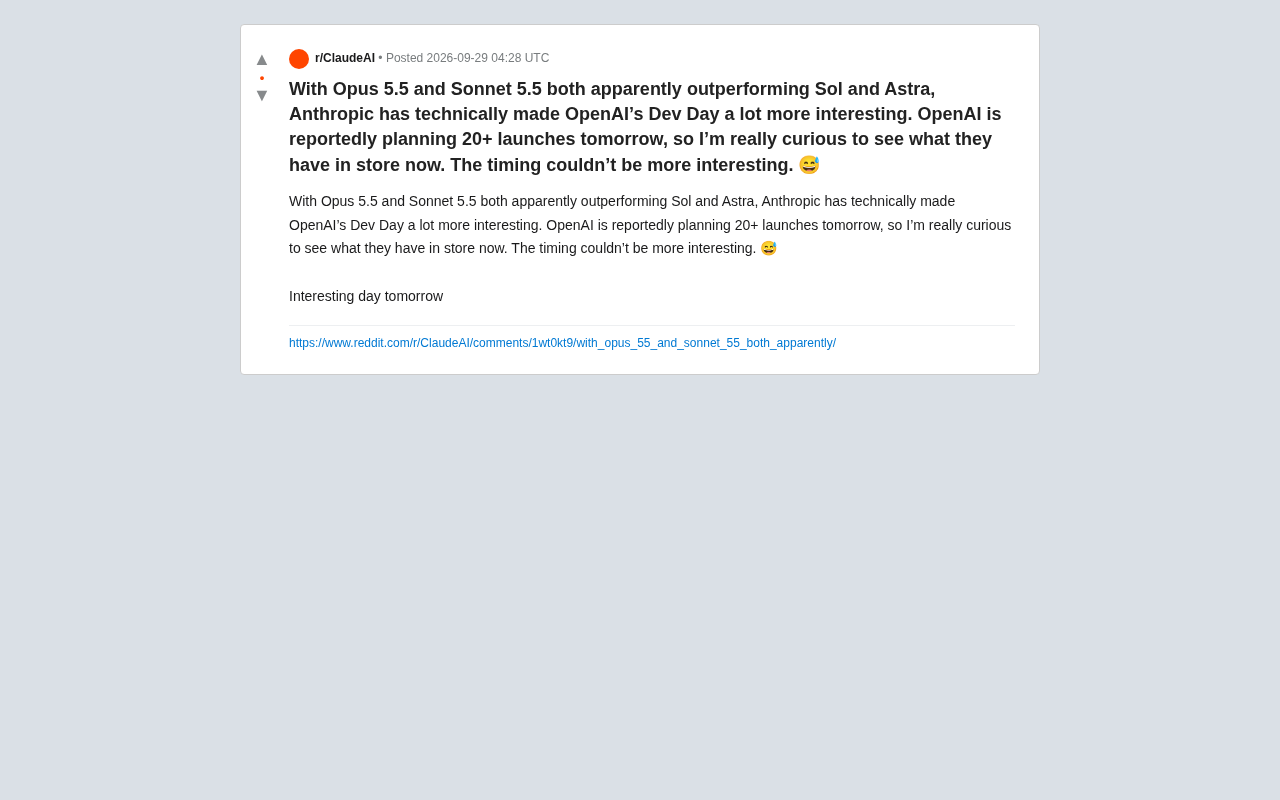
According to heated discussions on Reddit, Anthropic has reportedly launched two new models — Opus 5.5 and Sonnet 5.5 — and the community claims they outperform OpenAI's models codenamed Sol and Astra in certain comparisons. What's making this news especially noteworthy is the timing: it's dropping right on the eve of OpenAI's developer conference, Dev Day.
Some community members have pointed out that Anthropic's move essentially makes the upcoming OpenAI Dev Day "more interesting to watch." When a competitor drops a major model release the day before your big event — intentional or not — it inevitably raises the bar for what people expect from OpenAI's announcements.
It's worth noting that these performance comparisons are still at the level of community rumors and discussion, without authoritative third-party benchmark data to back them up. The claim that they "outperform Sol and Astra" should therefore be treated as an unverified opinion, not a settled fact.
What to Watch for at OpenAI Dev Day
Based on details mentioned in the Reddit thread, OpenAI is reportedly planning to unveil "20+ announcements" at Dev Day. If true, this would represent a dense wave of product and capability updates — likely extending well beyond the iteration of a single flagship model.
For developers, Dev Day has always been a key window into OpenAI's technical roadmap. A high-volume release typically signals moves at the platform ecosystem level — from API capabilities and toolchains to enterprise deployment solutions. And with Anthropic having already fired a signal flare, every OpenAI announcement will inevitably be viewed through a comparative lens.
This back-and-forth rhythm fundamentally reflects that frontier AI model competition has entered a phase of rapid, high-frequency iteration. Release windows among top players are becoming increasingly compressed, and the timing game itself has become part of the competitive strategy.
OpenAI Dev Day is OpenAI's annual developer conference. The inaugural edition in November 2023 introduced GPT-4 Turbo, the Assistants API, custom GPTs, and more, generating massive attention. The core audience is developers and enterprise customers building on the OpenAI API, so announcements tend to emphasize platform capabilities — such as context length, function calling, and multimodal interfaces — rather than pure benchmark score improvements. If "20+ announcements" proves accurate, it would follow that same playbook: reinforcing developer stickiness through dense ecosystem-level updates rather than a single flagship model reveal.
What the Model Names Signal About the Competitive Landscape
The naming itself carries meaningful information. Opus and Sonnet are two product lines within Anthropic's Claude family — Opus targets top-tier capabilities while Sonnet emphasizes the balance between performance and cost. Upgrading both lines to version 5.5 simultaneously suggests Anthropic wants to compete with rivals across different use cases at the same time.
As for Sol and Astra — the OpenAI codenames mentioned in the discussion — these are largely terms circulating within the community. Codenames like these are often hard to verify before an official launch, and readers should apply appropriate skepticism.
From a competitive standpoint, Anthropic choosing to make a move on the eve of a rival's major event is both a display of confidence and a strategy for claiming the narrative. As AI model competition grows increasingly commoditized, "who speaks first" and "who picks the better moment" are becoming significant factors in shaping public discourse.
Anthropic's Claude series has maintained a clear tiered structure since its 2023 launch: Opus represents the highest-end reasoning and complex task capabilities, carrying the highest pricing and compute demands; Sonnet sits in the middle layer, balancing speed and quality, making it the most frequently called version among developers; Haiku is the lightweight, low-latency option. The version number jumping from 3 to the now-circulating 5.5 also hints that Anthropic may not strictly follow linear versioning internally — perhaps choosing more impactful numbers for competitive marketing reasons. As for Sol and Astra: if accurate, Sol likely corresponds to a high-reasoning model (similar to an o-series iteration), while Astra shares its name with Google DeepMind's Project Astra — a coincidence that has led some community members to question the credibility of the source.
Taking a Rational View of Community Rumors
This kind of community-sourced leak has real value as an early signal of industry movements — but its limitations are equally clear: no official confirmation, no reproducible test data, and a healthy dose of subjective judgment mixed in. For practitioners and developers tracking AI progress, the safer approach is to treat these discussions as clues to investigate, not conclusions to act on.
What's truly worth waiting for is OpenAI's official disclosures at Dev Day, followed by independent organizations conducting cross-model benchmarking. Only when benchmark data and real-world usage experience are both on the table can anyone give a credible answer to "who's better."
Regardless of the outcome, top players competing intensely within the same time window is good news for the entire industry and for end users — it means capabilities are advancing rapidly and choices are multiplying. This well-timed rivalry is worth keeping a close eye on.
Related articles

Is the Agent Harness Dead? Cursor's Early Engineer Breaks Down the Real Architecture of AI Coding Agents
Cursor early engineer Jediah breaks down the real architecture of the agent harness: why "the harness is dead" is only half right, how the data flywheel lets the harness obsolete itself, and how Grokbot, software factories, and primitive design open new frontiers for agents.
Python Visitor Pattern and Better Alternatives Explained
A deep dive into Python's visitor pattern and four alternatives: method pattern, pattern matching, dictionary mapping, and functools.singledispatch. Choose the best decoupling design by change frequency.

357 Days of Deep Experience: Why Omarchy Made Me Stop Distro-Hopping
A 357-day deep dive into Omarchy: 59-second install, out-of-the-box audio and GPU support, the Quattro QuickShell rewrite migration pains, and why Arch users should try it.