Anthropic's $1.4 Trillion IPO Bid: Explosive Revenue Growth and a Massive Compute Bet

Anthropic is racing toward an IPO at a $1.33 trillion valuation, with revenue surging but $895 billion in compute commitments constituting a massive bet.
Anthropic plans to list on Nasdaq at a valuation of up to $1.4 trillion. Its revenue has soared from $41 million in 2023 to nearly $17 billion in Q3 2026, with office products like ClaudeCode driving growth. However, the company has signed about $895 billion in compute commitments, $70 billion of which comes due within 12 months, so revenue must keep growing fast to cover the bills. OpenAI, Google, and open-source models continue to apply pressure. The author estimates the IPO price is roughly flat within a year in the base case and rates it "Hold" for five years or more, viewing the stock as a speculative bet on execution whose value depends on profit after compute costs.
Business Today: From Coding Assistant to Full Office Suite
Anthropic, the AI company behind the Claude model family, is racing toward a Nasdaq listing at a valuation of up to $1.4 trillion. From $41 million in revenue in 2023 to nearly $17 billion in a single quarter, its growth curve is staggering. But behind that sky-high valuation lies an equally staggering compute bill. Can the company grow into the size it has priced itself at?
Anthropic was founded in 2021 by former OpenAI researchers. Its revenue comes from two legs: an API platform where enterprises pay by token usage, and Claude app subscriptions for individuals and teams. In the first nine months of 2026, usage fees accounted for 79% of revenue and subscriptions 21%.
The fastest-growing product is ClaudeCode—an assistant that can autonomously write, test, and fix software code. Less than a year after launch, its annualized revenue crossed $2.5 billion in February. The prospectus contains a telling comparison: enterprise users who don't use ClaudeCode spend under $75 per month on average, while the top 5% of users who do use it spend roughly 20 times that amount.
Cowork, launched in January, brought the same logic to office scenarios such as sales, legal, and finance. ClaudeDocs, ClaudeSlides, ClaudeSheets, Whiteboards, and ClaudeData followed, and Claude is now deeply integrated into Word, Google Docs, Sheets, and Slides. By October, users had created more than 45 million documents, presentations, and designs. In November, ClaudeMeetings entered public beta: it can join video calls as a visible participant and generate documents or whiteboards in sync as people talk.
Creative work is expanding too. ClaudeMotion can turn reports or charts into exportable animated explainer videos, and connectors built on the Model Context Protocol let Claude read and write 3D scenes, build objects, set lighting, and create animations directly inside third-party applications such as Blender. Coding remains the core, but the boundaries of office work are widening fast.
Customer quality is direct evidence of competitiveness. As of the end of September, more than 11,900 customers paid at least $100,000 a year, and about 250 paid more than $10 million. No single customer accounted for more than 10% of revenue, but the top five together made up roughly a quarter—concentration is real, though lower than in 2025.
Competitive Landscape: Leading, But Not a Monopoly
OpenAI is the main rival. ChatGPT reaches more than 1.2 billion people each week, far outpacing the Claude app. OpenAI's third-quarter revenue was about $10 billion, and it is targeting $70 billion in annualized revenue by year-end. Anthropic overtook OpenAI in quarterly revenue in the second quarter, mainly by selling to enterprises rather than consumers.
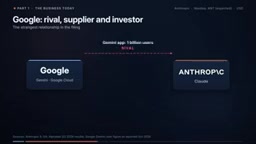
Google is another named competitor, and the most unusual one: the Gemini app has 1 billion users, and Google Cloud revenue doubled last quarter to $30.7 billion. At the same time, Google is one of Anthropic's largest suppliers, with at least $121 billion in compute commitments, and will subscribe to shares in the IPO. Meta, xAI, and cheaper open-source models from China continue to exert price pressure.
Judging whether the lead can last requires watching three things: whether revenue growth continues to outpace compute costs, whether large customers stay, and whether Claude can defend its pricing.
The Financial Reality: Extreme Growth, Equally Extreme Spending
Anthropic has only three full audited years. Revenue went from $41 million in 2023 to $386 million in 2024 and $4.6 billion in 2025. Quarterly revenue then jumped from $376 million in Q1 2025 to nearly $17 billion in Q3 2026, a more than 12-fold year-over-year increase. But growth is slowing as the base grows: 144% quarter-over-quarter in Q2, then 47% in Q3.
Operating margin was deeply negative in 2025, at -176% for the full year. It turned positive for the first time in Q2 2026 at +8%, then fell back to -3% in Q3 with a loss of $567 million, as compute costs jumped to $9.9 billion. The company prefers adjusted margins that exclude stock-based compensation, which came in at 15%. The $10.4 billion net loss over nine months is mainly a convertible bond accounting charge driven by rising valuations, not a cash outflow.
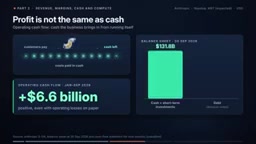
Operating cash flow is the money that actually comes from running the business: positive $6.6 billion in the first nine months of 2026. As of the end of September, Anthropic held about $132 billion in cash and short-term investments against $6.2 billion in debt. That cash comes mainly from investors—$141 billion raised cumulatively since founding.
The biggest number in the prospectus isn't revenue—it's compute commitments. Anthropic has signed roughly $895 billion in chip, data center, and cloud capacity commitments. About $70 billion comes due within the next 12 months, and about $448 billion by the end of 2030. Key partners include Broadcom, Google, SpaceX's AI division, Amazon, and Microsoft. Some commitments are cancellable, but most are not. It's a massive gamble: revenue must grow enough to cover these bills.
Management's expectations for the future are even more aggressive. As of the end of October, annualized revenue was running at about $81 billion. Reuters reported in August that Anthropic expects revenue of $190 billion to $200 billion in 2028, a figure the company has not confirmed. Its stated long-term goal is an adjusted operating margin above 35%. The video's author offers a more cautious base case: $860 billion in 2028 revenue—on the grounds that industry prices keep falling and competitors are catching up in coding.
Adjusted operating margin: This is a company-defined non-GAAP metric that typically excludes non-cash items such as stock-based compensation from operating profit. Stock-based compensation is widely used by tech companies to attract talent but significantly depresses reported profit. Anthropic's GAAP operating margin was -176% in 2025, while its adjusted margin was +15% in Q3 2026; the difference comes mainly from stock-based payments. Investors should note that while adjusted metrics can reflect cash-level operating efficiency, stock-based compensation is also a real economic cost (it dilutes shareholder equity) and should not be entirely ignored.
Convertible bond accounting charge: When a company's valuation rises, the fair value of the conversion rights (or redemption rights) embedded in convertible bonds increases, requiring recognition of a non-cash loss that hits net income but not operating cash flow. Much of Anthropic's $10.4 billion nine-month net loss falls into this category of valuation-driven book charges rather than actual business burn. That's why analyzing its cash position should focus on operating cash flow rather than net income.
IPO Pricing: A Good Company Isn't a Good Price
Anthropic plans to offer 825 million shares on Nasdaq at $70 to $78 per share under the ticker ANT. Pricing is expected on November 18, with trading beginning the next day. Seven partners, including Google, NVIDIA, and Microsoft, will subscribe to an additional $26 billion of non-voting shares. At the $74 midpoint, the fully diluted valuation is about $1.33 trillion. Control is highly concentrated: seven co-founders hold half the voting power, and an independent trust selects a majority of board members.

On outside views, valuation professor Aswath Damodaran put his estimate at about $1.45 trillion on November 3. After the November 5 market selloff, investors were reportedly discussing a range of $1.2 trillion to $1.3 trillion. At the midpoint, buyers are paying about 16 times current annualized revenue, or about 7 times reported 2028 forecast revenue.
The author offers his own calculation as of November 15, 2026: assuming about 18 billion fully diluted shares with no further dilution, and a net margin that deducts all costs, taxes, and stock-based payments. Base case: $160 billion in 2028 revenue, 18% net margin, 40x P/E, corresponding to $64 per share; bear case: $110 billion revenue, 8% net margin, 30x P/E, corresponding to $15 per share; bull case: the reported $200 billion revenue, 25% net margin, 50x P/E, corresponding to $140 per share. The one-year target (November 2027) uses the same base-case earnings but a 45x P/E, corresponding to $72.
That means, at the IPO price, the stock is roughly flat within a year in the base case and slightly lower after two years. The author's overall rating for five years or more is "Hold," with speculative characteristics. Demand is real and cash is abundant, but the compute bill is enormous and margins are unproven. The outlook improves if operating margins stay positive and expand; it weakens if growth slows below roughly 40% a year or if compute costs grow faster than revenue.
Anthropic can become one of the most important AI companies of the decade, but its stock remains a bet on execution. In the author's analytical framework, value depends on the profit left after subtracting the compute bill—not on revenue before the bill.
Fully diluted valuation and price-to-sales (P/S): Fully diluted valuation assumes all convertible securities, options, and restricted stock units (RSUs) have been converted into common shares, so the share count is higher than basic shares outstanding and the valuation is more comprehensive. Price-to-sales is market cap (or fully diluted valuation) divided by annualized revenue, measuring how much investors pay for each dollar of revenue. At the $74 midpoint, Anthropic trades at about 16 times current annualized revenue—far above traditional software companies (typically 5-10x), but below the extreme multiples of some high-growth AI companies. That multiple embeds the market's expectation of continued rapid revenue growth; if growth slows, the risk of multiple compression is significant.
Price-to-earnings (P/E) and net margin: The 40x and 45x P/E ratios used in the author's calculations are valuation multiples applied to assumed future earnings. For a company that isn't yet consistently profitable, a P/E model requires first forecasting net margin (net income as a share of revenue after all costs, taxes, and stock-based payments), then multiplying by the expected P/E to arrive at per-share value. The base case assumes an 18% net margin in 2028, meaning $160 billion in revenue corresponds to about $28.8 billion in net income. Whether that margin is achievable depends primarily on whether compute costs as a share of revenue can fall.
Related articles

Gemini 4 Neon Opens Paid API: Million-Token Long Tasks and Local LLM Benchmarks
Gemini 4 Neon opens its paid API with 1M-token context at $3/$15 per million tokens; OpenAI live dictation drops the 10-minute limit; local LLM tests show order-of-magnitude speed gaps; GitHub Skills rankings update.

Gemini 4 Neon Hands-On: Crushing Claude on Value, But Two Pitfalls
Gemini 4 Neon hands-on: ranks 2nd on KingBench 4 at 37.9/60 across six projects, doing for $20.36 what cost Fable 5.2 $222 — but container escapes and dead-API coding expose blind spots.

Anthropic IPO: The AI Gamble Behind a $1.33 Trillion Valuation
Anthropic launches its IPO at a $1.33T fully diluted valuation. Of its $104B nine-month GAAP loss, $94.3B is non-cash. Morningstar sees $92; Michael Burry flags $900B compute risk.