Anthropic's $1.4 Trillion IPO: The $400 Billion Compute Bill Hiding a Two-Way Trap

Anthropic's $1.4T IPO rests on a fatal mismatch: $400B in fixed compute commitments against revenue customers can cut at will.
Anthropic plans the largest IPO in history at roughly $1.4 trillion, raising nearly $90 billion as revenue surges from $787 million to $17 billion in a year. Yet the prospectus shows over $400 billion in long-term compute commitments payable regardless of usage, while about 80% of revenue is usage-based and cancellable. Third-quarter compute hit 58% of revenue, flipping operating profit to a loss, with $70 billion due within 12 months — more than half its $132 billion cash reserve.
Anthropic is racing toward the largest IPO in history at a valuation of roughly $1.4 trillion, but the prospectus contains a time bomb: more than $400 billion in long-term compute purchase commitments that must be paid whether or not customers ever show up. This is not a story about failure — it is a story about two ways of failing existing at the same time.
An IPO That Breaks Records
Anthropic plans to issue 825 million shares, raising $64.4 billion at the top of the range. Add private placements of roughly $10 billion each from NVIDIA and Google, and the total deal size approaches $90 billion. The ticker is ANT, with pricing set for November 18. Counting all options and equity awards, the valuation is about $1.4 trillion; counting only existing shares, it is close to $1 trillion. Order books are reportedly about six times oversubscribed.
What supports that valuation is a very real revenue curve: second-quarter revenue was $11.6 billion, versus just $787 million a year earlier; third-quarter revenue climbed further to $17 billion, an annualized run rate of roughly $81 billion. The company also posted its first operating profit in the second quarter. The revenue is real — which is exactly why the trap is so hard to spot.
Revenue Arrives by the Token, the Bill Is Signed by the Decade
The core problem is that the two ledgers operate on completely mismatched time scales. About 80% of Anthropic's revenue is usage-based, and the prospectus explicitly states that many contracts allow customers to cut usage or terminate with limited notice — or none at all. On the demand side, there is a faucet that can be turned down overnight.
On the supply side, the terms are set in concrete. Google's commitment runs at least $121 billion between April 2026 and July 2033; Amazon's at least $110 billion, extending to April 2036, with true-up payment clauses for underuse; Microsoft's at least $45 billion; and Broadcom involves $161 billion in five-year equipment lease rent, booked as a finance lease and therefore equivalent to borrowing, plus at least $15 billion in three-year equipment leases. Together, the four add up to roughly $437 billion. According to reporting on the prospectus, the Microsoft, Google, and Amazon agreements must be paid regardless of actual usage. Including leases, short-term agreements, and contracts not yet fully signed, analyst estimates range from $475 billion to nearly $900 billion, with some payments stretching to 2045.
More alarming still is who is collecting the rent: more than three-fifths of the commitments flow to competitors building rival models. SpaceX AI (formerly xAI) holds an NVIDIA chip supply agreement worth up to $120 billion while running its own AI platform. The prospectus even admits that Anthropic asked cloud partners for more compute than they were willing to provide. When chips are scarce, the landlord decides who eats first.

A finance lease is an arrangement in which the lessor effectively funds the purchase of an asset, while the lessee pays rent in installments and may ultimately acquire ownership. In accounting, a finance lease is treated as a debt-like instrument: the lessee recognizes a right-of-use asset and a lease liability on the balance sheet, with the interest portion of rent recorded as a finance expense. That is why Broadcom's $161 billion five-year equipment lease is not a simple operating expense but a long-term funding commitment equivalent to borrowing, one that significantly raises the company's leverage and fixed costs. It also explains why this commitment must be analyzed alongside procurement contracts from cloud providers like Google and Amazon.
Where Does All the Compute Go? A Treadmill Built in Advance
Anthropic signs contracts 12 to 18 months before compute is in place, and every commitment is a forecast about customers who are free to leave at any time. Dario Amodei has said publicly that if growth arrives a year late, the company goes bankrupt. That is not a critic's phrasing — it is the CEO describing the margin for error.
In the first nine months of this year, cost of revenue was $4.8 billion, while compute and infrastructure spending reached $18.8 billion. Even counting all cost of revenue as compute, the portion serving paying customers is less than a quarter of total spending. The rest goes to model training, research, internal use, and free access — capacity that does not directly generate revenue. So why keep spending? Because models released in the past six months generated more than 80% of third-quarter revenue. Stop, and the revenue expires.
Third Quarter: Demand Didn't Crack — the Crack Came From Shortage
In the second quarter, compute was 48% of revenue and the company posted $974 million in operating profit. In the third quarter, compute spending jumped to $9.9 billion, or 58% of revenue, and operating profit flipped to a $567 million loss. The prospectus attributes $5 billion of that short-term compute to "prices significantly higher than long-term contracts." Net loss for the quarter was $23.3 billion; the second quarter's $66 billion net loss was mainly an accounting charge tied to the company's own soaring valuation.
Those headline numbers look frightening, but what matters is the operating line — and it says demand did not crack. The first stumble came from shortage, from buying capacity in a hurry.
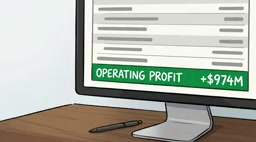
Operating income is revenue minus cost of revenue and operating expenses, excluding non-operating items such as interest and taxes. It reflects the profitability of the core business and is a key indicator of whether the main business is healthy. By contrast, net loss also includes non-cash or non-operating items such as stock-based compensation, asset revaluations, and interest expense. In the second quarter, operating profit was positive while net loss was enormous, mainly due to accounting charges from the soaring valuation; the third quarter's swing to an operating loss is the real signal of a change in the core business's cost structure.
How Long Can the Cash Last? The Trips in the Fine Print
As of the end of September, Anthropic held about $132 billion in cash and short-term investments — which sounds bottomless. But the calendar disagrees: roughly $70 billion in commitments come due within 12 months of September 30, more than half the cash reserve; about $447 billion comes due before the end of 2030. Suppliers have arranged roughly $82 billion in financing, but it is released in milestones tied to delivery and revenue targets. Broadcom's $42 billion note financing can only be used to pay Broadcom's own rent, carries a 9% rate that rises to 13% if certain revenue conditions are missed, and capitalizes interest into principal. When growth falls short, borrowing gets more expensive precisely then.
There is another tripwire: a $15 billion credit facility requires at least $5 billion in liquidity at each quarter-end, starting December 31 of this year. A default on certain commercial agreements could trigger cross-default on both that facility and the convertible notes.
Independent research firm Orn Research estimates that at the current ratio of compute spending to revenue, Anthropic would need to become roughly a $200 billion annual revenue business to carry the average commitment from late 2027 through 2030 — about three times the current $68 billion annualized pace. That is a single analyst's calculation, and it assumes margins hold steady. But the shape is clear: the company does not need to replicate past growth rates; it needs to sustain growth and margins for four more years, without a single year of delay.
Liquidity refers to the cash and high-quality liquid assets a company can use at any time to service short-term debt or meet expenses. Liquidity maintenance covenants in credit facilities require the borrower to hold no less than an agreed amount of liquid assets at each quarter-end, or else be in default. Such covenants are a risk-control tool for lenders: once triggered, banks can freeze credit lines or even demand early repayment. For Anthropic, maintaining at least $5 billion in liquidity starting December 31 means part of its cash reserve is locked up and cannot all go toward paying compute bills.
The Other Cliff: Why Not Just Buy Less?
Because Anthropic says it has consistently been compute-constrained, with customer demand exceeding available capacity — and because it has repeatedly underestimated its own needs. Every shortfall has to be filled with short-term compute, the expensive kind. One GPU rental index tracked by Orn showed prices for NVIDIA's B200 chips rising about 20% in a single month through the end of October. The spot market punishes buyers who are desperate for capacity.

Squeezed from both sides: buy too little and you pay panic prices while risking customer loss; buy too much and you pay rent on silence. History offers a mirror — telecom companies in the late 1990s laid fiber far faster than demand arrived, and Global Crossing filed for bankruptcy in January 2002. The fiber was real, the internet was real, demand was real — but the timing was wrong, and debt does not care.
Net revenue retention (NRR) measures how well revenue from an existing customer base is retained and expanded over a year, calculated as the revenue contributed by the beginning customer cohort at period-end divided by the starting revenue. An NRR above 100% means expansion and upgrades from existing customers outweigh churn and downgrades. Anthropic's NRR of roughly 900% means the same customers spend nine times as much a year later, reflecting how quickly usage deepens under the token-based billing model for AI models. But high NRR also carries risk: if customer usage contracts, the revenue decline is amplified just as much, creating an asymmetry against fixed compute commitments.
The Bull and Bear Ledgers
The bull case is not stupid. Revenue grew about 1,300% in the first half, net revenue retention is roughly 900%, and more than 11,900 customers spent at least $100,000 over the past year, versus about 950 a year earlier. One analyst at DA Davidson argues that no company in history has grown this fast and this efficiently, and that Anthropic is already profitable with ample cash. Morningstar believes the shares are undervalued even at this range, because the price reflects market sentiment on AI rather than company fundamentals. The valuation has also come down from the $2 trillion rumored weeks ago. Not all commitments are set in stone: the SpaceX AI agreement can be cancelled with 90 days' notice after early 2027, Microsoft's undelivered tranches carry cancellation clauses, and the IPO itself injects about $62 billion into the company's accounts.
The bears have a number too: at $1.4 trillion, Anthropic trades at roughly 40 times trailing twelve-month revenue. That price is a bet — a bet that frontier position will remain within reach year after year.
Every variable ultimately collapses into a single ratio. On one side are customers who can cut spending in short order; on the other, a landlord who does not negotiate. If revenue keeps growing faster than the bill, the trap never closes, and today's price may look cheap in hindsight. If growth slows, token prices fall (a risk the prospectus itself warns about), or rivals' cheaper models take share, the $400 billion in fixed obligations will not shrink.
There is no villain, no fraud, no secret. Just two ledgers written in different time zones, and a company standing on the dividing line. The only question the market is really pricing is this: will tomorrow arrive on schedule, or a year late?
(This article does not constitute investment advice.)
Related articles

Gemini 4 Neon Opens Paid API: Million-Token Long Tasks and Local LLM Benchmarks
Gemini 4 Neon opens its paid API with 1M-token context at $3/$15 per million tokens; OpenAI live dictation drops the 10-minute limit; local LLM tests show order-of-magnitude speed gaps; GitHub Skills rankings update.

Gemini 4 Neon Hands-On: Crushing Claude on Value, But Two Pitfalls
Gemini 4 Neon hands-on: ranks 2nd on KingBench 4 at 37.9/60 across six projects, doing for $20.36 what cost Fable 5.2 $222 — but container escapes and dead-API coding expose blind spots.

Anthropic IPO: The AI Gamble Behind a $1.33 Trillion Valuation
Anthropic launches its IPO at a $1.33T fully diluted valuation. Of its $104B nine-month GAAP loss, $94.3B is non-cash. Morningstar sees $92; Michael Burry flags $900B compute risk.