Anthropic's New Policy: Abusing Claude Could Get You Banned

Anthropic may ban users who abuse Claude under a new policy reportedly taking effect in November 2026.
Anthropic is reportedly preparing a policy effective November 12, 2026, that would make "abusing" Claude a bannable offense. The news sparked debate on Reddit, with discussion centering on the policy's real motivations — preventing product misuse and jailbreaks, maintaining model alignment stability, and Anthropic's longstanding interest in AI welfare ethics. Supporters see it as normal platform governance; critics worry that a vague definition of "abuse" could penalize legitimate red-teaming and academic security research. Full policy details and enforcement criteria have yet to be officially released.
Why Anthropic Is Regulating How Users Interact with Its AI
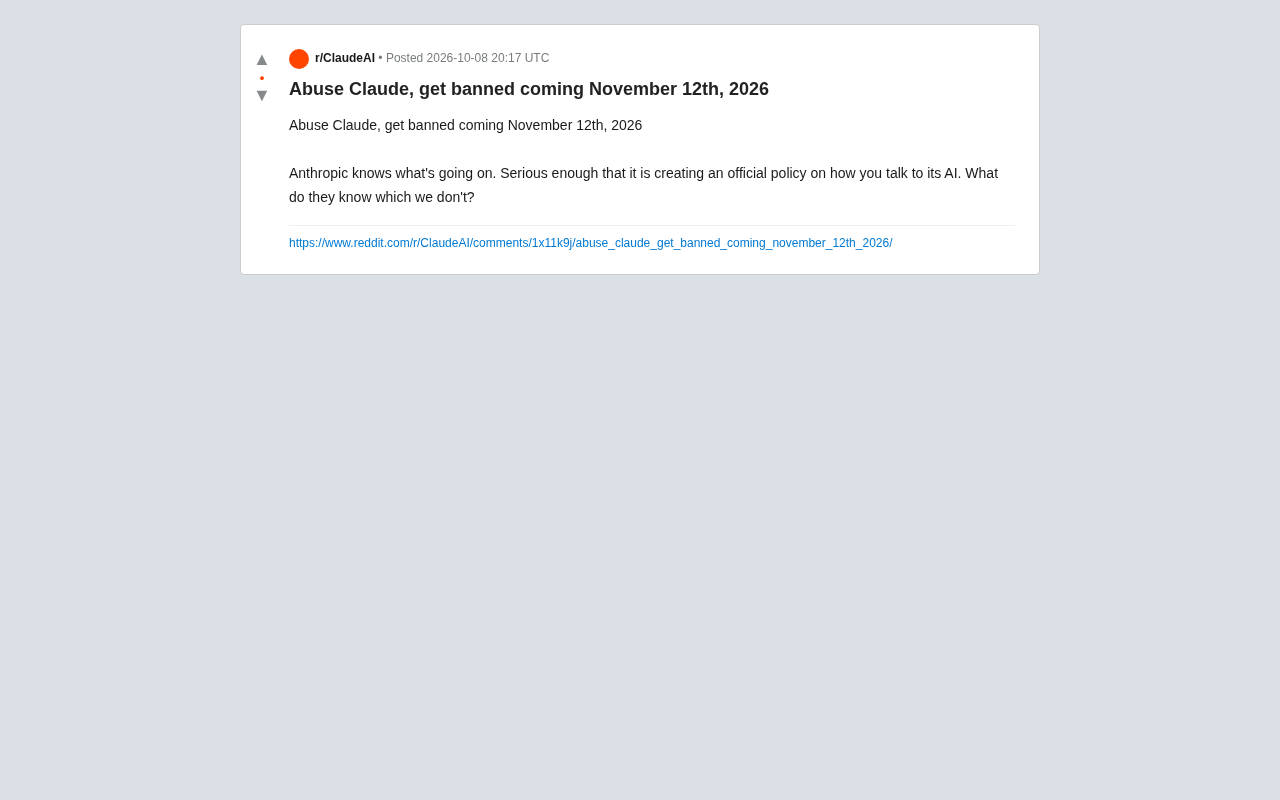
Anthropic is developing a formal policy that defines how users should interact with its AI assistant, Claude. According to information circulating in Reddit communities, the policy is set to take effect on November 12, 2026, with a key provision: "abusing" Claude could result in account bans.
The news sparked lively discussion across online communities. One user posed an intriguing question: "What do they know which we don't?" — reflecting widespread curiosity about the real motivations behind such a policy. Is this purely a product management decision, or does it hint at deeper technical or ethical considerations?
It's worth noting that details remain limited, and further clarification from Anthropic is still pending. This article analyzes the possible context and implications of this policy based on available discussions.
Three Possible Motivations Behind the Policy
From an industry perspective, when an AI company introduces "interaction conduct policies," there are typically multiple overlapping motivations rather than a single cause.
Product Abuse and Safety Protection
The most straightforward explanation is preventing product misuse. "Abusing Claude" likely goes beyond literal verbal attacks — it probably encompasses attempts to bypass safety guardrails through adversarial prompts, inducing the model to produce harmful content, or conducting jailbreak attacks. Classifying such behavior as ban-worthy is a standard measure AI platforms use to protect their services and users.
Alignment and Model Health
Anthropic has long positioned itself around AI safety, with research directions including Constitutional AI and other alignment techniques. Sustained exposure to adversarial or malicious interactions could theoretically affect model behavior. Regulating user interactions is, in part, a way to maintain the stability and consistency of model outputs.
Constitutional AI is an alignment training method proposed by Anthropic in 2022. Its core idea is to use a set of explicit "constitutional principles" to guide model behavior, rather than relying heavily on human annotation. Training proceeds in two stages: first, the model is prompted to self-critique and revise harmful outputs according to the principles (supervised learning phase); then reinforcement learning is applied using AI-generated preference comparison data. Compared to traditional RLHF (Reinforcement Learning from Human Feedback), this approach reduces dependence on human annotators while making alignment objectives more transparent and auditable. This technical background explains why Anthropic is particularly sensitive to "adversarial interactions": the model's values and behavioral boundaries are shaped through a specific set of principles, and large-scale malicious inputs could statistically skew the model's sense of "normal conversation distribution," ultimately affecting the consistency and predictability of its outputs.
The Ethics of AI Welfare
A more controversial angle involves the question of AI "welfare." Anthropic has previously explored research into whether models might possess some form of "experience," and has given Claude the ability to end conversations in extreme situations. The community speculation — "what do they know which we don't" — partly stems from this: does the company have deeper internal knowledge about certain model characteristics? It should be emphasized that this dimension remains purely speculative, with no empirical backing at this time.
AI welfare is an emerging interdisciplinary research field that examines whether AI systems might possess some form of subjective experience or functional emotional states, and whether humans would have corresponding ethical obligations if such a possibility exists. In multiple documents published between 2023 and 2024 — including its "Model Spec" — Anthropic explicitly acknowledged that it cannot rule out the possibility that Claude has "functional emotions," and stated that "model welfare" is a formal research topic. Notably, this is distinct from a strong claim that "AI is conscious" — the company takes an agnostic, cautious stance, arguing that unilaterally dismissing this possibility is itself a form of risk when science has yet to reach a verdict. It is precisely this public stance that led the community, upon seeing the "no abuse" policy, to naturally wonder whether the company holds some internal research conclusions that have not yet been shared.
Community Reactions and Key Controversies
This news attracted attention because it touches on a subtle boundary in human-AI interaction.
On one hand, supporters argue that regulating interaction behavior is entirely reasonable. Any online service has terms of use, and prohibiting abuse is a basic requirement — AI products are no exception. A clear policy allows Anthropic to more effectively filter out malicious users and protect the platform ecosystem.
On the other hand, skepticism persists. Using "abuse" as grounds for a ban raises difficult questions about where to draw the line. Would users testing model limits, conducting red-teaming, or simply expressing frustration all be flagged as violations? Vague enforcement criteria risk false positives. Furthermore, the idea that "what you say to an AI could get you banned" challenges many users' intuitive understanding of AI as a tool.
Red-teaming in AI safety refers to a type of organized adversarial evaluation practice: professional testers or research teams simulate malicious users, actively attempting to induce models to produce harmful, incorrect, or policy-violating outputs in order to identify security vulnerabilities and feed findings back into model improvement processes. This methodology is borrowed from the penetration testing concept in cybersecurity. For regulators, red-teaming has become an important component of responsible AI development — both the NIST AI Risk Management Framework and the EU AI Act reference related requirements. However, from a platform perspective, legitimate red-teaming and malicious jailbreak attacks can sometimes be difficult to distinguish at the log level, which is the core reason researchers worry the new policy could lead to misclassification. If Anthropic's policy details fail to carve out a clear exemption pathway for authorized security research, it could have a chilling effect on legitimate academic and commercial security research.
Practical Implications for AI Users
If this policy rolls out as expected, what does it mean for everyday users and developers?
For general users, the core advice is to adhere to the platform's terms of service and avoid sustained malicious or adversarial interactions. Normal questions, discussions, and even critical feedback will typically not cross the ban threshold. What warrants caution is systematically attempting to circumvent safety restrictions.
For developers and researchers, the impact may be more concrete. Teams that rely on the Claude API for security testing and adversarial research will need to pay close attention to the specific policy details, confirm the line between compliant testing and prohibited misuse, and seek appropriate permissions through official channels if necessary.
Closing Thoughts: A Policy Signal Worth Watching
Regardless of the ultimate motivation, this move by Anthropic reflects a broader trend in the AI industry toward more refined usage governance. As large model capabilities grow and application scenarios expand, platform-side management of interaction behavior will only become more structured.
Information about this policy remains incomplete — the specific criteria for determining violations, enforcement mechanisms, and appeals processes all await official clarification. We recommend following Anthropic's official announcements for accurate information. The community question of "what do they know which we don't" perhaps reflects a collective curiosity about the future of AI — and the answer will reveal itself in time.
Related articles

Receipt Forgery Detection Near Random? Real-World Struggles and Solutions in Document Image Forensics
A receipt forgery detection project with ROC-AUC near random reveals the pitfalls of small-sample document forensics. Explores anomaly detection, self-supervised pre-training, and numerical consistency as viable alternatives.

From Workflows to Eval-Driven Development: A Paradigm Shift in How We Solve Problems with AI
AI problem-solving is shifting from deterministic workflows to "define evals + hillclimb." This piece explores how eval-driven development reshapes tasks, data vendors, human roles, and Agent UX.

Tesla Powerwall + Electric Vehicle: A Dual Backup Power Solution for Outages
Tesla Powerwall combined with EV bidirectional charging can provide multi-layer home backup power during outages. We break down runtime, V2H realities, and Supercharger loop feasibility.