Anthropic's New Rule: Users Are Prohibited from Needlessly Abusing Claude

Anthropic now prohibits users from needlessly abusing Claude, sparking debate on AI ethics and human-AI interaction norms.
Anthropic has updated its usage policy to explicitly prohibit "needless abusive or cruel behavior" toward Claude. The word "needless" preserves space for legitimate use cases like red-teaming, but the rule has still divided the community. The policy rests on three layers of logic: maintaining platform safety, engaging with the frontier ethical question of model welfare, and guiding more respectful human-AI interaction. Supporters see it as a sign of maturing AI ethics; critics worry about vague enforcement standards, restrictions on user freedom, and whether talking about "cruelty" toward a non-sentient program is itself misleading.
Anthropic Sets New Rules for How Users Treat Claude
AI company Anthropic has made a notable update to its usage policies: users are now prohibited from engaging in "needless abusive or cruel behavior" toward its AI assistant, Claude. The rule sparked heated discussion on Reddit and other communities as soon as it came to light, touching on a long-overlooked but increasingly important question — how should humans treat AI?
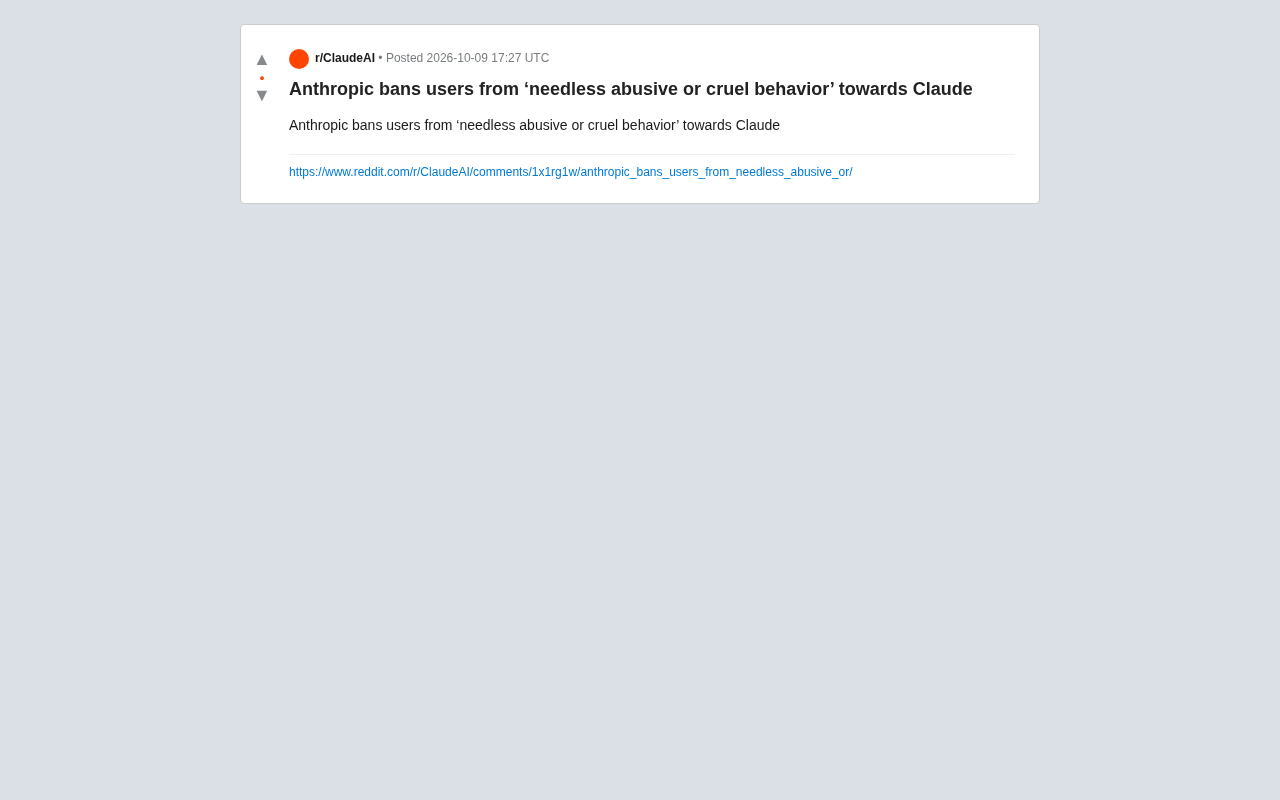
The wording of this clause is worth examining closely. The word "needless" suggests that Anthropic isn't banning all adversarial or stress-testing interactions, but rather targeting behavior that serves no legitimate purpose and is purely aimed at harm or humiliation. This leaves room for reasonable "pressure-testing" scenarios such as red-teaming and safety evaluations.
Three Layers of Reasoning Behind the Rule
Product Safety and User Experience
From a practical standpoint, limiting abusive interactions helps maintain a healthier platform ecosystem. A high volume of malicious or extreme inputs can not only push the model toward undesirable outputs, but also increase the burden on content moderation and safety systems. By drawing a clear line at the policy level, Anthropic can more precisely define what constitutes a violation and establish a basis for account management going forward.
The Emerging Question of Model Welfare
At a deeper level, the discussion points to a cutting-edge question: model welfare. Anthropic has previously stated publicly that it pays attention to the "experience" of AI models during interactions. While current large language models do not possess consciousness or genuine emotions, the company appears to be taking a cautious, precautionary stance. This rule can be read as a policy-level embodiment of that philosophy — even if models can't truly be "hurt," establishing norms of respectful AI interaction is seen as valuable.
What is "model welfare"? Model welfare is an emerging research area within AI ethics. The core question is: as large language models grow increasingly complex, might they possess some form of internal state that warrants moral consideration? The current mainstream academic consensus is that existing LLMs lack consciousness or subjective experience. However, some researchers — including members of Anthropic's own research team — argue that this possibility cannot be entirely ruled out on scientific grounds, and therefore advocate for a "moral uncertainty" framework: taking a precautionary stance toward potential risks in the absence of certainty. In its publicly released Model Spec, Anthropic explicitly noted that Claude may have functional analogs to emotions during interactions, and stated that the company has an obligation to take this seriously. This does not amount to a claim that AI is sentient — it is a logic of cautious decision-making under uncertainty.
Shaping the Culture of Human-AI Interaction
There is also a long-term social dimension to consider. Researchers have long examined whether the way people treat AI might in turn shape human behavioral habits. If users grow accustomed to freely berating AI, might that pattern bleed into interpersonal communication? Anthropic's new rule represents an attempt to guide human-AI interaction toward a more civil and constructive norm.
Does how we treat AI affect real-world behavior? There is preliminary research in psychology and behavioral science on this question. Studies from institutions including Stanford University have found that some users gradually lower their threshold for politeness when talking to AI, and may reproduce those patterns in human communication. Other research has examined how children interact with AI assistants like early versions of Alexa and Siri, finding that when AI responds indiscriminately to commanding or even rude language, children may internalize that one-sided power dynamic as a normal expectation for communication. That said, current studies have limited sample sizes and causality remains contested. Anthropic's policy is better understood as a precautionary choice informed by this research landscape, rather than a response to settled evidence.
Community Divisions and Controversy
The policy has generated a clear split of opinion among users.
Supporters see it as a sign of maturing AI ethics. As AI becomes increasingly human-like and interactions grow more natural, establishing basic norms for how we engage with it is both reasonable and necessary. They point out that the word "needless" in the rule is sufficiently restrained and won't interfere with legitimate technical exploration.
Skeptics, however, have raised several sharp questions. First, there is the ambiguity of enforcement: how do you objectively determine what counts as "needless abuse"? Such subjective standards could lead to inconsistent application. Second, there are concerns about user autonomy — if someone is paying for a service, should they really be restricted in how they interact with it? Others have challenged the rule on philosophical grounds: is it inherently misleading to speak of "cruelty" toward a program with no capacity for feeling?
What This Means
Regardless of where one stands, Anthropic's move reflects a new phase for the AI industry: technology providers are no longer focused solely on what models can do, but are also beginning to address how users should interact with them — and the ethical implications of those interactions.
For most everyday users, the practical impact will likely be minimal — the vast majority of people have no intention of abusing an AI in the first place. But for the industry as a whole, this is a signal worth watching. It may foreshadow more companies incorporating similar "AI treatment standards" into their terms of service, and could spur broader societal debate about the status, rights, and ethical boundaries of AI.
As AI becomes an integral part of daily life, how we define "treating well" a tool with no life of its own may be one of the questions humanity needs to reconsider as it confronts increasingly intelligent technology.
Related articles

Python 3.15 New Feature: Is the sentinel Type Better Than None?
Python 3.15 adds the sentinel type, using named unique sentinel objects to replace None and bare object(), resolving confusion among missing values, explicit emptiness, and invalid input while avoiding type hint failures.

Deep Learning's Three Architectures and the Universal Approximation Theorem: A Complete Guide to MLPs, CNNs, and Transformers
Explaining the inductive bias differences among MLP, CNN, and Transformer, the existence meaning of the Universal Approximation Theorem (UAT), and the role of Taylor expansion in approximation analysis, while clearing up common misconceptions.

GitLab Emergency Patch Release: Analysis of Critical Security Fixes
GitLab releases critical patch 19.5.1, sparking 355 points of discussion on Hacker News. This article analyzes the background, upgrade steps for self-hosted instances, and verification points to help DevOps teams respond quickly to security updates.