Anthropic's Record-Breaking IPO: A Test of Safety Credibility Behind $81.3 Billion

Anthropic completes the largest IPO in history at $81.3 billion, and its safety-first philosophy will face public market scrutiny.
Anthropic has completed an $81.3 billion IPO, surpassing SpaceX to become the largest listing case in history and setting a precedent for other AI labs. The article notes that the significance of this IPO goes beyond the fundraising figure: Anthropic has long made safety-first its brand core, but after going public it must face quarterly earnings, growth expectations, and shareholder pressure, while the long-term value of safety investment is difficult to quantify directly. Whether the company can continue to prioritize safety over commercial interests has become a focal point. As the first leading AI lab to complete a large-scale IPO, its valuation logic, information disclosure, and approach to publicizing safety commitments could all become industry standards and accelerate other AI companies' listings. The article emphasizes that reputation is both an intangible asset and a fragile promise, and the outcome of this trust game may be more noteworthy than the amount raised.
An IPO That Rewrites the Rules of the AI Industry
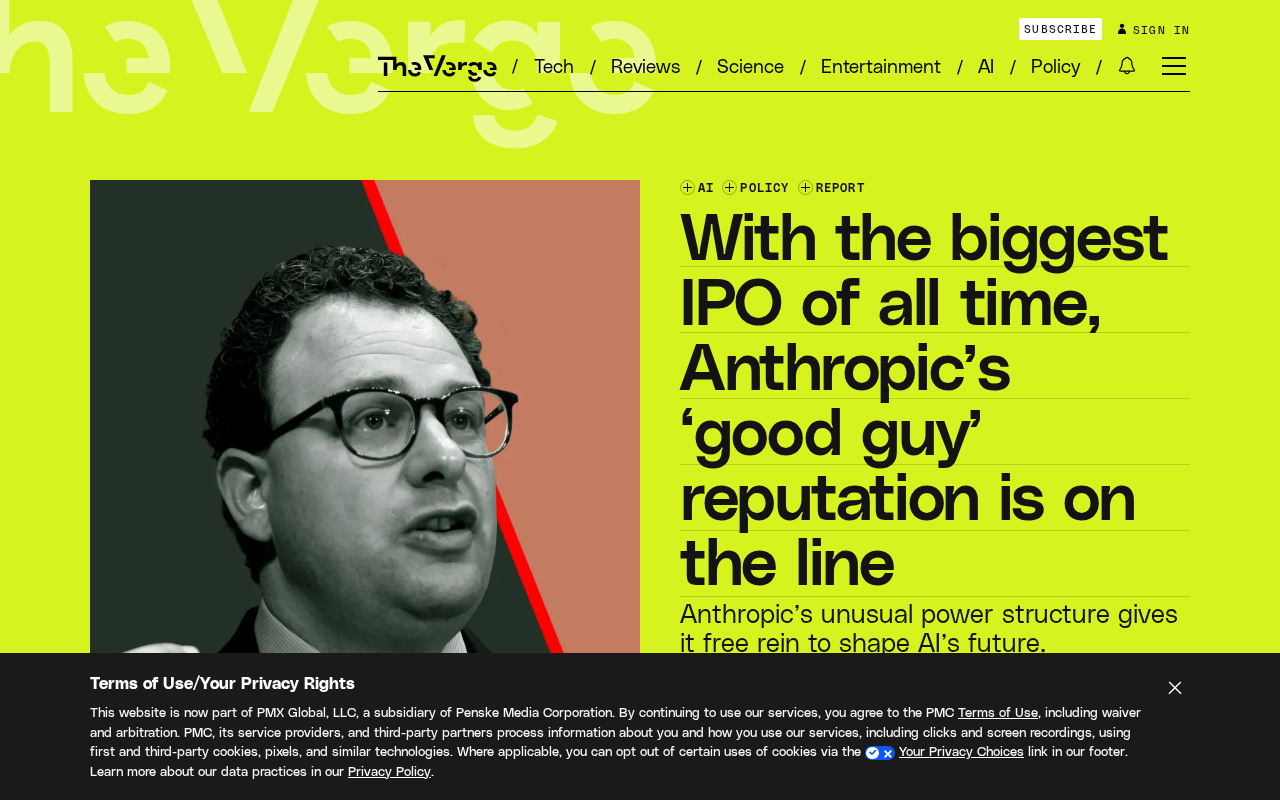
Anthropic has finally taken a historic step. According to reports, the safety-focused AI lab has completed the largest IPO to date, raising $81.3 billion and surpassing SpaceX to become the most valuable listing case in history. This is not only a financial milestone but also sets an important precedent for other public AI labs considering going public.
However, the significance of this IPO goes far beyond the numbers. Since its founding, Anthropic has made safety its top priority—a principle that is especially valuable in today's increasingly intense AI race. But as the company enters the public market and faces quarterly earnings and shareholder pressure, whether its "good guy" reputation can withstand the test has become a focus of industry attention.
IPO (Initial Public Offering) refers to the process by which a private company first issues shares to the public and lists them for trading on a stock exchange. For a company, an IPO is both a means of raising capital and a turning point in corporate governance: the company must regularly disclose financial reports and submit to scrutiny by regulators and public investors, and management shifts from being accountable to a small number of venture capitalists and founders to being accountable to a broad shareholder base. The $81.3 billion fundraising scale mentioned in the article is an extremely rare magnitude, typically achievable only by ultra-large enterprises with very high valuations and strong market expectations, which is why comparing it with SpaceX is symbolically significant. For AI labs, an IPO also means that research agendas, safety investments, and other formerly internal matters will be incorporated into public disclosure and market pricing systems.
The Collision Between Safety-First Ideals and Business Reality
Anthropic's founding story is quite unique in Silicon Valley. Amid a wave of AI companies chasing model scale and commercialization, Anthropic has consistently emphasized investment in AI safety research and made this the core of its brand differentiation. This positioning has earned it the trust of the research community and some enterprise customers, and has also attracted a large number of top talents concerned with AI ethics.
But going public means the rules of the game change. Public markets demand continuous proof of growth and profit expectations, while safety research often requires long-term investment and is difficult to directly quantify in terms of returns. When investors press for revenue growth, can Anthropic continue to prioritize safety over commercial interests? The answer to this question will directly affect its brand credibility.
AI safety research in the industry generally refers to various efforts to reduce harmful, uncontrollable, or unpredictable behavior in AI systems, including alignment research (making model behavior conform to human intentions and values), interpretability research, risk assessment and red teaming, and pre-deployment safety evaluations. This type of research is characterized by long cycles, results that are difficult to directly convert into product revenue, and value that is often reflected in "avoiding bad things from happening" rather than "creating new revenue." For this reason, when a company enters the public market and needs to show investors growth and profitability metrics on a quarterly basis, safety investment can easily be seen as a cost item rather than an asset item—this is the technical and financial root of the "collision with business reality" mentioned in the article.
Setting the Tone for Followers: A Benchmark for the AI Lab IPO Wave
As the first leading AI lab to complete a large-scale IPO, Anthropic's case will provide an important reference for other AI companies planning to go public. From valuation logic to information disclosure, from investor communication to the publicization of safety commitments, every step Anthropic takes could become an industry standard.
According to analysis, the success of this IPO may accelerate the listing process of other AI labs, while also making regulators and the public pay closer attention to the transparency of AI companies in the public market. How to present safety research results in the prospectus and how to explain the long-term value of safety investment to shareholders—these are questions Anthropic needs to answer first.
A prospectus is a legal document that a company submits to regulators and makes public to potential investors during an IPO. Its core contents include the company's business model, financial condition, risk factors, use of proceeds, and governance structure. For AI companies, the "risk factors" section of the prospectus is often a key window for outsiders to observe the true quality of their safety commitments—how the company describes model capability boundaries, misuse risks, and regulatory uncertainty will directly affect investor pricing and public perception. In addition, after listing, the company must fulfill ongoing information disclosure obligations, including regular financial reports and announcements of major matters, which means safety incidents or policy controversies may quickly be reflected in stock prices and reputation, creating a public constraint mechanism that does not exist in the private stage.
Reputation as an Asset: The Trust Game in Public Markets
For Anthropic, a "good guy" reputation is both an intangible asset and a fragile promise. In the private stage, the company can maintain this image through self-restraint and industry self-regulation; but after going public, every business decision will be scrutinized under a magnifying glass. If safety standards are relaxed for short-term performance, or principles are sacrificed in competition with rivals, it could trigger a trust crisis.
From a broader perspective, Anthropic's IPO is not just a capital event but also a public test of the AI industry's values. When safety ideals encounter the real pressures of capital markets, Anthropic's choices will profoundly affect public confidence in AI governance. The outcome of this trust game may be more noteworthy than the $81.3 billion raised.
Related articles

From 0 to 1: Vibe Coding an AI Knowledge Base — A Practical Retrospective and Tech Stack Breakdown
A retrospective on building the AI knowledge base OilBook from scratch with Vibe Coding: Next.js+Neon stack, Oil Dev Skill workflow, Stripe paywall security, interview-style writing, AI-flavor control, and Vercel deployment.

GLM-5.4 Hands-On: Native Vision Meets a New Vibe Coding Workflow
Hands-on with Zhipu GLM-5.4: native vision tested across a 3D product demo, pure-code video generation, and remote-control Vibe Coding, compared with GPT-6.2 and Gemini Neon.

AI and Humans Claim to Prove the Riemann Hypothesis: Machine-Verified, Yet Nobody Can Understand It
Anthropic mathematician and AI Claude claim to prove the Riemann Hypothesis with 17 million lines of Lean code, machine-verified but unreadable by humans. This article analyzes the event, the zero proportion record from 41.6% to 67.2%, and the gap between machine verification and human understanding.