Anthropic's Record-Breaking IPO Fails to Halt AI Stock Selloff as Global Markets Slide
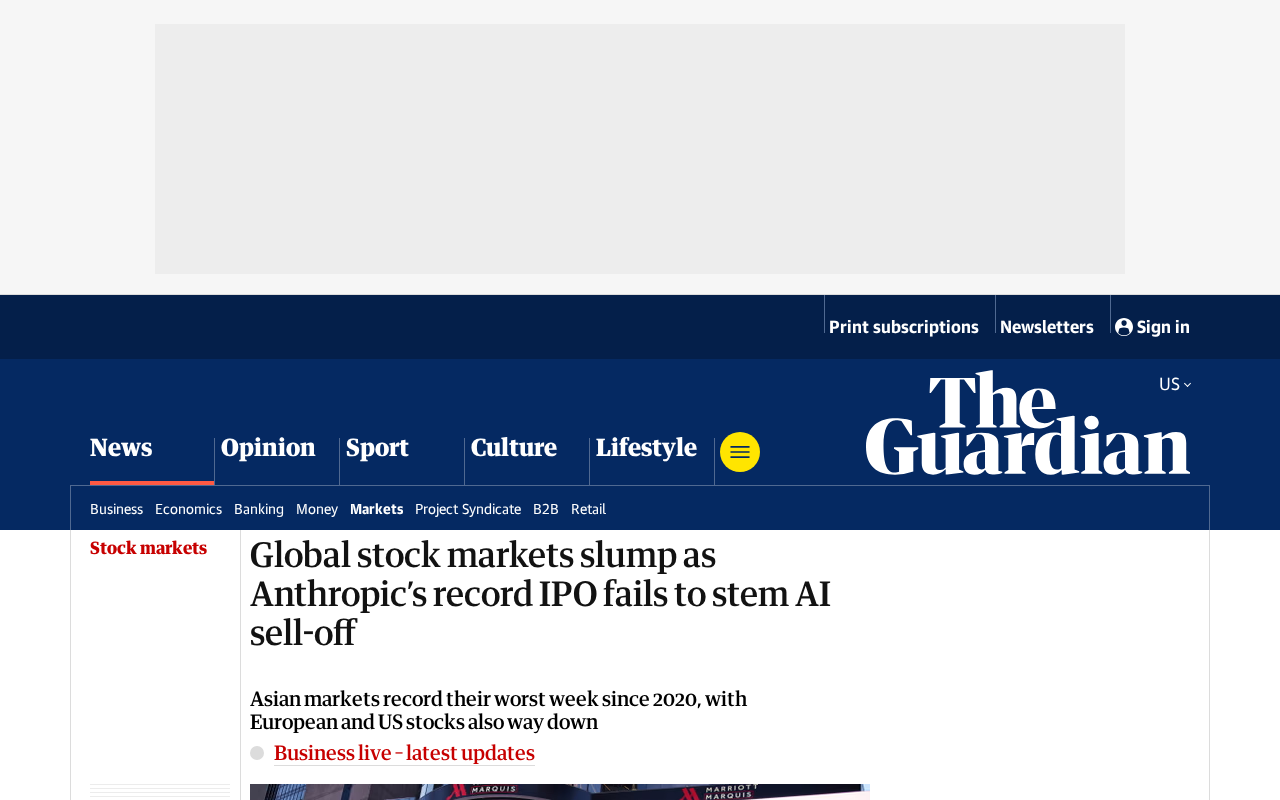
Anthropic's record IPO failed to stabilize markets, and the AI selloff signals a shift in pricing logic.
The article examines the AI sector selloff through Anthropic's record-breaking IPO failing to stop global stock declines. A leading AI listing should be good news, but the "sell the news" reaction suggests the IPO created a public valuation benchmark that deepened doubts about other AI assets. The selloff reflects structural rotation rather than wholesale exit, signaling public-market pricing discipline for AI.
Global stock markets are experiencing a pronounced wave of selling pressure, with the artificial intelligence sector at the center of the decline. According to a discussion on Hacker News, even Anthropic's record-breaking IPO failed to reverse the market's bearish sentiment toward AI assets. This signal deserves deeper analysis: when a leading AI company goes public at a fundraising scale rarely seen in history yet still cannot stabilize sector confidence, it suggests that investors' pricing logic for the AI narrative is shifting.
An IPO Where the Good News Was Already Priced In
Anthropic's IPO was labeled "record-breaking" and should have been a shot in the arm for the AI industry. By conventional logic, a successful listing by a leading company often lifts sentiment across the entire sector, providing an anchor for a new wave of capital inflows.
But the market's reaction was exactly the opposite. Far from halting the decline, the completion of the IPO was followed by continued losses in global equities. This "sell the news" pattern typically means the market had already priced in expectations to the fullest, and the actual event became a window for capital to cash out and exit. In other words, the better Anthropic's listing results, the more they highlight the market's unease about valuations of other AI assets.
Why a Leading Company's Listing Actually Deepened Concerns
One possible explanation: the IPO provided investors with a rare, publicly tradeable pricing benchmark for a leading AI asset. Once that benchmark was on the table, the market began reassessing whether other companies in the same space were reasonably valued. If a gap exists between Anthropic's offering price and its secondary-market performance, that gap quickly transmits across the entire sector.
IPO (Initial Public Offering) refers to the process by which a private company first issues shares to the public and lists them for trading on a stock exchange. For the company, an IPO is both a financing tool and an exit channel for early investors and employee shareholders; for the market, it provides a valuation benchmark formed through public trading. The so-called "sell the news" phenomenon is a classic pattern in market behavior: when a widely anticipated positive event actually materializes, prices have already reflected the expectation in advance, triggering profit-taking instead. The key to judging whether an IPO is genuine "good news" or a "sell the news" event lies in the gap between the offering price and post-listing secondary-market performance, as well as the reaction of other assets in the same sector during the same period.
Valuation benchmark plays an anchoring role in capital markets. During the private-market stage, AI company valuations are mostly determined by primary-market funding rounds, lacking continuous, public price signals, making horizontal comparisons difficult for investors. Once a leading company goes public, its price-to-earnings and price-to-sales ratios become observable reference points, and the market uses them to "re-rate" the pricing of both listed and unlisted companies in the same space. This re-rating is often non-linear: if the benchmark company's secondary-market performance falls below its offering price, it creates a negative anchor that amplifies doubts about the reasonableness of valuations across the entire sector.
The Deeper Logic Behind the AI Sector Selloff
This selloff is not an isolated event but a manifestation of the AI investment cycle entering a new phase. For some time, AI concepts have commanded extremely high valuation premiums, with capital continuously flowing in based on optimistic expectations for the future. When a landmark event occurs—such as a leading company completing an IPO—the market naturally takes the opportunity to recalibrate expectations.
The concentration of selling pressure in the AI sector indicates that capital is not withdrawing from stocks across the board but making structural adjustments: rotating from high-expectation, high-valuation AI names toward more resilient assets. This kind of rotation has recurred throughout the history of technology investing, and each time it comes with discussions of a "bubble."
What Investors Are Worried About
Judging from market behavior, concerns may center on several aspects: whether the pace of AI companies' earnings realization can match the pace of valuation expansion; whether high capital expenditure can translate into sustainable returns; and whether leading companies' moats are sufficiently strong as industry competition intensifies. These questions are magnified under the spotlight of an IPO and become catalysts for selling.
Valuation premium refers to the portion of an asset's price that exceeds the fair value corresponding to its fundamentals, typically stemming from the market's optimistic expectations for future growth. The AI sector has enjoyed a significant premium over the past period, underpinned by optimistic assumptions about computing demand, commercialization, and industry penetration rates. When landmark events occur, the premium is re-examined: if fundamental indicators such as the pace of earnings realization and return on capital expenditure cannot support the high premium, capital will proactively reduce exposure. Structural rotation refers to capital not exiting as a whole but reallocating across sectors, flowing from high-volatility, high-expectation assets toward targets with more resilient cash flows.
What This Signals for the AI Industry
The coincidence of Anthropic's IPO and the market decline is itself an industry milestone worth recording. It reminds practitioners and investors alike: the AI industry has moved past the stage where "telling a good story" was enough to raise capital, and the pricing mechanisms of public markets are beginning to exert a disciplining effect.
For AI companies still in the private market, this means subsequent fundraising and IPO window assessments need to be more cautious. For secondary-market investors, this correction may also offer an opportunity to re-examine the value of AI assets. Short-term market volatility does not change the long-term trajectory of technological evolution, but it does change the pace and structure of capital flows.
What bears continued observation is whether this selloff is a temporary pullback or a signal that the AI investment cycle is turning. Current information is insufficient to make a definitive judgment, but the fact that Anthropic's IPO failed to stabilize the market has already sounded a warning bell for the AI narrative.
One-line Summary
Anthropic's record-breaking IPO failed to stabilize the market, and the AI sector selloff reveals a shift in pricing logic.
Paragraph Summary
Using Anthropic's record-breaking IPO failing to prevent a global stock market decline as its entry point, the article analyzes the selling pressure the AI sector is experiencing. The author notes that a leading AI company's listing should have been good news for the industry, but the market reacted oppositely, exhibiting a classic "sell the news" pattern. The underlying reason is that the IPO provided the market with a publicly tradeable valuation benchmark for a leading AI asset, prompting investors to recalibrate valuations of companies in the same space. The selloff is not a wholesale capital exit but a structural rotation from high-valuation AI names toward resilient assets, reflecting market concerns about the pace of earnings realization, returns on capital expenditure, and competitive moats. The article argues that this marks the AI industry entering a phase of public-market pricing discipline, and subsequent fundraising and IPO windows need more cautious assessment—though short-term volatility does not change the long-term trajectory of technological evolution.
Related articles

Prompt Engineering for Beginners: From Writing Prompts to Engineering Thinking
Starting from the essence and four functions of prompts, this article systematically explains the six-step process, four success criteria, learning value, and practical limitations of prompt engineering to help you build a complete understanding.

Anthropic Launches Nasdaq IPO: AI Giant's Listing and Risk Disclosures
Anthropic officially launches its Nasdaq IPO under ticker ANT, with market valuation expected to potentially exceed SpaceX's record. The prospectus devotes nearly 100 pages to AI risks, while first-half revenue grew over 14x but net losses widened sharply, reigniting the AI bubble debate.

Rust cURL Clone Uses 4,832 unsafe Blocks—Is the Memory Safety Myth Broken?
A Rust cURL clone uses 4,832 unsafe keywords, challenging Rust's memory safety narrative. We analyze what unsafe really means, compare Fil-C, and examine rewrite motives.