Anthropic's Revenue Soars to $11.5 Billion: Growth Logic and Industry Implications

Anthropic's revenue hits $11.5B, reflecting explosive enterprise AI demand and fierce market competition.
Anthropic's annualized revenue has surged past $11.5 billion, driven by booming enterprise demand for Claude's API and subscription services. This article examines the growth logic, including the dual engines of API economy and subscriptions, the cost challenges of training and inference, intensifying price wars, and the strategic cloud provider investments from Amazon and Google that shape the competitive landscape.
Anthropic Hits a New Revenue High
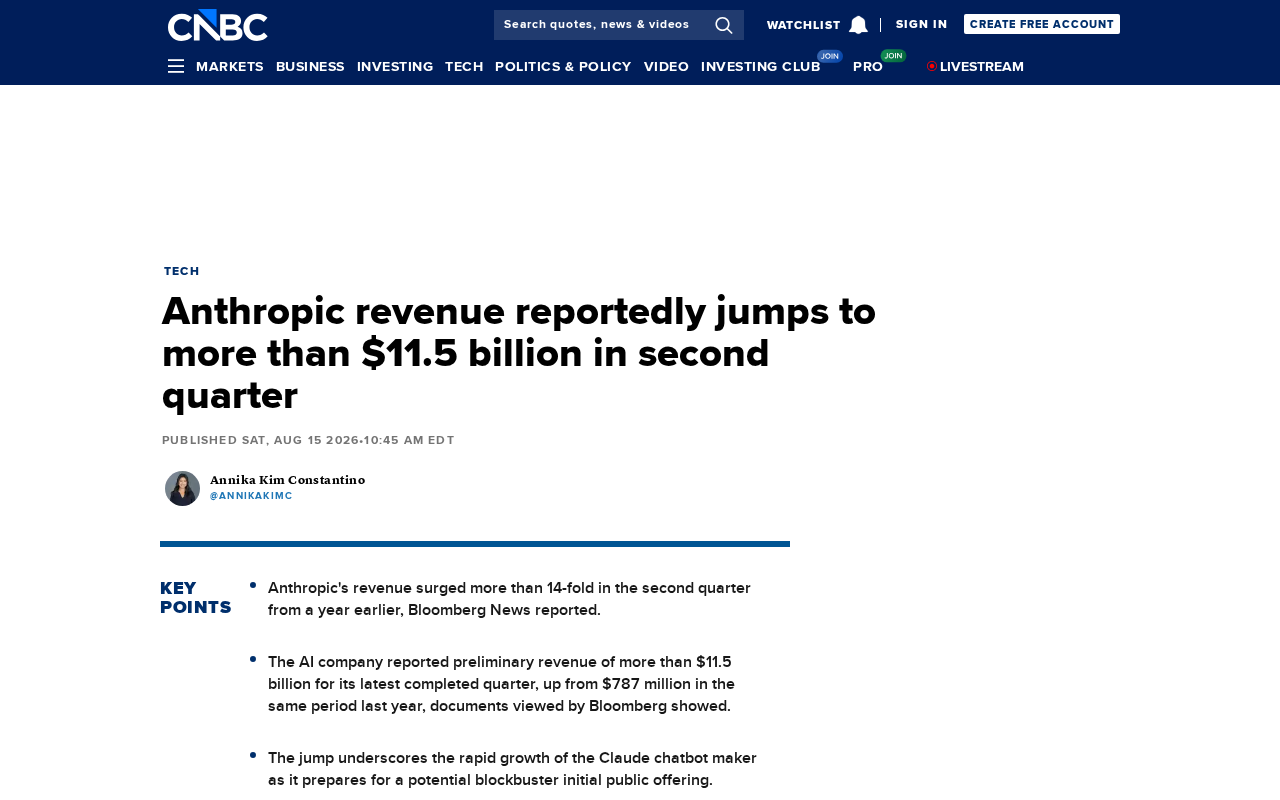
According to multiple reports, AI startup Anthropic's revenue surged past $11.5 billion in the second quarter. This figure marks a staggering pace of growth for the company founded by former core members of OpenAI, as it races ahead in the generative AI space. As the developer of the Claude series of large language models, Anthropic has transformed from a technical research organization into a commercial powerhouse in just a few years.
Anthropic was founded in 2021 by siblings Dario Amodei and Daniela Amodei, who previously served as VP of Research and VP of Safety & Policy at OpenAI, respectively. Their departure was fundamentally driven by disagreements over AI safety strategy — the Amodeis believed that "Constitutional AI" should serve as the core technical framework, enabling models to self-regulate based on a set of explicit principles, rather than relying solely on Reinforcement Learning from Human Feedback (RLHF). This technical philosophy runs through the design of the Claude model series and has become a key differentiator in Anthropic's enterprise market positioning.
It's important to note that the "revenue" figure here typically refers to Annualized Recurring Revenue (ARR) or run rate — an annualized projection based on current income levels, not the actual revenue booked in a single quarter. ARR is one of the most commonly used core metrics for SaaS and subscription-based businesses, calculated by multiplying Monthly Recurring Revenue (MRR) at a given point in time by 12. Run rate is even more aggressive — it may annualize revenue based on just the most recent month or even week. For high-growth AI companies, the difference between these two metrics can be significant: if a company's most recent monthly revenue is several times what it was at the start of the year, the run rate based on the latest data will far exceed actual revenue averaged over the full year. This distinction is critical for understanding the true financial health of AI companies, and it's a point repeatedly raised in tech community discussions.
The Industry Logic Behind the Growth
From Technical Leadership to Commercial Monetization
Anthropic's rapid growth reflects the explosion of enterprise-level AI application demand. The Claude model has won over a large number of enterprise customers with its strengths in long-context processing, code generation, and safety alignment. In the coding assistance space in particular, Claude has become one of the go-to tools for many developers and enterprises.
The core scenarios driving enterprise procurement of LLM API services span multiple domains: code generation and review (e.g., model calls behind IDE integration tools like Cursor and Windsurf), customer service automation (intelligent chatbots, ticket classification), document processing and knowledge management (contract review, internal knowledge base Q&A), and data analysis and report generation. Claude's advantage in long context windows (supporting up to 200K tokens) makes it particularly well-suited for long-document analysis tasks. Additionally, Claude's "Artifacts" feature enables the generation of interactive code components and documents within conversations, while the "Computer Use" capability allows the model to directly operate computer interfaces — these innovations have also opened up new enterprise use cases.
This growth is not an isolated phenomenon. The entire LLM industry is experiencing an unprecedented acceleration in commercialization. From OpenAI to Anthropic, the revenue curves of leading companies almost universally show steep upward trajectories. Behind this lies genuine enterprise willingness to pay for AI capabilities, as well as the concentrated release of two years' worth of accumulated technological progress.
Dual Engines: API Economy and Subscription Model
Anthropic's revenue comes primarily from two channels: API services for developers and Claude subscription services for enterprises and individual users. The API economy is characterized by near-linear revenue expansion as call volumes grow, with marginal costs primarily concentrated in inference compute.
The advantage of this business model lies in its scalability, but it also entails enormous compute expenses. AI model operating costs break down into two major categories: training costs and inference costs. Training costs represent large one-time investments (for a model at Claude's level, a single training run can cost hundreds of millions of dollars), while inference costs grow continuously with user volume and call frequency. Each API call requires the model to perform a complete forward pass computation, consuming substantial GPU compute. The industry commonly uses "cost per million tokens" to measure inference efficiency. To reduce inference costs, companies are employing various technical approaches, including model quantization (reducing floating-point precision from FP16 to INT8 or INT4 to decrease computation), Speculative Decoding (using a smaller model to predict larger model outputs to accelerate generation), KV cache optimization, and developing dedicated inference chips (such as Google's TPU and Amazon's Trainium/Inferentia). How to control inference costs while growing revenue will be the central question determining whether AI companies can achieve profitability.
A Sober Assessment from the Tech Community
In HackerNews discussions, the tech community has exhibited its characteristically cautious stance toward this figure. Commenters widely pointed out that the $11.5 billion revenue number needs to be examined against the backdrop of the company's massive expenditures.
High Revenue Does Not Equal High Profit
High revenue does not equal high profit. AI companies face staggering costs in model training and inference, and Anthropic is no exception when it comes to expensive GPU procurement and cloud computing costs. Some commenters noted that when evaluating such companies, one should focus more on gross margins, compute cost structures, and cash flow rather than revenue scale alone.
Moreover, the AI industry's price war continues to intensify. Since 2024, the API price war among large model providers has escalated dramatically. OpenAI slashed prices by 50% when launching GPT-4o, and the subsequent GPT-4o-mini was priced at just one-tenth of GPT-4 Turbo. Anthropic followed suit with more competitively priced Claude 3.5 Haiku and Claude 3.5 Sonnet. Competition in the Chinese market is even fiercer, with ByteDance, Alibaba, Baidu, and other vendors at one point pushing API prices to near cost. The fundamental driver of this price war is that large models are transitioning from differentiated products to infrastructure, and infrastructure competition inevitably follows the logic of economies of scale and cost leadership. As model capabilities converge, companies continuously lower API prices to capture market share, which may erode profit margins per unit of revenue. However, while price decreases erode margins, they may also expand the overall market by stimulating more use cases.
Can Explosive Growth Be Sustained?
Some voices in the community also question the sustainability of this explosive growth. Part of the current high-speed growth stems from enterprises' "experimental" procurement and pilot projects. Once these projects move into scaled deployment, customers will scrutinize costs and actual ROI more rigorously. The real test is whether Anthropic can convert short-term high growth into long-term, stable customer retention.
Far-Reaching Impact on the AI Competitive Landscape
The Anthropic-OpenAI Duopoly
Anthropic's rise further solidifies its duopoly position with OpenAI in the large model space. The two companies emphasize different technical directions — OpenAI focuses more on general capabilities and ecosystem expansion (spanning multimodal capabilities including text, image, video, and voice), while Anthropic differentiates on safety and enterprise-grade reliability (emphasizing predictable model behavior and low hallucination rates). This competitive dynamic is beneficial for driving technological progress across the industry.
Notably, Anthropic is backed by strategic investments from two major cloud providers — Amazon, which has invested a cumulative $4 billion, and Google, which has contributed approximately $2 billion. The logic behind these investments isn't purely financial returns, but rather the "AI arms race" among cloud computing giants. For Amazon, deeply integrating Claude into AWS's Bedrock platform enhances AWS's appeal to enterprise customers, preventing them from defecting to Microsoft Azure (which is deeply tied to OpenAI). For Google, investing in Anthropic serves as a hedge against the risk that its own Gemini model might fall behind, while also increasing platform stickiness by offering multiple model choices through Google Cloud Platform. This "models as ammunition" competitive dynamic among cloud providers means Anthropic effectively has priority distribution status on two cloud platforms simultaneously, providing it with ample compute resources and distribution channels. This deep integration is both an advantage and a potential challenge to strategic autonomy — when the interests of the platform and the model company diverge, maintaining independent decision-making will become a delicate balancing act.
Lessons for AI Entrepreneurs
For AI entrepreneurs, Anthropic's story is both inspiring and cautionary. It proves that with the right technical direction and business strategy, AI companies can achieve unprecedented growth rates. But it also reminds us that in this capital-intensive, fiercely competitive arena, only a very few players with top-tier technology and deep pockets can survive. Anthropic's ability to stand out is inseparable from its founding team's deep technical experience accumulated at OpenAI, its commitment to the differentiated positioning of AI safety, and the massive strategic funding secured at critical junctures. For entrepreneurs lacking these advantages, finding entry points at the application layer and in vertical domains may be a more pragmatic approach.
Conclusion
Anthropic's revenue breakthrough of $11.5 billion is a significant milestone in the commercialization of generative AI. It demonstrates the immense business value of AI technology moving from the lab to industrial applications. However, as the tech community reminds us, while celebrating this number, we should maintain rationality — the cost structure behind high revenue, the path to profitability, and the sustainability of growth are what truly determine an AI company's value.
Future competition will not just be a contest of technical capabilities, but a comprehensive showdown of business models and operational efficiency. In this race with no finish line, whoever achieves the balance between technological advantage and commercial profitability first will ultimately define the future landscape of the AI industry.
Key Takeaways
Related articles

Workbuddy for Absolute Beginners: How a Desktop AI Agent Fits Into Real Workflows
A beginner's guide to the Workbuddy desktop AI agent: installation, claiming credits, file management, and building automated workflows—compared with CodeX for fit and cost, helping professionals shift from AI question-askers to AI managers.

OpenAI's New Agent Stack: Computer Use, Decisions API, and Ultra-Fast Workflows
OpenAI Dev Day unveiled a new agent stack: Computer Use outperforms humans, Decisions API delivers ultra-low-latency classification via Luna, Agents API opens the same Computer Use capabilities, and GPT-6.1 Sol costs only one-seventh of Astra. Core updates, benchmark data, and developer insights.

Liang Wenfeng Open-Sources DeepInfo Inference Framework, Takes On U.S. Ban
DeepSeek open-sources its DeepInfo inference framework after its models, featuring GPU/CPU cross-pipelining, small-model prediction with large-model verification, and full Huawei Ascend and NVIDIA chip support—facing the U.S. federal ban head-on. This article analyzes its significance for AI deployment and open-source strategy.