Anthropic's S-1 Leaked: $17 Billion in Revenue Over Three Months, Yet a $567 Million Loss

Anthropic's S-1 reveals $17B in quarterly revenue and a $567M loss, exposing the true cost of AI.
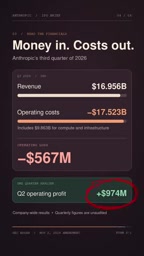
According to a tech commentary show, Anthropic may launch its IPO process in about a week, and its S-1 filing with the SEC systematically discloses the company's financials for the first time. The filing shows nearly $17 billion in revenue over three months but an operating loss of $567 million — versus nearly $1 billion in operating profit the previous quarter, with rising short-term compute costs as a key driver. The article recommends that businesses factor AI vendors' financial sustainability into risk assessments.
Anthropic's IPO Is Imminent — What Does the S-1 Reveal?
According to an analysis by a tech commentary YouTube channel, Anthropic — the company behind Claude — may kick off its IPO process in about a week. Even if you've never used Claude, this filing is worth paying attention to, because it marks the first time outsiders can systematically examine the real financials of a leading AI company.
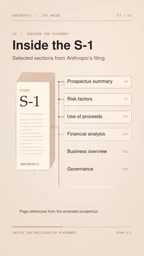
As part of the IPO process, Anthropic filed an S-1 with the SEC. The core value of an S-1 is that it lays the company's books bare: how much money came in, how high operating costs are, and whether anything is left over. For those who don't regularly read SEC filings, this document offers a rare window.
The Key Numbers: $17 Billion in Revenue and a $567 Million Loss
The show's author — an IT professional who describes himself as having limited financial knowledge — used Risk Rhino's AI agents to comb through the S-1 data and highlighted the starkest contrast: Anthropic recorded nearly $17 billion in revenue over three months, but posted an operating loss of $567 million over the same period.
What's even more intriguing is the previous quarter's performance: at that time, the company still generated nearly $1 billion in operating profit. Swinging from close to a billion in profit to a loss of hundreds of millions is a massive shift. One reason cited in the episode is that the company had to pay more for short-term compute capacity. Although the original wording is somewhat vague here, the implication is clear — compute costs are the key variable driving the sharp swings in profitability.
These numbers matter because they offer a rare look at the real cost of building and running AI at this scale. Revenue is already substantial, but so are the costs.
What Is an S-1 Filing?
An S-1 is the registration statement a U.S. company must file with the Securities and Exchange Commission (SEC) when applying for an initial public offering (IPO) — essentially a "prospectus" for the public. Its core components include audited financial statements, risk factor disclosures, a description of the business model, and the use of proceeds. Unlike earnings reports, an S-1 is filed before going public and often contains the company's first systematic disclosure of historical operating data, making it the best window for outsiders to examine a company's true financial footing. In an S-1, "operating loss" refers to the result after deducting R&D, sales, and administrative expenses from gross profit; it differs from net income in whether non-operating items such as interest and taxes are included, and therefore better reflects the health of the core business.
Compute Costs: The Hidden Bill of the AI Business
For technical teams, the lesson from this case goes beyond the financial figures. The show's author points out from an IT perspective that short-term compute capacity commands a higher premium, which directly eats into profit margins. In other words, the current revenue growth of AI companies is built largely on expensive compute procurement.
This raises a more fundamental question: AI companies may be willing to absorb losses in exchange for market share, but the industry as a whole is still in the phase of "figuring out the real cost of AI." Pricing strategy, compute contracts, model efficiency — a change in any one of these could flip the profit-and-loss statement.
Short-Term Compute Capacity vs. Long-Term Contracts
AI companies typically procure compute in two ways: first, signing multi-year reserved contracts with cloud providers at lower unit prices but requiring capacity to be locked in advance; second, renting GPU clusters on demand or short-term, which is flexible but carries a clear premium. When training or inference demand suddenly exceeds reserved quotas, companies can only turn to the spot market, where unit costs may be several times higher. This explains why profits can swing sharply even as revenue grows — the stronger the demand, the more expensive the "overflow" from temporary procurement. For investors, it's important to distinguish "compute capital expenditure" (buying chips, building data centers) from "compute operating expenditure" (renting cloud services): the former is depreciated over time, while the latter is charged directly to current-period costs, and the two affect the income statement on completely different timelines.
What It Means for Businesses: How to Assess AI Vendor Risk
The show's author demonstrated another use case: using AI agents to continuously monitor relevant news and events online, then using another agent to help interpret filings like this one — thereby determining which business processes depend on a particular AI vendor and evaluating that dependency against existing risk and control frameworks.

The key question he raises is: before embedding AI into critical business processes, what should you ask first? When the vendor itself is still losing money to buy market share, businesses that depend on it need to assess not just functionality, but also the company's financial sustainability.
The episode's conclusion is quite thought-provoking: AI is becoming a key tool for understanding the economic system it is reshaping. An S-1 filing that would originally take days to dig through can be broken down by AI agents in minutes. This capability applies not only to IPO analysis but also to brand sentiment monitoring, interpreting new regulations, and finding gaps in risk control frameworks.

Vendor Concentration Risk and Due Diligence
In risk management frameworks, entrusting critical business to a single vendor constitutes "vendor concentration risk." When evaluating AI vendors, beyond functionality and price, you should also consider how long their cash reserves can sustain losses, whether revenue is highly dependent on a few large customers, whether compute contracts contain minimum purchase commitments, and whether model iteration speed can maintain competitiveness. A practical approach is to build a vendor financial health scorecard, update it regularly using public information (funding news, SEC filings, credit ratings), and integrate it into existing third-party risk management processes rather than starting from scratch.
Editorial View
The most memorable takeaway from this S-1 data isn't any specific number, but the structural contradiction it reveals: leading AI companies can generate substantial revenue, yet struggle to achieve stable profitability. The episode also mentions that if your team uses ChatGPT, OpenAI may go public in 2027, and its filing will be worth examining for the same metrics. For enterprise technology decision-makers, incorporating AI vendors' financial health into the risk assessment checklist may be more practical than comparing model benchmark scores.
One-line Summary
Anthropic files S-1, disclosing $17 billion in quarterly revenue and a $567 million loss, revealing the true cost of AI.
Paragraph Summary
According to a tech commentary show, Anthropic may launch its IPO process in about a week, and its S-1 filing with the SEC systematically discloses the financials of this leading AI company for the first time. The filing shows nearly $17 billion in revenue over three months but an operating loss of $567 million over the same period — versus nearly $1 billion in operating profit the previous quarter. One major driver of the sharp swing is rising short-term compute capacity costs. The article notes that the filing offers a rare look at the real cost of building and running AI at scale, and recommends that businesses incorporate AI vendors' financial sustainability into risk assessments rather than merely comparing model features. The episode also mentions that OpenAI may go public in 2027, at which point the same metrics can be used for comparison.
Related articles

Abnormal Error Rate Spike in Claude Mythos 5.2 and Fable 5.2
Claude Mythos 5.2 and Claude Fable 5.2 show an abnormal spike in request error rates, marked as investigating on the official status page. This article covers the incident overview, practical impact on developers, and recommended responses.

ReAct Runtime Context Trimming: Why Claude Code Acts at 70%
A deep dive into ReAct runtime context trimming: why Claude Code compresses at ~70% usage, why tool calls dominate, why messages must be dropped in pairs, and why codebases don't need RAG.

AI Agent vs LLM: How Cursor and Claude Code Actually Work
An in-depth analysis of the essential difference between AI Agents and LLMs: LLMs generate code suggestions, while Agents modify files and run tests via tool calls. Using a Spring Boot bug fix as an example, it breaks down the workflows, permission control, and verification mechanisms of Cursor and Claude Code.