Anthropic Sued: Claude Max 20x Plan Allegedly Delivers Only 6x Usage?
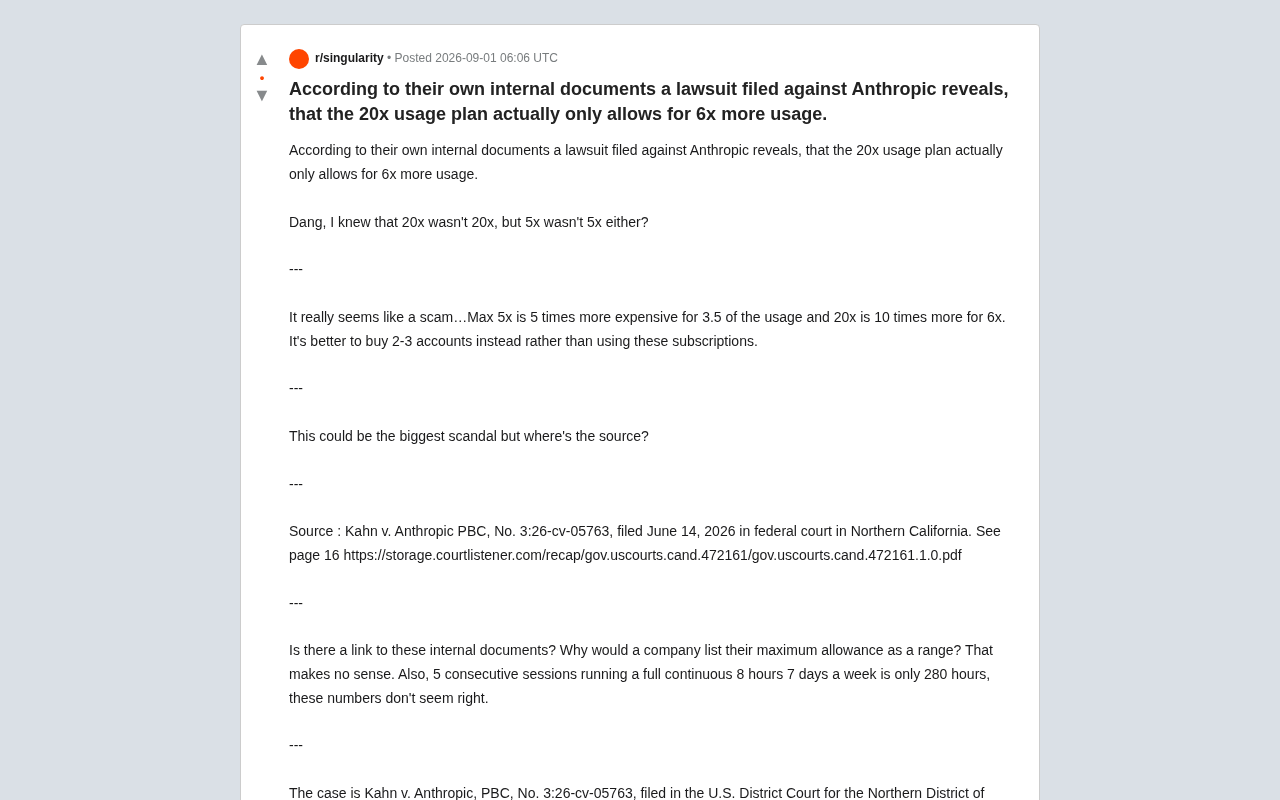
Lawsuit claims Anthropic's Claude Max 20x plan actually delivers only about 6x the usage.
A lawsuit filed against Anthropic (Kahn v. Anthropic PBC) alleges that its Claude Max subscription plans dramatically overstate their usage multipliers — the 20x plan reportedly delivers only ~6x, and the 5x plan only ~3.5x. While the community debates the accuracy of the data and the legal merits, the case spotlights a broader transparency crisis in AI subscriptions, where vague multipliers and dynamic rate limiting make it nearly impossible for users to verify what they're actually getting.
A Lawsuit Uncovers the "Multiplier Mystery"
Recently, a widely controversial story spread across the Reddit community: a lawsuit filed against Anthropic alleges that the company's Claude Max "20x usage" plan actually delivers only about 6x the usage allowance, while the so-called "5x" plan provides roughly 3.5x in real terms.
Anthhropic was founded in 2021 by siblings Dario Amodei and Daniela Amodei, with Dario being a former VP of Research at OpenAI. It is one of the most closely watched companies in the AI space today. Its flagship Claude series of large language models has evolved to the Claude 4 series, excelling in code generation, long-document comprehension, and complex reasoning tasks. On the subscription side, Anthropic offers a free tier, a Pro plan (~$20/month), and Max-tier plans (5x at ~$100/month, 20x at ~$200/month). The Max plans primarily target professional developers, researchers, and high-volume content creators, with their core selling point being a multiplicative increase in usage allowance relative to the Pro plan.
According to the post, the case is Kahn v. Anthropic PBC, No. 3:26-cv-05763, filed on June 14, 2026, in the U.S. District Court for the Northern District of California. Page 16 of the complaint cites Anthropic's "internal documents," alleging a significant gap between the multiplier advertised for each plan and the actual usage delivered.
For power users who rely heavily on Claude for intensive development and content production, this news was nothing short of a bombshell. As one user put it bluntly: "I always knew 20x wasn't really 20x, but I didn't expect 5x to not even be 5x either."
The "Value Scam" in Users' Eyes
If the data cited in the lawsuit holds up, it would directly undermine the pricing logic of Anthropic's subscription plans. Some community members ran the numbers:
- Max 5x plan: Priced at 5x the base plan, but actual usage is only about 3.5x;
- Max 20x plan: Priced at 10x the base plan, but actual usage is only about 6x.
By this calculation, the marginal value for money actually decreases as you upgrade to higher-tier plans. This led some users to a rather ironic conclusion: instead of buying a high-multiplier plan, you'd be better off simply registering 2 to 3 separate accounts — you'd actually get more total usage for your money.
This kind of "life hack" advice is a direct reflection of users' intense dissatisfaction with the transparency of Claude's subscription plans. When advertised multipliers diverge from the real experience, paying customers easily feel misled — and that's precisely why lawsuits like this resonate so strongly with public opinion.
Skeptical Voices: Do the Numbers Hold Up?
Interestingly, the community itself has maintained a notable degree of rationality and caution regarding this "exposé," rather than piling on Anthropic unanimously.
Some users raised a critical question: Why would a company list its "maximum allowance" as a range? This doesn't logically make sense. A usage cap should typically be a definitive threshold, not a vague range.
Others raised technical objections to the specific numbers in the lawsuit: "If you calculate based on 5 consecutive sessions, 8 hours of full-load operation per day, 7 days a week, that's only 280 hours total — the numbers don't add up." Such calculations suggest that the "internal document" data cited in the complaint may be subject to interpretive disputes, or may have been taken out of context.
To understand the technical background of this controversy, you need to know how LLM services measure usage. In large language models, a token is the basic unit for measuring text — for English, one token corresponds to roughly 4 characters or 0.75 words; for Chinese, one character typically maps to 1–2 tokens. Every interaction between a user and the model consumes input tokens (the prompt) and output tokens (the model's response), with different computational costs for each — output tokens are generally more expensive. More critically, providers widely employ Dynamic Rate Limiting to manage server load: the system dynamically adjusts each user's available quota based on real-time concurrency, user tier, time windows, and other factors. This means a user's "actual available usage" is not a fixed number but a floating metric influenced by time, load, and policy — and this is the fundamental reason why "multiplier" promises are so difficult to verify precisely at a technical level.
In other words, whether the conclusion that "20x actually delivers only 6x" reflects Anthropic's genuine rate-limiting design or the plaintiff's selective interpretation of internal documents still requires careful consideration. Without the full context, it's premature to draw conclusions based on a single page from a legal complaint.
The Lawsuit's Own Points of Contention
This lawsuit has also sparked an interesting discussion at the intersection of law and product logic. One user joked: "It looks like Kahn is willing to trade this lawsuit for permanently losing the right to use Claude."
Another user responded with a sharp retort: "There was never a 'right to use Claude' in the first place, so there's nothing to give up."
This remark highlights an essential truth about SaaS subscription services: users purchase conditional access to a service, not some inalienable right. SaaS (Software as a Service) is a business model where software is delivered over the internet — users don't need local deployment and pay on a subscription basis. In traditional SaaS, billing metrics are usually clear and transparent — cloud storage charges by the GB, CDN by bandwidth, and API services by the number of calls. However, the emergence of large language model services has disrupted this transparency. Their computational costs depend on multiple dimensions — token count, model parameter size, GPU compute during inference — and costs vary enormously across different conversations. This leads providers to package their pricing with vague concepts like "multipliers" or "allowances."
Terms of Service (ToS) typically contain extensive ambiguous language around usage limits and Fair Use Policies — and this is precisely the gray area where such disputes arise. Providers retain the flexibility to adjust rate-limiting policies at any time, while users find it nearly impossible to verify exactly "how much they actually got."
From a legal perspective, filing in the Northern District of California is no coincidence. California has some of the strictest consumer protection laws in the U.S. — the Unfair Competition Law (UCL, Business and Professions Code §17200) and the False Advertising Law (FAL, §17500) — which allow consumers to sue over misleading business practices without needing to prove actual damages, only the "likelihood of deception." Such cases are typically pursued as class actions, with the plaintiff representing all similarly situated consumers. However, it's worth noting that tech companies' terms of service usually include mandatory arbitration clauses and class action waivers, which could serve as a significant defense weapon for Anthropic. The outcome of this case will largely hinge on whether the court considers the "multiplier" advertising to constitute a legally binding specific promise, or merely general marketing language.
The Transparency Dilemma of AI Subscriptions
Regardless of the ultimate outcome of this lawsuit, it highlights a transparency dilemma that pervades the entire AI subscription market.
Unlike traditional SaaS, which charges based on clear metrics (such as storage space or API call counts), LLM service "usage" is often packaged into vague "multipliers," "allowances," or "message counts." Behind these metrics lie complex token calculations, dynamic rate limiting, peak load management, and other mechanisms that ordinary users have virtually no way to independently verify.
This dilemma isn't unique to the AI industry. Fair Use Policies (FUP) have a long history in the telecom and internet service sectors. The most classic precedent is the early "unlimited data" mobile plans — carriers advertised "unlimited" usage but buried FUP clauses in their terms of service, dramatically throttling speeds once users exceeded hidden thresholds. This practice triggered waves of consumer complaints and regulatory intervention; the U.S. Federal Trade Commission (FTC) penalized carriers like AT&T multiple times for misleading "unlimited" advertising. The "multiplier" promises in AI subscription services are essentially the same dilemma as the old "unlimited data" debacle: when marketing language implies a definitive quantitative commitment, but actual delivery falls short due to various hidden conditions, a trust gap inevitably emerges.
When providers use marketing language like "20x" to entice users into upgrading, failing to provide quantifiable, verifiable delivery standards easily plants the seeds of a trust crisis. Win or lose, the Kahn lawsuit serves as a wake-up call for the entire industry:
- Advertised multipliers should have clearly defined measurement criteria, not vague relative expressions;
- Rate-limiting policies need greater transparency, so users know exactly what they're paying for;
- Dynamic adjustments should be disclosed in advance, to prevent the trust collapse caused by "silent downgrades."
Conclusion: Waiting for More Facts
For now, this remains a lawsuit in its early stages, and community skepticism about the data's validity hasn't subsided. We should neither treat it as a "smoking gun scandal" nor ignore the genuine user pain points it reflects.
For developers and content creators who rely on AI tools like Claude, the rational approach is: follow the case's developments while keeping records and monitoring your own actual usage. When advertised numbers diverge from real experience, data is the most powerful evidence.
Whether this Anthropic lawsuit becomes a landmark case in AI subscriptions, or ultimately fizzles out due to data interpretation disputes, is well worth watching.
Related articles

JobRunner MCP Server: AI Agents Can Now Fix Failed Java Jobs
JobRunner launches an open-source MCP server enabling AI agents to view cluster status, diagnose failures, and recover Java jobs—incident response from any cloud coding environment or existing agent.

MLAI Digital Launches 9 Security Agents: MCP Server Safeguards the Full Lifecycle of Agentic AI
MLAI Digital launches Security MCP Server with nine built-in specialized security agents covering vulnerability discovery, attack simulation, prompt injection detection, API and infrastructure assessment, and accelerated remediation—embedding security validation across the full Agentic AI lifecycle from development to production.

Running Isaac Lab on H100 GPUs: Exploring Better Approaches
Exploring optimization methods for running Isaac Lab on NVIDIA H100 GPUs, including MIG configuration, mixed precision, TensorRT acceleration, and community experience to improve robotics simulation and reinforcement learning efficiency.