StyleX vs Tailwind: Choosing a CSS Framework in the Age of AI Agent Coding
In AI-driven coding, StyleX's type safety and constraints may outshine Tailwind's developer-friendly DSL.
As AI Agents increasingly write frontend code, the criteria for choosing CSS frameworks are shifting from writing convenience to correctness guarantees. A veteran developer argues that StyleX—Meta's type-safe, compile-time CSS-in-JS solution—holds structural advantages over Tailwind CSS in AI-driven workflows, thanks to stronger constraints, predictability, and scalability.
A Decade-Long Veteran's Shift in Perspective
In the world of frontend development, Atomic CSS frameworks have come a long way. From early projects like BuzzFeed Solid and Basscss to Tailwind CSS—now practically an industry standard—this technical trajectory has been refined and validated over nearly a decade.
The core idea of Atomic CSS dates back to around 2013, when Yahoo engineer Thierry Koblentz introduced the ACSS framework. The concept was to break styles down into the smallest, indivisible, single-purpose class names. BuzzFeed Solid and Basscss were early practitioners of this philosophy, each validating the viability of "functional CSS" in their own way. After Adam Wathan released Tailwind CSS in 2017, it quickly became the de facto standard in this space, thanks to its complete design system, high configurability, and excellent developer experience. As of 2025, Tailwind is one of the most downloaded CSS frameworks on npm and comes integrated by default in mainstream projects like Next.js and Vercel.
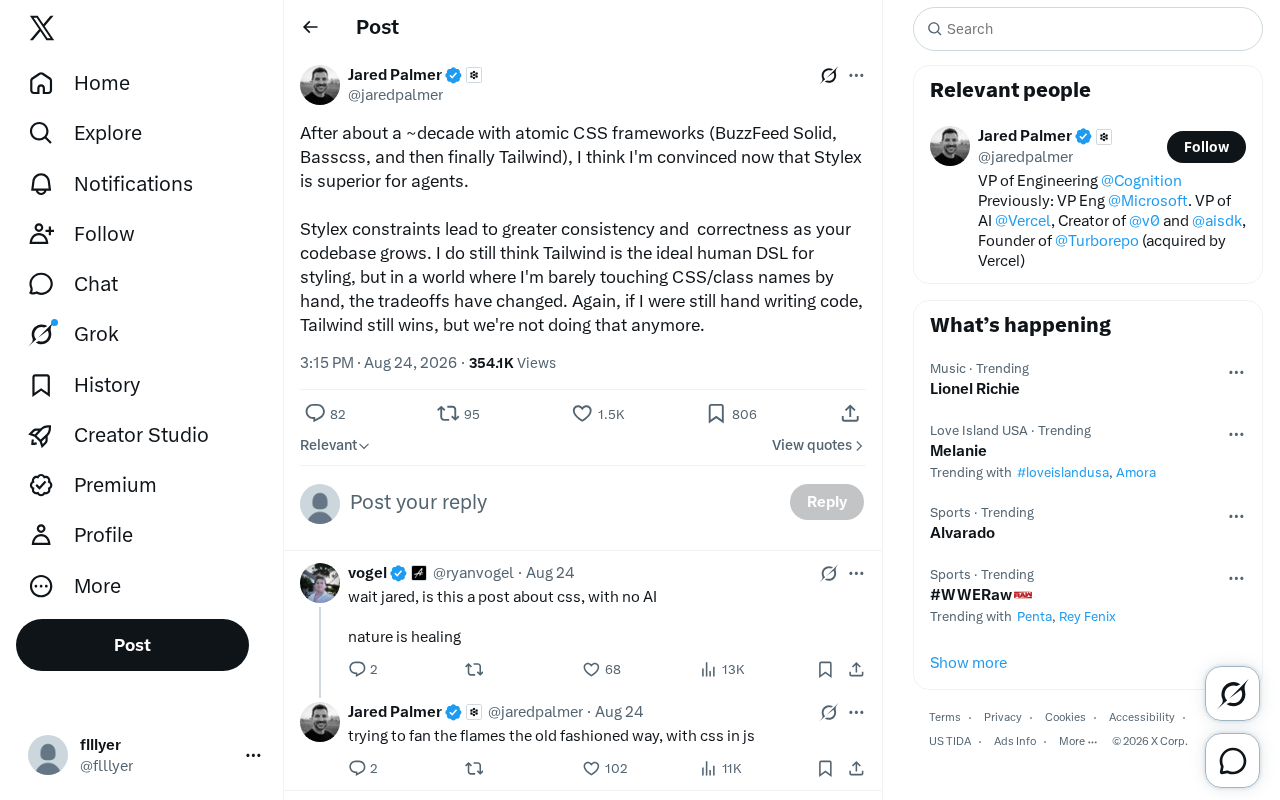
However, a developer with ten years of Atomic CSS experience recently shared a thought-provoking take on social media: in the new era where AI Agents are deeply involved in coding, StyleX may hold a significant advantage over Tailwind.
What makes this observation worth paying attention to isn't that it simply dismisses Tailwind—it's that it reveals a widely overlooked reality: when the primary author of code shifts from humans to AI, the criteria by which we evaluate CSS tools should shift accordingly.
Tailwind CSS's Strengths: A DSL Built for Humans
The developer made it clear that if we were still in the era of hand-written code, Tailwind would remain the undisputed winner.
Why Tailwind Works So Well for Human Developers
Tailwind is essentially a carefully designed Domain-Specific Language (DSL). A Domain-Specific Language is a programming language designed for a particular problem domain, as opposed to general-purpose languages like JavaScript or Python. Tailwind's class name system effectively constitutes a DSL for CSS—developers don't need to write raw CSS properties and values but instead use a curated set of shorthand vocabulary. For example, pt-4 represents padding-top: 1rem, and text-center represents text-align: center. The value of this abstraction layer lies in converging CSS's infinite degrees of freedom into a finite set of design-validated options while baking in design conventions like spacing scales and color systems, allowing developers to code quickly while maintaining design consistency.
This design is extremely friendly to human developers:
- Fast to write: No need to switch back and forth between HTML and CSS files
- Low cognitive overhead: Class names are semantically clear and closely mirror natural style descriptions
- Mature ecosystem: Documentation, toolchains, and component libraries are highly refined
For developers who frequently need to manually tweak styles, Tailwind delivers a near-ideal development experience. Its atomic approach genuinely solves many pain points of traditional CSS, including style bloat, naming conflicts, and maintenance difficulties.
StyleX's Core Advantage: Built for Constraints and Correctness
When we shift our perspective to scenarios where AI Agents drive the coding process, the balance begins to tip.
Constraints Bring Consistency
StyleX is Meta's open-source CSS-in-JS solution. Unlike Tailwind's reliance on class name strings, StyleX adopts a stricter, object-based approach to style definitions with stronger type constraints.
From an architectural standpoint, StyleX emerged from years of large-scale production use inside Meta, powering products like Facebook, Instagram, and WhatsApp Web. Unlike traditional CSS-in-JS libraries (such as styled-components and Emotion), StyleX extracts styles into static CSS at compile time, avoiding runtime performance overhead. Its core design includes: defining style objects with stylex.create(), applying styles via stylex.props(), and style merging that follows a strict "last applied wins" rule. The key reason Meta chose to develop StyleX rather than adopt Tailwind is that their codebase—maintained by tens of thousands of engineers—demands stronger static analysis capabilities and deterministic behavior.
The original author's central argument is: StyleX's constraints lead to greater consistency and correctness as a codebase grows.
This point is especially critical in AI coding scenarios. When AI Agents (such as GitHub Copilot, Cursor, Claude, etc.) generate frontend code, style generation is one of the most error-prone areas. Common issues with Tailwind include: generating non-existent class names (e.g., writing round-lg instead of rounded-lg), using deprecated class names, composing styles that are invalid under a specific Tailwind configuration, and producing inconsistent patterns across responsive breakpoints and state variants. Since Tailwind class names are strings embedded in HTML class attributes, traditional IDE type checking cannot catch these errors at compile time—they can only be discovered at runtime through visual inspection.
Why Constraint Mechanisms Are More AI-Friendly
- Type safety: StyleX's strong type system catches errors at compile time, immediately exposing incorrect styles generated by AI. Compile-time checking means that wrong CSS property names, non-compliant property values, or incompatible style combinations can be detected and blocked before the code actually runs. TypeScript's type system is the key infrastructure enabling this—StyleX defines strict type interfaces so that a typo like
color: 'rde'(should bered) gets flagged instantly in the editor. This "Shift-Left" error detection strategy has been proven in software engineering to significantly reduce the cost of fixing defects: the earlier an error is caught, the cheaper it is to fix. - Predictability: A strict structure makes it easier for AI to generate spec-compliant code
- Correctness at scale: As a codebase expands, constraint mechanisms prevent the style system from gradually spiraling out of control
In other words, Tailwind optimizes for the writing experience, while StyleX optimizes for correctness guarantees. When humans are no longer the primary code writers, the value of the former is diluted while the value of the latter is amplified.
A Fundamental Shift in CSS Framework Selection Criteria
The real significance of this discussion is that it reflects a quiet revolution in the software development paradigm.
From "Easy to Write" to "Easy to Verify"
The author's key insight is summed up in one line: "In a world where I almost never manually touch CSS and class names anymore, the tradeoff calculus has changed."
In the past, we evaluated CSS tools largely based on how friendly they were to human developers—whether they were easy to write, read, and remember. But in an era where AI Agents handle a large share of the coding work, the evaluation criteria are shifting:
| Evaluation Dimension | Human-Led Era | AI-Led Era |
|---|---|---|
| Core Focus | Writing convenience | Correctness guarantees |
| Advantaged Tool | Tailwind CSS | StyleX |
| Error Handling | Manual discovery | Compile-time interception |
| Scalability | Relies on conventions | Relies on type constraints |
A New Logic for Frontend Tool Selection
This shift means that in future technology decisions, we may need to ask ourselves more often: "Does this tool enable AI to generate more reliable code?" rather than simply "Does this tool make me write code more enjoyably?"
Constraints, type systems, and compile-time checks—features once considered sources of development friction—become core competitive advantages in the AI era. AI doesn't complain about things being "cumbersome"; it just needs clear, verifiable rules.
AI-Native Development is emerging as a new software development paradigm. Its core assumption is that AI is no longer merely an assistive tool but the primary producer of code, with human developers gradually shifting toward architecture design, requirements definition, and code review. Similar transitions have precedents in other fields—for example, in autonomous driving, the design standards for road signage have expanded from "Can a human driver quickly recognize this?" to "Can computer vision accurately parse this?" The frontend tooling landscape is undergoing a similar cognitive upgrade, where more constrained, more strictly typed solutions may demonstrate structural advantages in AI-driven development workflows.
Open Questions Worth Considering
Of course, this perspective is still one person's opinion, and there are points worth debating.
First, AI Agent capabilities are still evolving rapidly. As models develop an increasingly accurate understanding of Tailwind class names, Tailwind's "error-prone" issues may gradually diminish. Second, StyleX's ecosystem maturity and community size still can't match Tailwind's, which is a non-negligible cost in real-world projects.
But regardless of the final verdict, this discussion raises a question that every frontend practitioner should confront: When AI becomes the primary producer of code, our philosophy for choosing tools needs recalibration.
Designs optimized for human cognitive load are not necessarily the best choices for machine verification. In this sense, revisiting the idea that "constraints are advantages" may be an important step as we move into the era of AI-native development.
Key Takeaways
Related articles

Chain of Thought Isn't Just for AI: How Humans Can Use CoT to Improve Thinking Quality
Chain of Thought isn't just a prompt trick for large models. Starting from a Hacker News discussion, this article analyzes why CoT works for human thinking too, breaks down actionable ways to transfer it, and highlights the key differences between human CoT and machine CoT.
Cloudflare Teams Up with OpenAI: Closi…
Cloudflare Teams Up with OpenAI: Closing the Loop from Vulnerability Discovery to Defense with AI
Cloudflare uses OpenAI Daybreak to investigate security vulnerabilities and generate reviewable remediation plans, while developers use Codex to boost coding efficiency and quality.

Orca Multi-Agent Orchestration in Practice: A Guide to Parallel Collaboration with Claude and Codex
Orca is Stable AI's free open-source agent workbench supporting 34 agents like Claude Code and Codex in parallel. Learn its Git worktree isolation, multi-model orchestration, and mobile management.