Anthropic Surpasses OpenAI for the First Time: The Truth Behind the AI Coding Tool Price War and How to Respond
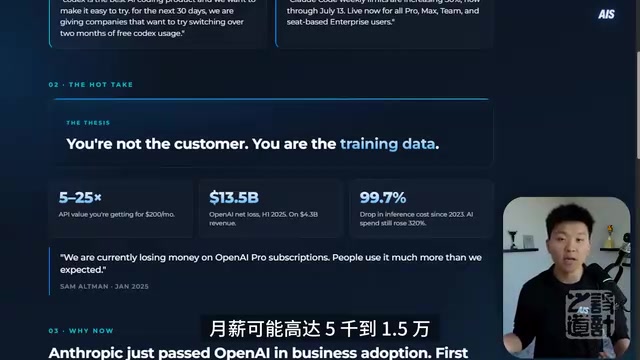
Anthropic's enterprise adoption surpasses OpenAI for the first time, reshaping the AI competitive landscape.
In April 2025, Anthropic's enterprise adoption rate reached 34.4%, surpassing OpenAI's 32.3% for the first time—marking a substantive shift in AI industry competition. Both companies immediately launched an intense battle in AI coding tools, with OpenAI offering free Codex migration deals and Anthropic boosting Claude Code usage limits. Behind the loss-leader pricing of these tools, the real objectives are capturing user dependency and accumulating training data to build long-term competitive moats.
Anthropic's Enterprise Adoption Rate Surpasses OpenAI for the First Time: The AI Competitive Landscape Is Being Rewritten
In April 2025, the AI industry reached a landmark moment—Anthropic surpassed OpenAI in enterprise application adoption rate for the first time. According to the latest industry research report, Anthropic's enterprise adoption rate climbed to 34.4%, a 3.8% increase from the previous period, while OpenAI declined 2.9% to 32.3%.
Understanding the context behind this data is crucial. Anthropic was founded in 2021 by former OpenAI Research VP Dario Amodei and his sister Daniela Amodei, with most of the core team coming from OpenAI. The company's central mission is "AI safety," and its flagship Claude model series emphasizes Constitutional AI methodology—constraining model behavior through preset value principles rather than relying solely on Reinforcement Learning from Human Feedback (RLHF). Enterprise Adoption Rate is a key metric for measuring B2B AI market penetration, typically obtained by third-party research firms through surveys of enterprise IT decision-makers. It reflects the proportion of enterprises that have actually deployed a given AI platform in production environments, not merely those in trial or evaluation phases.
Since early 2023, OpenAI had maintained its lead in enterprise applications. While this overtaking represents only a percentage-point-level change, its symbolic significance far outweighs the numbers themselves—it signals a substantive shift in the AI industry's competitive landscape.
That said, leading in adoption rate doesn't equate to winning across the board. The report also highlights real challenges facing Anthropic: incentive structures not fully aligned with enterprise client interests, some users reporting Claude performance fluctuations, and computing stability that still needs improvement. This is a marathon, not a sprint.
Claude Code vs Codex: A Textbook-Level Business Offensive and Defensive Battle
After the data was released, both companies' reactions were nothing short of spectacular. Sam Altman almost immediately tweeted that "Codex is the strongest AI coding product" and offered an extremely aggressive promotion: two months of free Codex access for enterprises switching from Claude Code.
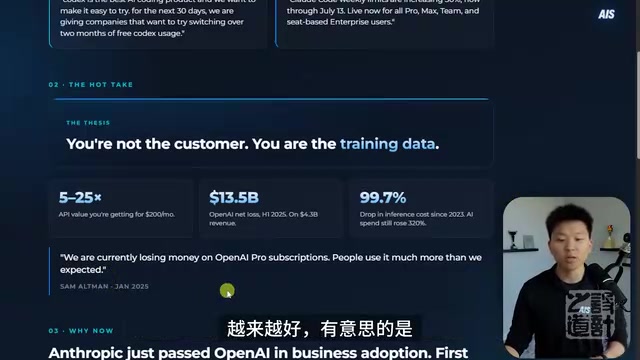
Just 45 minutes later, Anthropic responded: Claude Code's weekly usage limit increased by 50%, with the promotion running through July 13th.
The protagonists in this showdown deserve a closer look. Claude Code is Anthropic's AI coding assistant for developers, deeply integrated into terminal and IDE environments, supporting multi-file codebase understanding and autonomous programming task execution. OpenAI Codex is OpenAI's model series specifically optimized for code generation—its early version served as the underlying engine for GitHub Copilot, and the 2025 version of Codex is positioned as a cloud-based AI software engineer capable of handling multiple programming tasks in parallel. The core difference lies in architectural philosophy: Claude Code emphasizes collaborative interaction with developers, while the new Codex focuses more on autonomous task completion as an "Agent." This segment is widely regarded in the industry as one of the most promising directions for AI commercialization, because software development is the most standardized area of knowledge work where AI's replacement value is most directly quantifiable.
This near-real-time commercial confrontation clearly demonstrates the white-hot intensity of competition in today's AI coding tool market. Both companies are spending real money to win over developers, and behind this lies a deeper business logic.
Why Are AI Coding Tools Being Sold at a Loss? User Data Is the Real Target
This is the most thought-provoking question in the entire discussion. The current pricing model for AI coding tools has an obvious "irrationality":
Suppose you pay $200 per month for Claude Code. The actual output you receive—even if you're not a professional software engineer—could be equivalent to the work of a full-time developer earning $5,000 to $15,000 per month. If you were to pay by token through the API for the same usage, the cost could be 5 to 25 times the subscription fee.
To understand this price inversion, you first need to understand the cost structure of AI tools. The operating cost of large language models is measured in tokens—the smallest unit of text the model processes, with roughly every 750 English words corresponding to 1,000 tokens. When calling directly through the API, users pay for actual input and output tokens consumed, with costs linearly proportional to usage. Subscription models, on the other hand, package uncertain usage into a fixed monthly fee—essentially a risk transfer: heavy users receive subsidies, while light users subsidize the platform. For AI coding tools, an active developer might consume millions of tokens per month. Calculated at API unit prices, costs could reach thousands of dollars, while the subscription price is only around $200, with the platform absorbing the difference. This inverted pricing is not uncommon in business history—it's fundamentally the classic play of trading capital for market share.
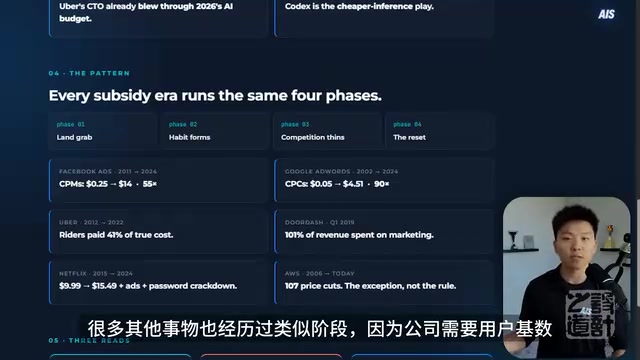
These companies are clearly absorbing massive losses themselves. Sam Altman publicly stated about a year and a half ago that OpenAI loses money on Pro subscriptions. So the question becomes: why are they willing to do this?
The answer lies in two key concepts: user adoption and data accumulation.
Creating Deep Dependency Among Developers
These companies' primary goal is to get as many people as possible using their AI coding tools and forming deep dependencies. Think about it—if you've grown accustomed to using Claude Code or Codex to handle nearly all your programming tasks every day, how much discomfort would you feel if the tool suddenly went down or was taken away? You might even start wondering, "Can I still code normally without AI assistance?"
This is exactly the feeling they want you to develop. Once dependency is formed, users' switching costs skyrocket.
Data Accumulation: AI Companies' True Moat
Even more valuable than user numbers is the data generated during usage—how developers use the tools, how they describe requirements, which scenarios need improvement. This proprietary data is the core fuel for training stronger AI models and may become the biggest competitive barrier in the future.
**Behind this is the AI industry's unique "data flywheel"
Related articles
Meta Muse Hits 900K Downloads in Six D…
Meta Muse Hits 900K Downloads in Six Days: The AI Agent Era Has Officially Arrived
Meta's AI agent Muse hit 902K downloads in 6 days, topping US App Store and Google Play charts above ChatGPT and Claude. A deep dive into Muse's capabilities and the AI Agent race.
 Industry Insights
IRS Fully Embraces Claude AI, Accelerating Federal Government's AI Adoption
The IRS is recruiting staff with 24/7 Claude AI access, marking Anthropic's breakthrough into the federal government. Explore the strategic implications and tax use cases.
 Industry Insights
The IRS Mobile App Debate: A Trust Crisis in Government Digital Transformation
The IRS's proposed mobile app has sparked heated debate. This article analyzes the core arguments, exploring data security, privacy, and the trust crisis in government digital transformation.