Anthropic Tops Intelligence Index with Dual-Version Launch, API Fees Cut 20%

Anthropic tops the index with dual versions on the same base and cuts prices 20%, as model competition shifts toward cost-effectiveness and scenario fit.
The article rounds up multiple AI developments from the same day: Anthropic releases Fable 5.2 and Mythos 5.2 on a shared base, both scoring 65 to top the Intelligence Index, while cutting API fees 20% to lower developer selection costs; Google adds two more 8th-gen TPUs, reaching four in a year, with 8i Max doubling compute via dual-chip packaging; Meta launches the small-and-fast Muse Ember at $0.1 per million input tokens for repetitive agent tasks; on security, research finds Claude Code writes batch commands verbatim to project files, exposing passwords and tokens on disk; open source sees Ant Lingbo's Limbo Touch tactile foundation model and Baidu's Ernie Evolve automated research system. The overall trend: model competition is shifting from "who's stronger" to "who's more cost-effective and better fit for the scenario."
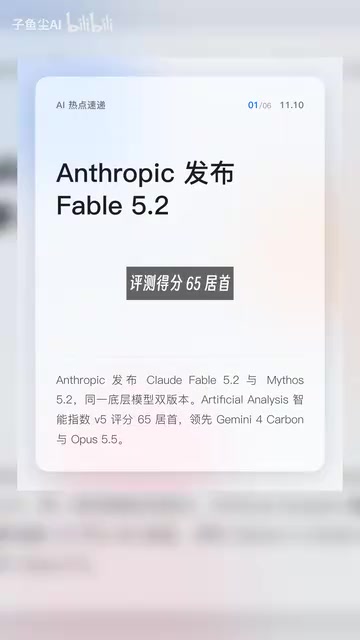
Anthropic released two versions on the same day: Fable 5.2 and Mythos 5.2, built on the same underlying model, both scoring 65 to top the Intelligence Index. This isn't a simple new model launch — it's a coordinated play: carving out different positioning from a single base model while cutting API call fees by 20%.
According to a breakdown by a tech content creator on Bilibili, the story here isn't the benchmark score itself, but the product strategy behind the "dual versions, same base" approach and its real impact on developer costs.
Dual Versions, Same Base: One Model, Two Ways to Sell It
Fable 5.2 and Mythos 5.2 share the same underlying model, both scoring 65 and sitting atop the Intelligence Index. This "same base, dual versions" approach is uncommon in the industry — the more mainstream thinking has been to train models of different sizes for different scenarios, with clear differences in parameter count and compute investment.
Anthropic chose a different path: no differentiation at the underlying capability level, with differences reflected in version positioning. For developers, this means lower selection costs — no more back-and-forth between "strong but expensive" and "weak but cheap." For Anthropic, one training investment covers two product lines, resulting in lower marginal costs.
Combined with the 20% API fee reduction, the intent behind this package is clear: build technical trust with the top benchmark ranking, lower the barrier to adoption with the price cut, and pull developers into its ecosystem.
The so-called "Intelligence Index" is an aggregate metric used by some third-party evaluation organizations to compare large models' overall capabilities: scores from multiple benchmark categories — mathematical reasoning, code generation, instruction following, knowledge Q&A, and others — are normalized and weighted into a single sortable score. Its value lies in comparability, making it easy for developers to quickly locate a model's tier; its limitation is that the weighting choices are subjective, and leaderboard performance doesn't necessarily match real-world business scenarios. So the score of 65 topping the list is more a signal of marketing and technical trust — actual selection should still involve small-sample validation against your own tasks.
Google TPU Keeps Stacking: Four 8th-Gen Chips Already Out
On the same day, Google added two more 8th-generation TPUs, bringing the total number of 8th-gen TPUs released within a year to four. Among them, 8i Max packages two 8i chips together, doubling compute.
The pace is worth noting. TPU iteration cycles are shortening, and the product line is fragmenting — rather than one chip for everything, multiple SKUs are being carved out around different workloads. The packaging approach of 8i Max is essentially "trading interconnect for compute" — as single-chip performance gains slow, integrating at the packaging level continues to push the ceiling of per-node compute.
For cloud providers, the density and cadence of in-house chips are becoming key variables in the compute cost competition. Anthropic's confidence in cutting prices by 20% partly comes from the continued loosening of upstream compute supply.
A TPU (Tensor Processing Unit) is Google's in-house dedicated AI accelerator chip, following the ASIC route with hardware-level optimization for tensor operations like matrix multiplication, offering higher energy efficiency than general-purpose GPUs on specific training and inference workloads. Its iterations are numbered by "generation," with each generation typically targeting newer model scale and precision requirements (such as lower-precision compute and greater memory bandwidth). SKU fragmentation refers to splitting a single chip generation into multiple models by compute, memory, and interconnect capability, each suited to different workloads like training, inference, and high-density deployment — a common practice among cloud providers developing in-house chips.
Meta Muse Ember: Betting "Small and Fast" on Agents
Meta's Muse Ember is officially positioned as "smallest and most efficient," targeting repetitive agent tasks, priced at $0.1 per million input tokens.

This pricing is quite aggressive in the current model market. Agent scenarios are characterized by high call frequency, simple individual tasks, and latency sensitivity — the demand for model "smartness" is actually lower than the demand for stability and cost. Muse Ember's product definition reads almost like it was written for this exact scenario.
This also reflects a trend: model vendors are no longer just competing on leaderboard scores but are starting to build specialized products for specific workloads. General-purpose large models handle the ceiling; small models handle the volume — each plays its role in agent architectures.
An agent refers to an AI system capable of autonomous planning, tool invocation, and multi-turn task execution to accomplish goals, typically composed of a large model as the decision core along with tool calling, memory, and orchestration frameworks. Its cost structure differs markedly from chat scenarios: a single user request may trigger dozens of model calls (planning, reflection, tool result parsing, etc.), multiplying token consumption exponentially — so per-token pricing and inference latency have a far greater impact on total cost than single-conversation quality. This also explains why vendors are now designing small models specifically for the high-frequency, short-task, low-latency workloads of agents.
Security Playing Catch-Up: Claude Code's Plaintext Disk-Write Issue
According to AP Arrow research, Claude Code writes batch command text verbatim into project files, and passwords and tokens embedded in those commands end up on disk in plaintext.

This is a typical "convenience first, security catch-up" problem. AI coding tools, for traceability and reproducibility, tend to record execution processes completely into project directories — but developers often pass parameters directly on the command line, and sensitive information ends up on the filesystem. If these files are committed to a version repository, the risk is amplified further.
For teams using AI coding tools, the takeaway is direct: move key management out of command-line arguments, switch to environment variables or a secrets management service, and explicitly exclude these record files in project configuration. The tools' security design also needs to keep up — recording execution processes and security isolation shouldn't be an either-or choice.
Writing keys into command-line arguments is a common but dangerous practice. On most operating systems, command-line arguments appear in process lists, shell history files (like .bash_history), system logs, and audit records, and can be obtained by any process with local read access. By contrast, environment variables, system keychains, or dedicated secrets management services (like Vault or cloud provider KMS) provide access control and rotation capabilities. The prevailing principle in security engineering is minimizing exposure surface: sensitive credentials should not enter data channels that can be persisted or forwarded, including logs, project files, and version repository commit records.
Open Source Side: Ant Lingbo's Limbo Touch and Baidu's Ernie Evolve
Ant Lingbo open-sourced Limbo Touch, a tactile foundation model that encodes heterogeneous tactile signals into unified tactile tokens, targeting robot manipulation scenarios.

The heterogeneity of tactile data has always been a challenge in robotics — different sensors, different sampling rates, different physical dimensions make it hard to feed directly into models the way images are. The idea of unifying into tokens essentially pulls touch into the same modeling paradigm as language and vision, which has real value for the infrastructure of embodied intelligence.
Baidu, meanwhile, released Ernie Evolve, an automated research system that uses a dual-loop structure to organize direction selection and experiment iteration, with 5 roles dividing the research work. The system's approach is to break down the scientific research process into orchestratable agent roles, replacing single-shot generation with a loop structure. The automated research track has been heating up recently, but practical results still need more public validation.
In a Nutshell
Flagship models are competing on price, compute is expanding capacity, and security is playing catch-up. Anthropic is courting developers with dual versions and a price cut, Google is squeezing costs with TPU density, and Meta is carving out agent scenarios with small models — three lines pointing in the same direction: model competition is shifting from "who's stronger" to "who's more cost-effective and better fit for the scenario."
One-line Summary
Anthropic tops the index with dual versions on the same base and cuts prices 20%, as model competition shifts toward cost-effectiveness and scenario fit.
Related articles

RePlan-VLA: Progress-Aware Replanning Breakthrough for Long-Horizon Robotic Manipulation
The RePlan-VLA framework converts VLA models' short-horizon capabilities into reliable long-horizon execution through progress-aware adaptive replanning, improving success rates by 21.9% and 10.4% on RoboCasa365 and CALVIN, and validating real-world deployment on a Franka Research 3 robot.

Geometric Bridge Flow Matching: A New Breakthrough in Blind Rigid Motion Correction
Geometric bridge flow matching enables blind rigid motion correction in head CBCT, achieving 37.1 dB PSNR and 0.27 mm RPE on simulated data in ~9.1 minutes, outperforming existing methods.

Google Releases Gemini 4 Hydrogen: 2.5x Faster Without Sacrificing Intelligence
Google releases the lightweight Gemini 4 Hydrogen: 2.5x faster task completion, AA Intelligence Index of 54 beating its flagship sibling, 7.3s single-step on Agent Arena faster than Claude and GPT rivals, four thinking levels with pay-as-you-need pricing, now available across AI Studio and more.