Anthropic Unifies Claude Chat and Cowork: One Interface for Conversations and Collaboration
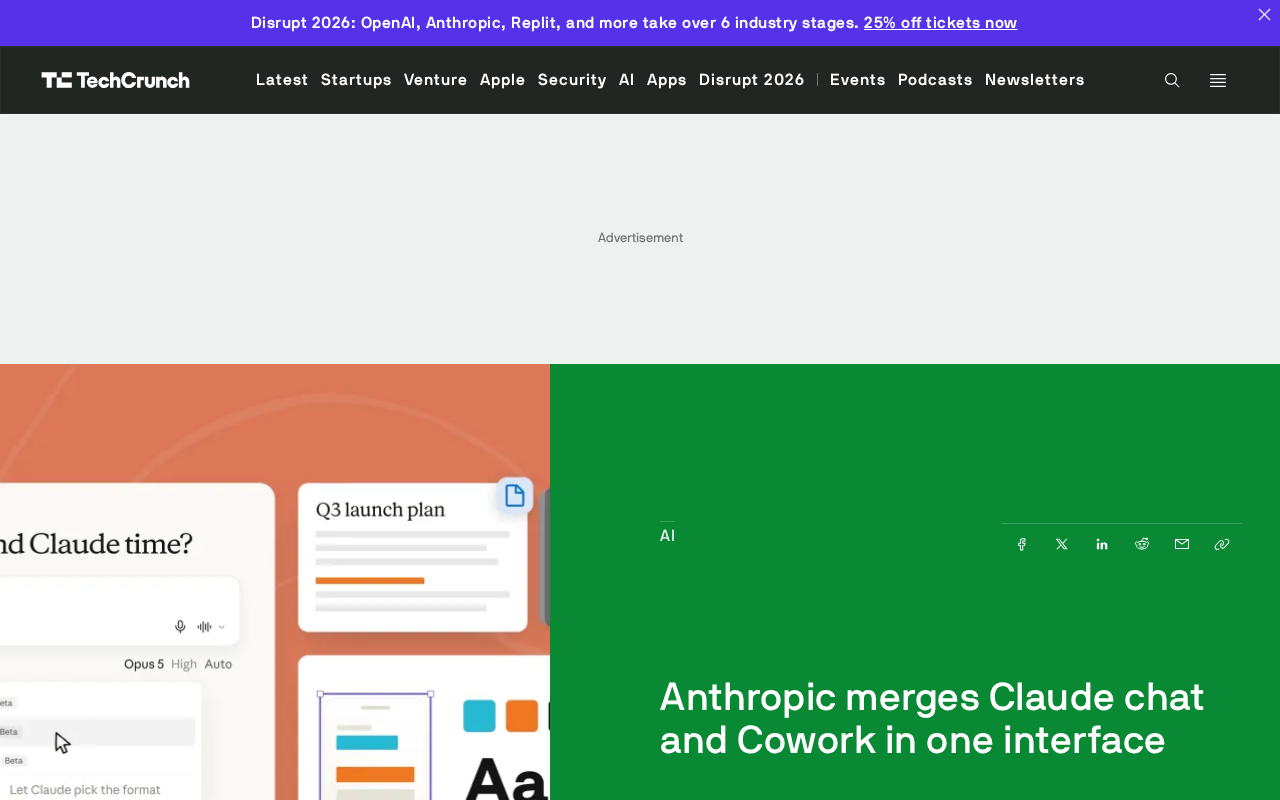
Anthropic unifies Claude chat and Cowork into one interface, prioritizing Pro and Max subscribers.
Anthropic has announced the integration of Claude's chat and Cowork collaboration module into a single unified interface, eliminating the need to switch between separate feature entry points. Users can now move seamlessly from open-ended conversation to structured collaborative tasks within one workspace. The rollout targets Pro and Max paid subscribers first, marking a significant step in repositioning Claude from a chat tool to an all-in-one work platform. This move reflects a wider industry trend where leading AI vendors are shifting competitive focus from raw model capability toward deeper, smoother integration into real user workflows.
Anthropic Takes a Major Step Toward Interface Unification
Anthropic is merging Claude's chat functionality with its Cowork collaboration capabilities into a single, unified interface. This means users no longer need to switch between separate conversation windows and collaboration tools — instead, they can complete everything from asking questions and discussing ideas to executing tasks within one unified workspace.
From a product strategy perspective, this kind of integration reflects a broader shift: AI assistants are evolving from "simple chatbots" into "all-in-one work platforms." Conversation is just the entry point — the real value lies in embedding AI deeply into users' actual work scenarios, and unifying the interface is the most direct way to reduce friction.
Cowork is Anthropic's collaborative feature module for Claude, designed for more structured task scenarios beyond ordinary chat — such as collaborative document editing, project task management, and multi-step workflow tracking. Unlike a standard conversation window, Cowork emphasizes persistent work context: after a conversation ends, task progress, generated content, and collaboration records are retained for users to pick up later. This mirrors the approach taken by products like Notion AI and Microsoft 365 Copilot — embedding AI capabilities into the "work artifact" itself, rather than simply offering a question-and-answer interface. By merging chat and Cowork into a single interface, users no longer need to cross separate product boundaries when shifting from open-ended exploration to structured task execution.
Rolling Out First to Pro and Max Subscribers
According to Anthropic, these new features will be made available to Pro and Max plan subscribers first. This kind of staged rollout is quite common in AI product development — paying users often serve as the first wave of testers for new features, providing real-world usage feedback while making the value of premium subscriptions more tangible.
For power users who rely on Claude for daily work, merging chat and Cowork means a more seamless experience. Previously, using AI in a collaborative context might have required jumping to a different feature module; with the integration, context generated in conversation can flow more naturally into collaborative tasks, reducing information gaps and redundant input.
Within Claude's subscription tiers, the Pro plan targets heavy individual users with higher usage quotas and priority access compared to the free tier, while the Max plan raises usage limits further, typically serving professionals and small teams with higher API call or usage frequency needs. Staged rollouts are a common risk-management strategy for tech products launching new features: paying users tend to have higher product dependency, more specific feedback, and greater tolerance for potential rough edges — making them a natural stress-test group for new capabilities. This strategy also reinforces the differentiated value of paid subscriptions. In a fiercely competitive AI assistant market, feature prioritization has become an important lever for retaining high-value users.
The Industry Logic Behind Interface Integration
Merging chat and collaboration features is not merely a UI adjustment — it represents a fundamental repositioning of Claude's product identity. Competition among AI assistants has entered a phase defined by "who can integrate more seamlessly into users' workflows," and interface-level unification is the foundational infrastructure for achieving that goal.
When users can freely converse and execute structured collaborative tasks within the same interface, Claude's role shifts from "a tool that answers questions" to "a partner that participates in work." This also aligns with what the Cowork name implies — emphasizing genuine collaboration between humans and AI, rather than a one-way question-and-answer dynamic.
For the broader industry, what makes this move noteworthy is the convergence: mainstream AI vendors are all trending toward a "unified workbench" model, where integrated interfaces, contextual continuity, and task automation are becoming the new competitive battleground.
What This Means for Users
For everyday users, the most immediate impact is a simplified workflow. There's no longer a need to remember which feature lives where — a single entry point covers both conversational and collaborative needs. For teams and professional users, a unified interface promises smoother handoffs for AI-assisted, continuous work tasks.
It's worth noting that publicly available information remains limited at this stage. Specific feature details, the boundaries of Cowork's capabilities, and whether access will eventually expand to free-tier users are all pending further disclosure from Anthropic. We recommend following official updates for complete feature details and firsthand usage impressions.
Related articles
The Siberian Ice Maiden and the Archaeological Mysteries of the Scythian World
The Siberian Ice Maiden is a Scythian female mummy from the Ukok Plateau. Her tattoos, silk garments, and grave goods reveal ancient nomadic art, social hierarchy, and cross-regional trade — alongside ongoing repatriation controversies.
SQL Row Pattern Matching: Implementing "Row-Level Regex" with MATCH_RECOGNIZE
MATCH_RECOGNIZE gives SQL regex-like power over row sequences. Detect brute-force attacks, fraud patterns, and user behavior flows with clean, declarative syntax — no more messy self-joins.
Hackers Break Into Flock Surveillance Cameras, Exposing the Inner Workings of License Plate Recognition Systems
Hackers breached Flock Safety's ALPR cameras, exposing how license plate recognition systems collect data and the privacy and security risks they pose.